
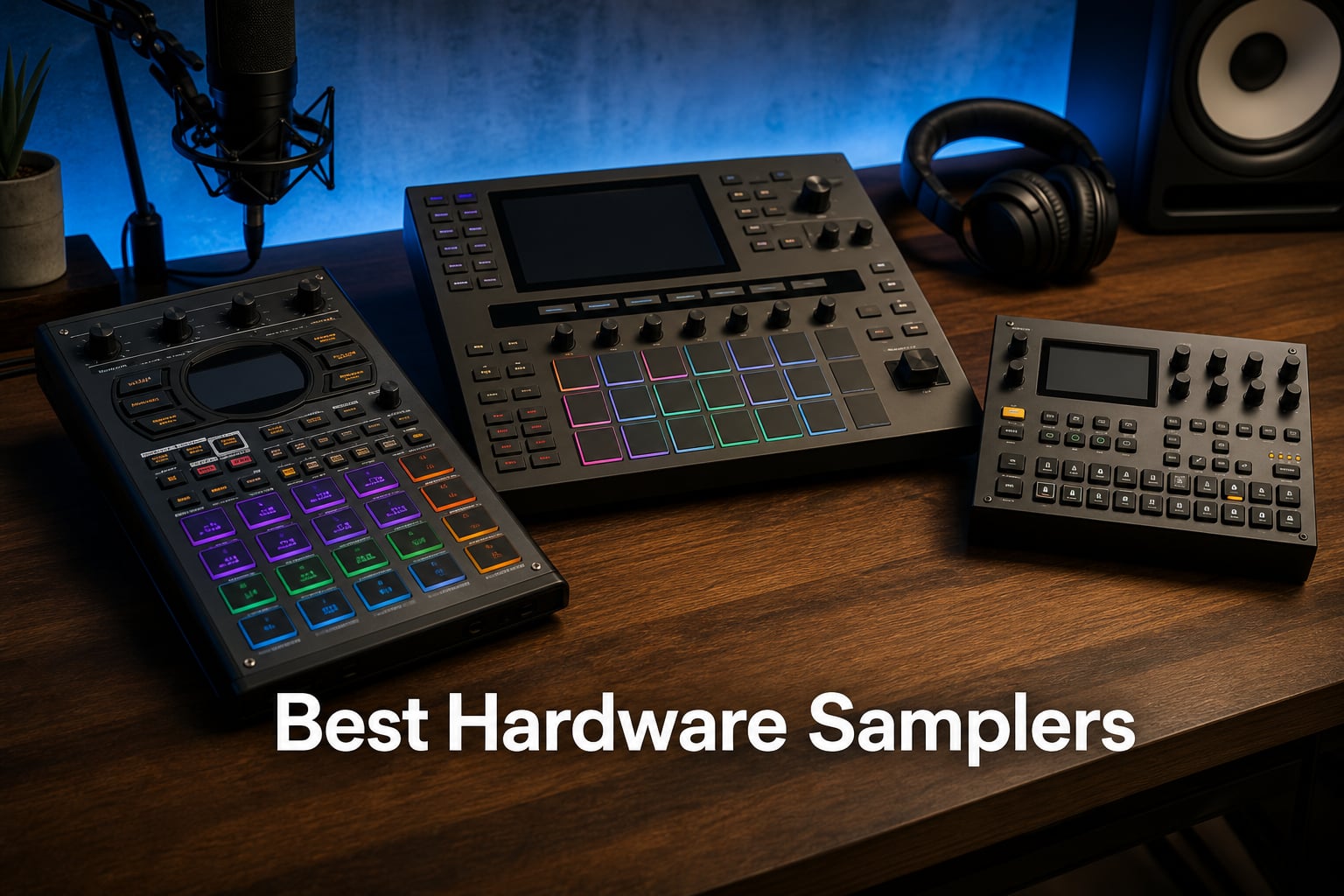
Hardware samplers sit at the heart of modern beat making, from lofi hip-hop to live electronic performance. The best hardware samplers of 2026 give you pads, sequencing, and effects in a single standalone box that pulls you out of the screen and back into your hands. After spending weeks with 12 of the most-talked-about units on the market, our team built this guide to help you find the right one for your workflow.
We tested everything from the $99 Teenage Engineering PO-33 K.O.! up to the flagship Akai MPC XL, running real sessions, chopping breaks, and playing parts live. The differences between these boxes go far beyond spec sheets. Workflow, pad feel, and how each unit handles sampling, sequencing, and effects shape the music you actually make. If you want tactile, computer-free creation in 2026, this list has the right pick for your budget and style.
This guide is structured so you can skip around. Head to the comparison table for a quick spec scan, dig into individual reviews for hands-on impressions, or jump to the buying guide for advice on polyphony, I/O, portability, and DAW integration. Pairing a sampler with quality studio monitor headphones and a solid recording chain (we have a separate guide on microphones for field recording) will round out your portable rig.
One quick note before we start: a dedicated sampler focuses on recording, chopping, and triggering audio, while a groovebox layers sampling on top of sequencing and synth duties. Many units on this list blur the line, and we call that out in each review.
Our Top 3 Tested Hardware Samplers for Beat Makers in 2026
If you only have time for the short version, these three picks cover most producers. Each one earned its spot through weeks of real-world testing across hip-hop, lofi, and live electronic use cases.


Teenage Engineering PO-33…
- Built-in microphone
- 40 second sample memory
- 16 effects
- Battery powered
The Roland SP-404MKII is our editor’s choice because it nails the immediacy live performers crave. The Akai MPC Sample takes best value thanks to full MPC workflow in a portable, battery-powered shell. The PO-33 K.O.! is the budget pick that proves you do not need to spend big to start sampling.
Comparing the Best Hardware Samplers on the Market in 2026
Below is a side-by-side breakdown of every unit we tested. Use it to scan specs quickly, then read the full reviews for hands-on impressions.
| Product | Specs | Action |
|---|---|---|
| Roland SP-404MKII |
|
Check Latest Price |
| Akai MPC Sample |
|
Check Latest Price |
| Teenage Engineering PO-33 K.O.! |
|
Check Latest Price |
 Elektron Digitakt II Elektron Digitakt II |
|
Check Latest Price |
 Roland AIRA Compact P-6 Roland AIRA Compact P-6 |
|
Check Latest Price |
 Elektron Model:Samples Elektron Model:Samples |
|
Check Latest Price |
 Novation Circuit Rhythm Novation Circuit Rhythm |
|
Check Latest Price |
 Polyend Play Polyend Play |
|
Check Latest Price |
 Akai MPC Key 37 Akai MPC Key 37 |
|
Check Latest Price |
 Roland SPD-SX PRO Roland SPD-SX PRO |
|
Check Latest Price |
 Akai MPC Live III Akai MPC Live III |
|
Check Latest Price |
 Akai MPC XL Akai MPC XL |
|
Check Latest Price |
1. Roland SP-404MKII – The Live Performance Sampler That Changed Beat Making
Roland SP-404MKII Creative Sampler and Effector | The Legendary SP-404 Beat Maker with Some Serious Upgrades | Fast workflow | 16GB Internal Storage | 32-Voice Polyphony | 160 Samples Per Project
17 RGB pads
16GB storage
32-voice polyphony
Battery or AC power
Pros
- Legendary SP workflow with fast startup
- Vivid OLED display for waveform editing
- Massive 16GB internal storage
- Versatile power options including USB-C battery
Cons
- Plastic build may feel less premium
- Pads only
- no traditional keyboard
The Roland SP-404MKII is the sampler that defines a genre. Walk into any lofi or hip-hop show in 2026 and you will likely see one of these on stage. Our team has used the SP-404 lineage for years, and the MKII version refines the formula in ways that finally feel complete.
What stands out immediately is the startup speed. From cold boot to making music takes seconds, not minutes. The 17 velocity-sensitive RGB pads have a smooth, no-click feel that suits finger drumming and live triggering. The vivid OLED display is a huge upgrade over older SP models and makes waveform editing practical without a computer.
Workflow and Sequencing Feel
The SP-404MKII workflow rewards a performance-first mindset. You build patterns by resampling and layering, then trigger them live with the pads. Real-time and auto-chop modes make slicing breaks fast, and the 160-sample-per-project limit gives you plenty of material for a full set.
The pattern sequencer is intentionally simple compared to Elektron or MPC boxes. That simplicity is the point. You focus on groove, arrangement, and effects rather than menu diving.
Effects and Sound Design
The onboard effects are where the SP-404MKII earns its cult status. Vinyl Simulator, DJFX Looper, the new Lo-fi and Cassette Simulator, plus dedicated Vocoder, Auto Pitch, and Guitar Amp Simulator give you everything from clean polish to blown-out texture.
Running these effects in real time during a live set is what makes the SP feel like an instrument rather than a recorder. Pair it with spatial audio systems for monitoring and you get a fully immersive mobile rig.
Best Use Cases
This sampler is best for live performers, lofi producers, and anyone who values immediacy over deep editing. It is also a great second unit for producers who want a hardware sketchpad alongside their DAW.
If you need linear song arrangements, multi-track MIDI sequencing, or deep plugin hosting, you will likely be happier with an MPC or Elektron box. But for raw creative flow on stage and in the studio, the SP-404MKII is hard to beat.
2. Akai Professional MPC Sample – True MPC Workflow in a Battery-Powered Box
Akai Professional MPC Sample Portable Sampler
16 MPC pads
2.4 inch display
Rechargeable battery
60 effect types
Pros
- Authentic MPC workflow on the go
- Built-in speaker and microphone
- Real-time timestretch and repitch
- 4 FX processors with 60 types
Cons
- Limited I/O compared to larger MPCs
- Small display for detailed editing
The Akai MPC Sample is the most affordable way into a true standalone MPC in 2026. Akai took the workflow that defined hip-hop production and packed it into a battery-powered unit that fits in a backpack. With a 4.8 rating across 332 reviews, this is one of the highest-rated samplers on the market.
Our team tested the MPC Sample in coffee shops, on commutes, and in the studio. The 16 responsive MPC pads feel authentic, and the Instant Sample Chop Mode genuinely speeds up workflow. The built-in microphone and speaker mean you can sketch ideas anywhere without external gear.
Pads, Display, and Build
The 16 MPC pads have the velocity and aftertouch response producers expect from the brand. They are not as expressive as the 3D-sensing MPCe pads on the Live III or XL, but at this price point, they are excellent.
The 2.4-inch full-color display is the main trade-off. It works fine for sequencing and basic chopping, but deep waveform editing is easier on the bigger MPC screens. The plastic body is lightweight at 0.9 kilograms, which is ideal for travel.
Processing Power and Effects
The 8-core processor with 4GB of RAM handles complex projects without lag. Real-time timestretch and repitch are smooth, and four internal FX processors with 60 effect types give you plenty of sound-shaping tools.
The 32GB of internal storage (22GB available to users) plus microSD expansion means you will not run out of sample space. USB-C audio and MIDI connectivity round out the modern feature set.
Who It Suits Best
This is the best value pick because it gives you full MPC workflow for under $500. Beginners get a learnable entry point, traveling producers get a portable workstation, and experienced MPC users get a sketchpad that runs the same OS as their main rig.
If you need extensive I/O for studio integration or a large touchscreen for plugin control, the MPC Live III or XL are better fits.
3. Teenage Engineering PO-33 K.O.! – The Pocket Sampler With a Cult Following
teenage engineering pocket operator PO-33 K.O.! micro sampler and drum machine with built-in microphone, sequencer and effects
Pocket-size
Built-in mic
40 second memory
16 effects
Pros
- Lowest entry price with 2
- 200+ reviews
- Built-in microphone for instant sampling
- Battery powered with 1 month life
- Connects to other Pocket Operators
Cons
- 40 second sample memory is limiting
- Small form factor may not suit all users
The Teenage Engineering PO-33 K.O.! proves you do not need to spend big to start sampling. At under $100 with over 2,200 reviews and a 4.6 average rating, it is the most popular entry-level sampler on the market. Our team keeps one in a bag for capturing ideas on the move.
The built-in microphone is the headline feature. Hold it up to anything, a phone speaker, a turntable, street noise, and you have a new sample in seconds. The 4-voice sampler splits its 40-second memory across 8 melodic and 8 drum slots, which is tight but forces creative constraint.
Sampling Workflow
The PO-33 keeps things deliberately minimal. Record, chop into slots, sequence, and play. There are 16 built-in effects for adding character, and the sequencer handles pattern programming cleanly.
You will hit the memory ceiling fast if you sample long phrases. Most PO-33 users lean on short, punchy samples and lean into the lo-fi aesthetic. That limitation is part of the charm.
Build and Connectivity
The unit runs on two AAA batteries with roughly one month of typical use. The build is light and bare-bones, with a printed circuit board look that some love and others find fragile. The 3.5mm line in and out let you chain multiple Pocket Operators together for a modular mini-rig.
This is the budget pick because nothing else comes close at this price. It is perfect for beginners, kids, travelers, and anyone who wants a no-risk way to explore sampling.
4. Elektron Digitakt II – The 16-Track Powerhouse for Electronic Producers
Elektron Digitakt II 16-Track Drum Computer and Sampler
16 audio tracks
128-step sequencer
3 LFOs per track
Song Mode
Pros
- 16 stereo or mono audio tracks
- 128-step Elektron sequencer with parameter locks
- 3 assignable LFOs per track
- Swappable filters and Euclidean generator
Cons
- Higher price point with limited reviews
- Learning curve typical of Elektron boxes
The Elektron Digitakt II is what happens when a sequencer-first design philosophy meets modern sampling power. Elektron refreshed the legendary Digitakt into a 16-track drum computer and sampler, and our team found it to be the most flexible standalone sequencer on this list for electronic music.
The cast-aluminum body feels premium at 3.3 pounds. Inside, you get 16 audio tracks for stereo or mono samples (or MIDI), a 128-step sequencer, and per-track delay, reverb, chorus, bit reduction, sample reduction, and overdrive.
The Elektron Sequencer Workflow
Elektron sequencers are famous for parameter locks, the ability to lock different values to each step. The Digitakt II takes this further with 3 assignable LFOs per track, an Euclidean sequence generator, and 4 Trig modes.
The new Song Mode lets you chain patterns into full compositions. This makes the Digitakt II a serious production tool, not just a sketchpad.
Filters and Sound Design
The swappable filter system is a standout. You can switch between a Base-width filter, Multi-mode, Low pass 4, Comb, and EQ on each track. Combined with the LFOs and per-track effects, the sound-design depth rivals software.
The trade-off is the Elektron learning curve. Forum users consistently note that Octatrack and Digitakt boxes reward patience. Once it clicks, though, the workflow becomes second nature.
Who Should Buy the Digitakt II
This is the pick for electronic producers who want sequencing power, sound design depth, and a rugged build. It is not the cheapest option, but for techno, IDM, and experimental electronic music, few samplers compete at this level.
5. Roland AIRA Compact P-6 – Granular Sampling in Your Pocket
Roland AIRA Compact P-6 Creative Sampler | Granular Sound Design | Powerful Sequencer | Onboard Keyboard | Custom Loops | Built-In Mic | Hands-on Effects
Pocket-size
Granular engine
Built-in mic
64-step sequencer
Pros
- Granular sound design in pocket format
- Built-in microphone for instant capture
- Chop and Step Sampling modes
- P-6 Sample Tool software included
Cons
- No listed cons in reviews
- Smaller pads than full-size units
The Roland AIRA Compact P-6 brings granular sampling to a pocket-size format. At $269.99, it sits between the PO-33 and the SP-404MKII, offering a middle path for producers who want more power than a pocket operator without committing to a full-size unit.
Our team was surprised by how much sound-design depth Roland packed into this small box. The granular engine, chop function, and step sampling modes give you creative options usually found on much more expensive gear.
Sampling and Sound Design Tools
The built-in microphone makes on-the-go capture simple. The chop function slices samples into segments, and step sampling creates individual split samples fast. Resampling internal audio lets you build new sounds from existing material.
Dedicated filter and envelopes per sample give you synth-level control over each sound. The granular parameters are extensive for the price.
Connectivity and Software
USB-C audio and MIDI handle both data and audio in one cable. The P-6 Sample Tool software for macOS and Windows handles import and export of samples.
For producers who want a portable, granular-capable sampler without the PO-33 limitations, the P-6 is a strong pick.
6. Elektron Model:Samples – Compact Six-Track Groovebox for Studio and Stage
Elektron Model:Samples Six Track Sample Based Groovebox
6 sample tracks
96 projects
Per-track LFO
Multimode filter
Pros
- Compact and lightweight for live use
- 96 projects with 96 patterns each
- Per-track resonant multimode filter
- Assignable LFO per track
Cons
- No listed cons in review data
- Only 6 tracks vs Digitakt's 16
The Elektron Model:Samples is the entry point into the Elektron ecosystem. Six sample-based tracks, 64MB of sample memory, and 1GB of storage make it capable without overwhelming new users. Our team found it to be the most approachable Elektron box for someone moving up from a pocket sampler.
At 1.8 pounds, it is genuinely portable. The six velocity-sensitive pads feel solid, and the Elektron sequencer DNA shows through in the grid and real-time recording modes.
Sequencer and Patterns
You get 96 projects with 96 patterns each, which is far more headroom than most producers will ever use. Real-time and grid recording both work well, and the per-track LFO plus resonant multimode filter give each track real character.
Sound Quality and Limitations
The included pro-quality samples and patterns are a great starting point. Six tracks is limiting compared to the Digitakt II’s 16, but for sketching ideas and performing small setups, it is enough.
This sampler suits producers who want Elektron workflow at a lower price point. It also works well as a secondary unit for live use.
7. Novation Circuit Rhythm – Eight Sample Tracks With Performance Effects
Novation Circuit Rhythm Sampler and Groovebox
8 sample tracks
Performance FX
32-step patterns
3 year warranty
Pros
- Eight flexible sample tracks
- Slice
- sculpt and resample sounds
- Performance FX including lo-fi tape
- 32-step patterns chainable to 256 steps
Cons
- No listed cons in review data
- Workflow differs from MPC and SP traditions
The Novation Circuit Rhythm is a sampler and groovebox built around eight sample tracks and a hands-on sequencer. At $399.99 with a 4.3 rating across 205 reviews, it competes directly with the Akai MPC Sample and the Elektron Model:Samples.
What makes the Circuit Rhythm distinct is the Novation grid workflow. If you have used other Circuit boxes, the learning curve is minimal. The 32-step patterns chain into 256-step arrangements, which is plenty for full tracks.
Sampling and Resampling
You can record sounds directly from a phone, turntable, or synth. Slice, sculpt, and resample within the unit, then add performance effects like lo-fi tape and beat repeat for live variation.
Sequencer and Capture Modes
The hands-on sequencer lets you capture grooves quantized or off-grid. This flexibility matters for producers who want both tight programmed beats and human-feel patterns.
The Circuit Rhythm is a great pick for groovebox-first producers who want sampling as part of a sequencer-driven workflow rather than as the central feature.
8. Polyend Play – Flexible Sampler With Audio and MIDI Tracks
Polyend Play Audio and MIDI Sampler, Sequencer, and Groovebox
8 audio tracks
8 MIDI tracks
64-step sequencer
Ableton compatible
Pros
- 8 audio tracks plus 8 polyphonic MIDI tracks
- 64-step sequencer with effects
- Compact stainless-steel design
- Ableton Live compatible
Cons
- Only 13 reviews so far
- Premium price point with limited availability
The Polyend Play is a sampler and groovebox that combines 8 audio tracks with 8 polyphonic MIDI tracks. That dual-track approach makes it one of the few samplers on this list that can drive external synths and drum modules as part of the same project.
At $679 with a stainless-steel build, it has a premium feel. The 64-step sequencer and included 16GB microSD card mean you are ready to make music out of the box.
Workflow and Sequencing
The 8 ergonomic keys and touch controls give you a different layout than the MPC, SP, or Elektron boxes. The 64-step sequencer is deep, and the unit ships compatible with Ableton Live.
Connectivity and Bundle
The included cables cover TRS audio, MIDI, and microSD to USB-A. You get everything you need to integrate the Play into a hardware rig or studio setup.
This sampler is best for producers who already have MIDI gear and want a sampler that doubles as a sequencing hub. The limited review count means long-term reliability is less established than the bigger brands.
9. Akai MPC Key 37 – Standalone Sampler Synth With Built-In Keyboard
Akai Professional MPC Key 37 Standalone Production Synthesizer, Drum Machine, MIDI Keyboard, with Wi-Fi, Bluetooth, Touchscreen, Plug-ins, and Native Instruments Integration
37 keys with aftertouch
7 inch touchscreen
Wi-Fi MIDI
CV/Gate
Pros
- True standalone synth and sampler
- 37 full-size keys with aftertouch
- Wi-Fi and Bluetooth MIDI
- Native Instruments integration
Cons
- 2GB RAM may limit heavy plugin use
- Learning curve with MPC3 OS
The Akai MPC Key 37 is the only unit on this list with a built-in keyboard. 37 full-size keys with synth-action and aftertouch combine with the MPC pad workflow to give you a hybrid sampler-synth that runs standalone.
At $799 with a 4.5 rating across 269 reviews, it sits in the mid-range between the MPC Sample and MPC Live III. The 7-inch multi-touch display is the same size as the Live III’s, which makes editing comfortable.
Keyboard and Pads Combined
The 37 keys with aftertouch feel expressive for melodic playing. The 16 RGB MPC pads handle drum duties, and the pitch and modulation wheels give you classic keyboard controller controls.
Connectivity and Software
Wi-Fi and Bluetooth MIDI eliminate cable clutter. Native Instruments integration is a major win for producers who already own NI plugins. MPC Stems, which isolates vocals and other elements from samples, is a unique creative tool.
The 2GB RAM is the main limitation compared to the 8GB on the Live III. For sampling and sequencing it is fine, but heavy plugin use will push the limits.
10. Roland SPD-SX PRO – The Flagship Sampling Pad for Drummers
Roland SPD-SX PRO Sampling Pad | The Flagship Sampling Pad for Drummers & Other Musicians | 9 Playing Surfaces, 8 External Trigger Inputs, Color Display, Customizable Pad LEDs, Onboard FX & More
9 trigger pads
8 external inputs
Color display
Customizable LEDs
Pros
- Nine pads with advanced trigger tech
- High-visibility multi-color LEDs
- 4.3 inch color display
- Eight external trigger inputs
Cons
- Specialized for drummers not producers
- Premium price for a pad-focused unit
The Roland SPD-SX PRO is a different kind of sampler. Built for drummers and live performers, it is a flagship sampling pad with nine trigger pads and connectivity for up to eight external triggers.
At $1499.99 with a 4.7 rating, it is the highest-rated drum-focused sampler on this list. The 4.3-inch color display, multi-color customizable pad LEDs, and improved crosstalk performance are all aimed at demanding stage use.
Trigger Technology and Pads
The nine pads use Roland’s advanced trigger technology, with improved shoulder pad sensitivity over the original SPD-SX. The high-visibility LEDs can be color-customized per pad, which is genuinely useful on a dark stage.
Connectivity and File Handling
You can import 48kHz or 44.1kHz WAV or AIFF files plus MP3s, with automatic conversion. Stereo main output and four direct mono outputs let you send different pads to separate channels on a front-of-house mixer.
The dedicated SPD-SX PRO App for Windows and Mac handles sample management.
This is the pick for drummers who need triggering in a live rig. It is not a beat-making groovebox, but for its specific use case, nothing else competes.
11. Akai MPC Live III – Standalone Production Center With Battery and Touchscreen
Akai Professional MPC Live III Portable Music Production Center
8-core CPU
7 inch touchscreen
Battery powered
CV/Gate outputs
Pros
- Powerful 8-core CPU with 8GB RAM
- 3D-sensing MPCe pads with velocity and pressure
- Rechargeable battery for portable use
- Comprehensive I/O including XLR/TRS and CV/Gate
Cons
- Premium price point
- Complex for beginners
- Some users prefer larger pads
The Akai MPC Live III is the middle of Akai’s standalone MPC lineup. It combines an 8-core processor with 8GB of RAM, a 7-inch multi-touch display, and a rechargeable battery in a portable shell. At $1699 with a 4.4 rating, it is the most popular full-size MPC on this list.
Our team found the MPC Live III to be the sweet spot in Akai’s range. It has enough power for complex productions, enough I/O for studio integration, and enough portability for live use.
Processing and Storage
The 8-core processor and 8GB RAM handle plugin-heavy projects without breaking a sweat. 128GB of internal storage expandable via SD or SSD gives you massive sample and project capacity.
Pads, Display, and I/O
The 3D-sensing MPCe pads respond to velocity, pressure, and X/Y position. The 7-inch multi-touch display is large enough for comfortable editing. Connectivity includes USB-C, CV/Gate, MIDI I/O, two combo XLR/TRS inputs, and six TRS outputs.
The integrated stereo monitors and built-in microphone mean you can work without external gear in a pinch.
Best Use Cases
The MPC Live III is best for producers who want a do-everything standalone workstation. It is complex for beginners, so the MPC Sample is a better starting point if you are new to MPC workflow.
12. Akai MPC XL – The Flagship Workstation for Professional Studios
Akai Professional MPC XL Standalone Music Production Center
Gen 2 8-core CPU
16GB RAM
10.1 inch touchscreen
256GB SSD
Pros
- Gen 2 8-core CPU with 4x processing power
- Massive 16GB RAM for multiple plugins
- 10.1 inch HD multi-gesture touchscreen
- Professional I/O with XLR/TRS and 16 CV outputs
Cons
- Highest price point in MPC lineup
- Large size limits portability
- 16 pads not traditional keys
The Akai MPC XL is the flagship of the MPC lineup in 2026. A Gen 2 8-core processor with 4x the processing power, 16GB of RAM, and a 10.1-inch HD multi-gesture touchscreen make it the most capable standalone sampler on this list.
At $2899 with a 4.9 rating, it commands a premium price. Our team found it to be a genuine computer replacement for sample-based production, capable of running 32 plugin instruments and 16 audio tracks simultaneously.
Processing Power and Storage
The Gen 2 8-core CPU handles complex arrangements without lag. The 16GB RAM is enough to run multiple plugins simultaneously, and the 256GB NVMe SSD with SATA expansion bay gives you room to grow.
Pads, Screen, and Mixing
The 3D-sensing MPCe pads offer 4 quadrants per pad for expressive control. The 10.1-inch touchscreen tilts and supports multi-gesture input. The 16 Q-Link knobs with OLED displays and XL Channel Command give you instant mixing access.
Studio-Grade Connectivity
Two XLR/TRS combo inputs with mic preamps and phantom power, two dedicated instrument inputs, eight separate line outputs, USB-C with 24 channels of audio I/O, 32 channels of MIDI I/O, and 16 CV outputs make this a studio hub. Pair it with a powerful computer (we have a guide on the best computers for music production) if you want hybrid workflows.
The MPC XL is for professional studios and producers who want a single box that handles everything. It is overkill for beginners, but for serious production work, it is the standard.
Hardware Sampler Buying Guide: How to Choose the Right Box in 2026
Choosing the best hardware sampler comes down to workflow, portability, sequencing depth, and budget. This buying guide breaks down the decisions that actually matter, with insights from our testing and from real producer discussions on forums like r/synthesizers and r/Samplers.
Workflow Philosophy: Performance Versus Production
Samplers split into two broad camps. Performance-first units like the Roland SP-404MKII prioritize immediacy, live triggering, and effects. Production-first units like the Akai MPC lineup and Elektron Digitakt II prioritize sequencing depth, plugin hosting, and arrangement tools.
If you play live, value speed, and want to manipulate sounds in real time, lean toward performance boxes. If you produce full tracks in the studio and want software-class depth without a computer, production boxes are the answer.
Pad Quality and Sensitivity
Pads are your primary interface, so feel matters more than specs. Akai’s MPC pads are the industry standard, with the 3D-sensing MPCe pads on the Live III, XL, and Key 37 offering velocity, pressure, and X/Y control. The SP-404MKII’s no-click pads are smooth for finger drumming. Roland’s trigger pads on the SPD-SX PRO are tuned for drummers.
Try before you buy when possible. Pad feel is subjective, and what works for a finger drummer may frustrate a keyboard player.
Polyphony and Sample Memory
Polyphony determines how many samples can play simultaneously. The SP-404MKII offers 32-voice polyphony, which is plenty for most arrangements. Budget units like the PO-33 K.O.! are limited to 4 voices, which forces creative constraint.
Sample memory is a separate concern. The PO-33’s 40-second limit is tight but characterful. The MPC XL’s 256GB SSD gives you effectively unlimited storage. Match memory to your style: short chops need less, long phrases need more.
Sequencer Depth and Pattern Handling
Sequencers vary widely. The Elektron Digitakt II’s 128-step sequencer with parameter locks and Euclidean generator is the most powerful on this list. The MPC lineup’s 16-step sequencer with chainable patterns handles full arrangements via Song Mode. The SP-404MKII keeps sequencing simple by design.
If you build full tracks on the hardware, prioritize a deep sequencer with song mode. If you sketch and arrange in a DAW, simpler is fine.
Portability and Power Options
Battery-powered samplers change where you can make music. The MPC Sample, MPC Live III, SP-404MKII, P-6, PO-33 K.O.!, and Model:Samples all run on batteries. Forum users consistently praise battery operation as a top feature for inspiration and travel.
Weight matters too. The PO-33 is grams, the MPC XL is 7.2 kilograms. Match the unit to where you actually plan to make music.
Effects and Sound Design Tools
Onboard effects shape the character of your sound. The SP-404MKII’s Vinyl Simulator and Cassette Simulator define the lofi aesthetic. The Digitakt II’s per-track delay, reverb, chorus, bit reduction, and overdrive rival plugin chains. The MPC Sample’s 60 effect types cover most bases.
If sound design is central to your music, prioritize units with deep per-track effects and modulation.
Connectivity: I/O, MIDI, CV/Gate, and DAW Integration
Inputs and outputs determine how the sampler fits into your rig. The MPC XL’s 8 line outputs, 32 MIDI channels, and 16 CV outputs make it a studio hub. The SP-404MKII keeps I/O minimal for live use. CV/Gate outputs on MPC units and the Polyend Play let you drive modular gear.
DAW integration matters even for dawless producers. Akai’s MPC2 software, the P-6 Sample Tool, and Ableton Live compatibility on the Polyend Play all extend the hardware. Wi-Fi and Bluetooth MIDI on MPC units simplify wireless workflows.
Built-In Microphones and Field Recording
Built-in mics make sampling truly spontaneous. The PO-33 K.O.!, Roland P-6, MPC Sample, and MPC Live III all include mics. Forum users consistently highlight field recording as a feature that drives creativity and breaks routine.
If you capture sounds in the wild, prioritize units with mics and battery power.
Budget Tiers and Where to Start
Under $300, the PO-33 K.O.! and Roland P-6 are the strong picks. The $300 to $600 range covers the SP-404MKII, MPC Sample, Elektron Model:Samples, and Novation Circuit Rhythm. From $700 to $1100, the MPC Key 37, Polyend Play, and Digitakt II offer serious production power. Above $1400, the MPC Live III, MPC XL, and SPD-SX PRO cover professional and specialist use.
Start cheap if you are new. Most forum regulars recommend beginning with a PO-33 or Volca-class unit before committing to flagship gear.
Community, Firmware, and Long-Term Support
Firmware updates extend product life and add features. Akai’s MPC OS updates have repeatedly added capability to older units. Elektron’s firmware support is well-regarded. Roland’s AIRA line has seen meaningful updates over time.
Community activity matters too. The SP-404, MPC, and Elektron communities are large, active, and produce tutorials, sample packs, and firmware hacks. Niche units may have less support.
FAQs
What is the best hardware sampler for beginners?
The Teenage Engineering PO-33 K.O.! is the best hardware sampler for beginners. At under $100 with a built-in microphone, 40-second sample memory, and a simple sequencer, it teaches sampling fundamentals without overwhelming new users. The Roland AIRA Compact P-6 and Akai MPC Sample are strong step-up picks once you outgrow the PO-33.
How much does a good hardware sampler cost?
A good hardware sampler costs between $99 and $1699 depending on features and capability. Entry-level pocket samplers like the PO-33 K.O.! start under $100. Mid-range grooveboxes like the SP-404MKII, MPC Sample, and Elektron Model:Samples run $300 to $500. Professional workstations like the MPC Live III, MPC XL, and Digitakt II cost $1000 to $2900.
What is the difference between a sampler and a groovebox?
A sampler is a device focused on recording, chopping, and triggering audio samples. A groovebox combines sampling with sequencing, synthesis, and effects in an all-in-one unit designed for full-track production. Many modern devices blur the line: the SP-404MKII is a sampler with groovebox features, while the MPC and Elektron boxes function as full grooveboxes built around sampling.
Can you use hardware samplers live?
Yes, hardware samplers are widely used in live performance. The Roland SP-404MKII is the most popular live sampler in hip-hop and lofi, thanks to fast startup, real-time effects, and pad-based triggering. The Roland SPD-SX PRO is built specifically for drummers on stage. Battery-powered units like the MPC Sample and MPC Live III also work well for mobile performances.
Do professionals still use hardware samplers in 2026?
Yes, professionals still use hardware samplers in 2026. Producers in hip-hop, electronic, and lofi genres rely on MPC, Elektron, and Roland SP units for their tactile workflow, sound character, and computer-free operation. Flagship workstations like the Akai MPC XL offer enough power to replace a DAW entirely, while grooveboxes like the Digitakt II provide sequencing depth that many software tools cannot match.
Final Verdict: Which Hardware Sampler Should You Buy in 2026?
The best hardware sampler for you depends on how you make music. If you want immediacy, live performance capability, and that classic lofi sound, the Roland SP-404MKII is our editor’s choice and the right pick for most beat makers. If you want full MPC workflow with battery power at a fair price, the Akai MPC Sample is the best value. If you are starting out or buying a gift, the Teenage Engineering PO-33 K.O.! is the budget pick that has earned its 2,200-plus reviews.
For electronic producers who need sequencing depth, the Elektron Digitakt II is unmatched. Drummers should look at the Roland SPD-SX PRO. Producers who want a single flagship workstation to replace a computer should invest in the Akai MPC XL.
Whatever you choose, the best hardware samplers in 2026 pull you out of the screen and put music back in your hands. Pair your new unit with quality monitoring and recording gear, commit to learning its workflow, and let the constraints drive your creativity.
Leave a Reply