
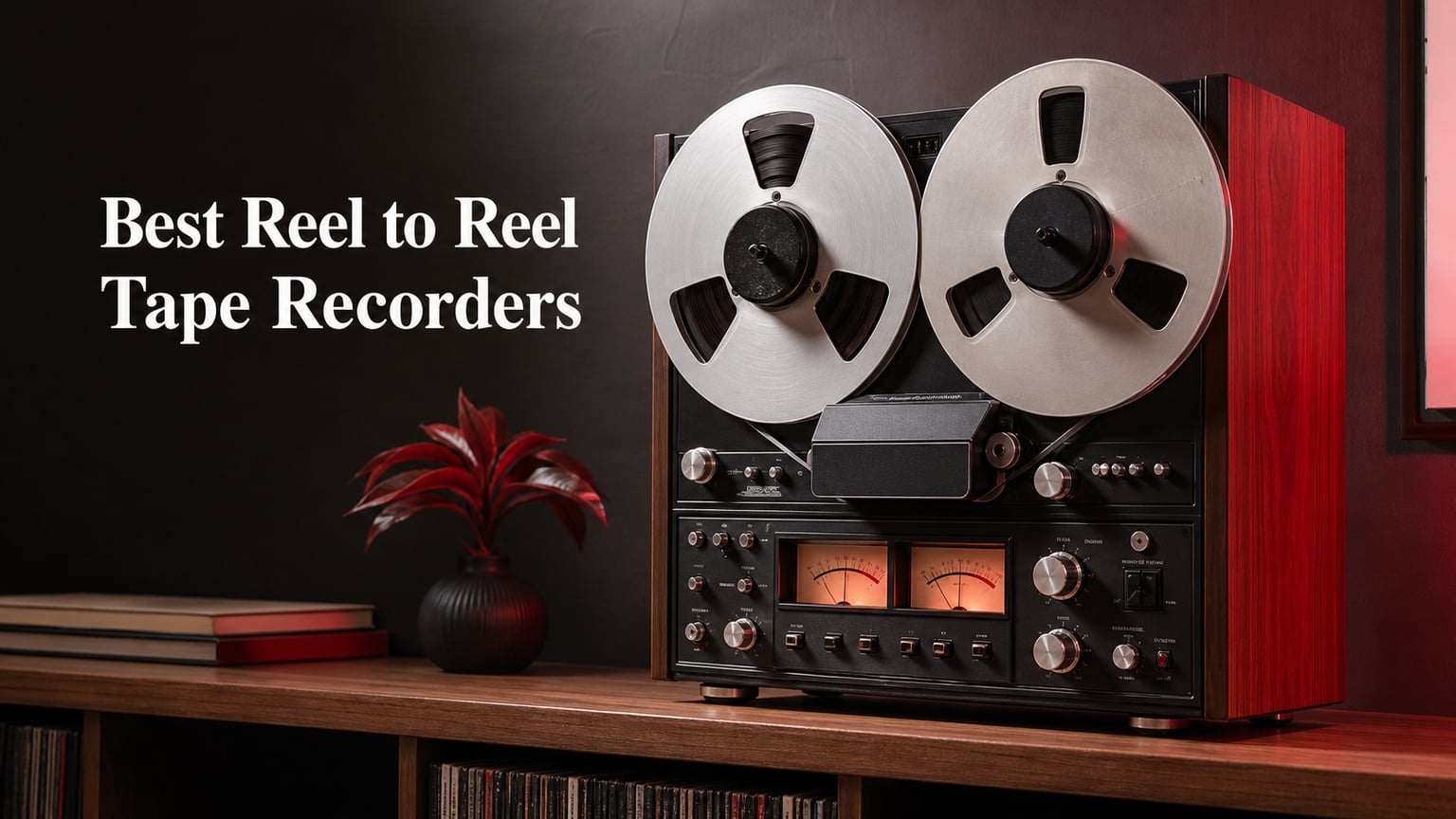
The best reel to reel tape recorders are not simply the most famous machines. They are the open-reel decks that play your tape format correctly, have a documented service path, and fit the work you actually plan to do: listening, recording, mastering, or preserving a tape library.
That distinction matters because an analog tape machine is a precision transport as much as it is an audio component. A beautiful vintage tape recorder with worn heads, unstable tape tension, or missing parts can become a project before it becomes a source of music.
Our research found no qualifying marketplace products to feature in this guide, even after broad searches intended to locate complete recorders rather than blank reels, tape stock, or accessories. So, rather than pretend that a short-lived listing is a dependable recommendation, we built the guide I would want before pursuing a reel to reel for sale: how to narrow the format, assess condition, identify models worth studying, and choose where to buy.
Reel-to-reel is still relevant in 2026 because it serves several different groups well. Audiophiles enjoy the tactile, full-size format and tape character; home recordists want hands-on control; studios may need a dedicated mastering or recording machine; and archivists need playback that matches the tapes in hand.
It is not an automatic replacement for vinyl, streaming, or a digital recorder. Tape brings ongoing cleaning, alignment, storage, and calibration work, and the result depends on the deck, the tape formulation, the head condition, and the recording itself.
The good news is that there is a sensible route through the category. Start with compatibility and service evidence, then let brand, cosmetics, rarity, and extra features influence the final choice.
A serviced, format-matched deck is the best reel-to-reel choice
The fastest way to choose is to define the job before naming a model. The comparison below is an informational decision grid, not a ranking or a list of current product offers.
A beginner should start with a serviced consumer deck that matches the tapes they own
Look for straightforward operation, accessible documentation, a local technician or active owner community, and a clear demonstration that the transport works. Community discussions repeatedly point to parts access and maintenance history as the first risks to control.
Quarter-track playback is often relevant when the goal is enjoying many consumer pre-recorded tapes, but the tape library itself must decide the format. Do not treat a familiar name or attractive faceplate as proof of compatibility.
A home recordist should choose the track format and monitoring method before the transport
A half-track recorder favors higher-quality stereo recording on a tape side, while a quarter-track format uses more tracks and is common in consumer playback. A three-head design can let you monitor a recording from the playback head rather than guessing from the input signal.
Seek stable tape handling and controls you can operate accurately. Features such as pitch control, auto-reverse, feather-touch controls, or VU meters can be useful, but they do not repair a neglected mechanism.
An archivist should match equalization, speed, track layout, and head condition to the collection
Archival playback is a compatibility task. Identify tape speed, track arrangement, reel size, and any NAB or CCIR equalization requirement before selecting a machine, since a mismatched deck may reproduce a tape inaccurately even when it appears to run normally.
A machine with a known service history and available alignment support is more useful than one with a long feature list. For irreplaceable recordings, a qualified transfer specialist may be the safer first stop.
A studio user should prioritize the transport, connections, and support path over collector appeal
Studio recording and mastering ask more from a tape deck than occasional playback. Stable speed, repeatable tension, appropriate head configuration, and balanced XLR outputs where the signal chain calls for them matter more than decorative design.
Professional and semi-professional machines can be rewarding, but they also require calibration knowledge and a realistic maintenance plan. Confirm who will service the deck before moving it into a production workflow.
A collector should treat cosmetic condition as secondary to mechanical evidence
Original accessories, meters, wood cases, and clean panels can make ownership more satisfying, yet the capstan, heads, pinch roller, brakes, and reel motors determine whether the deck is usable. Ask for an operating demonstration at more than one speed where possible.
Collectors also benefit from service documentation and an active user base. Those two items make a rare deck less isolated when a routine wearable part needs attention.
This approach answers a common beginner question directly: the most reliable reel to reel tape recorder is usually the individual example with verified maintenance, compatible tapes, and reachable support. Reliability is a condition-and-service question, not a permanent property of a badge on the front panel.
Your ownership tier should reflect your use, repair tolerance, and support access
Search results show a wide spread between basic vintage machines and specialist new-production decks. Rather than frame that spread as a list of product prices, it is more practical to think in ownership tiers: entry playback, enthusiast recording, professional or archival work, and new-production ownership.
An entry playback tier works when you want to learn the format without taking on an unknown project
This route is for someone who wants to hear open-reel tape, handle reels safely, and build confidence with cleaning and tape threading. The sensible target is a complete consumer machine that has been demonstrated, described honestly, and supported by parts knowledge.
Do not confuse “works” with “serviced.” A seller’s basic playback clip may not show speed stability, channel balance, record operation, brake behavior, or the condition of the heads, so ask focused questions before committing.
An enthusiast recording tier makes sense when you need deliberate stereo recording choices
Here, track format, head layout, tape speed, and calibration become central. A home recordist may prefer a machine that supports the tape speed and monitoring workflow they expect to use, rather than an auto-reverse consumer deck selected for convenience.
More capability brings more variables. Keep enough room in the ownership plan for cleaning supplies, correct tape, periodic adjustment, and professional help if record and reproduce alignment drift.
A professional or archival tier is justified when repeatability matters more than nostalgia
Studio mastering, serious recording, and archival playback place a premium on stable transports, appropriate equalization, head configuration, and an experienced service path. The research also identifies models from Otari, Studer, Ampex, Revox, and TEAC in the professional or semi-professional conversation.
That does not make every example ready for work. A professional deck with an unclear history can need more attention than a well-kept consumer machine, and a specialist should assess head wear and calibration before critical sessions.
A new-production tier makes sense when you want known provenance and manufacturer support
Modern open-reel options exist alongside vintage machines, including decks discussed from Balfinger and Analog Audio Design. Their appeal is not a claim that new is inherently better sounding; it is the possibility of a known starting condition, contemporary engineering, and a direct support route.
Ask the same questions you would ask of any deck: which equalization and speeds are supported, which heads are fitted, what connections are supplied, and how future service will be handled. New-production ownership still depends on tape compatibility and setup knowledge.
Vintage decks offer established communities, while new-production decks reduce unknown-history risk
Vintage and modern are two different ownership experiences, not opposing camps. The right choice depends on whether you would rather assess a mature used ecosystem or begin with a newer machine whose provenance is easier to establish.
A vintage deck can be rewarding when its maintenance trail is clear
Many enthusiasts value vintage recorders for their industrial construction, controls, meters, and established communities. Brands repeatedly appearing in research and discussion include TEAC, Akai, Pioneer, Revox, Otari, Studer, Ampex, and Sony.
The strength of a mature ecosystem is knowledge. Service manuals, experienced owners, specialist dealers, and parts sources can make diagnosis less mysterious, but availability differs sharply by model and by the condition of consumables.
The weak point is uncertainty. Belts, idler wheels, pinch rollers, switches, capacitors, bearings, brakes, and head assemblies all age, and forum users specifically warn that idler wheels and belts can be harder to source over time.
A new-production deck can simplify provenance but cannot remove compatibility decisions
A newly made machine avoids decades of unknown storage, shipping, and informal repairs. It may also offer current production support and a clearer answer to who will provide service documentation or technical help.
It does not automatically play every tape correctly. A buyer still needs to confirm track format, equalization, reel handling, speed options, and whether the machine is configured for playback, recording, or both.
A refurbished deck is only as dependable as the scope of the work
“Refurbished” is useful only when the seller states what was inspected, replaced, aligned, and tested. A meaningful description identifies transport work, electronic service, head assessment, and playback or recording checks rather than relying on a broad condition label.
Ask whether the heads were measured or merely cleaned, whether tape tension and speed were checked, and whether record and reproduce functions were aligned. A complete answer helps you compare specialist dealers with casual vintage-market sellers on facts rather than presentation.
A local technician can make a less famous model a smarter choice
The brand that has support near you may be more practical than a celebrated machine with no nearby expertise. Before you buy, identify a technician familiar with open-reel transports and ask which makes, formats, and repairs they will accept.
This is the part of the decision I would do first, especially for a heavy deck that cannot be shipped casually. Access to service is a real feature because it determines whether a minor fault becomes a long storage problem.
Tape format and transport condition determine whether a deck fits your recordings
The core technical terms are easier to manage when you connect each one to a listening or recording decision. You do not need to become a calibration engineer to buy carefully, but you do need to know what a deck is designed to reproduce.
A half-track deck favors higher-quality stereo recording on each tape side
Half-track, also written as two-track in some contexts, allocates more tape width to each stereo program than quarter-track. That makes it a common point of interest for serious recording, mastering, and audiophile playback, while reducing interchangeability with tapes made for quarter-track consumer machines.
Do not assume that “half-track” means every tape will play as intended. Check whether your recordings were made in the same track layout and direction, then confirm the deck’s head block and operating configuration.
A quarter-track deck suits many consumer tapes but needs format matching
Quarter-track divides the tape into more narrow tracks, which allows programs to be arranged differently on a reel. It is strongly associated with consumer open-reel use and is one reason a deck can be convenient for a particular tape library.
The trade-off is compatibility, not quality in the abstract. A mismatch between a tape and the head arrangement can produce incomplete, reversed, or otherwise incorrect playback, so the tape box, recording history, and deck documentation should all agree.
A tape speed choice changes fidelity, running time, and interchangeability
Open-reel tape machines commonly use 7.5, 15, or 30 IPS, meaning inches per second, with some consumer decks also supporting slower speeds. Higher speeds move more tape past the heads in a given time and are associated with more demanding recording and mastering applications, while slower speeds extend playing time.
Speed alone does not tell you whether a tape will sound right. The tape must be played at the speed at which it was recorded, and a buyer should verify that the machine’s speed settings engage reliably and hold steady.
Wow and flutter describe unwanted speed variation. A seller may not have laboratory measurements, but uneven pitch on sustained notes, unstable piano tones, or visibly inconsistent tape movement are reasons to pause and ask for service evidence.
NAB and CCIR equalization must match the recordings you intend to play
Equalization is part of how a tape recording is made and reproduced. NAB and CCIR are standards named in open-reel research because the wrong playback equalization can alter the tonal balance of a recording.
For ordinary casual listening, the deck and tape source may already align. For archival tapes, master dubs, or technically specific recordings, identify the required equalization before purchase and consult a transfer professional when the provenance is uncertain.
A three-head layout gives recordists immediate confidence in what reached tape
A three-head design separates erase, record, and playback duties. Its practical benefit is confidence monitoring: during recording, you can listen from the playback head and hear what was actually placed on the tape rather than only the incoming source.
This is useful for home recording and studio work, but it is not a substitute for alignment. Head cleanliness, azimuth, tape formulation, level calibration, and electronics all contribute to the recorded result.
Head wear is the physical condition check that no feature list can replace
The tape heads touch every reel you play, so their surface condition matters. Visible wear patterns, grooves, corrosion, or uncertain relapping history should lead to questions about playback quality, channel balance, and replacement compatibility.
A clean head does not necessarily mean a healthy head. Ask for close photos in addition to a functional demonstration, and have a specialist examine the deck if the intended use is archival or recording work.
A capstan, pinch roller, and tension system keep tape moving predictably
The capstan and pinch roller control tape movement across the heads, while reel motors and tension control manage the supply and take-up reels. Direct drive, servo motor, closed-loop dual-capstan, and microprocessor transport control are terms buyers may encounter because all describe approaches to stable transport behavior.
The practical inspection is simpler: thread a reel, run it through the available modes, listen for abnormal mechanical noise, and watch for smooth winding, controlled starts, and controlled stops. Uneven pack, scraping, hesitation, or aggressive braking can point to service needs.
Balanced XLR outputs matter when the deck joins a professional signal chain
Balanced XLR outputs can be useful in studio environments where the rest of the equipment uses balanced connections. Home systems may use different connections, so the important question is whether the deck integrates cleanly with your preamplifier, interface, console, or recorder.
Do not buy a deck based on connector type alone. Confirm whether the inputs and outputs support the workflow you need, how levels are handled, and whether adapters would add confusion to routine use.
Auto-reverse and pitch control are convenience features, not condition reports
Auto-reverse can make long listening sessions easier, while pitch control can help with particular playback or recording tasks. Feather-touch controls and VU meters also improve the daily experience of using an analog tape machine.
These features are worth checking during a demonstration because they add mechanisms and controls that may need attention. Put correct playback, stable speed, clean heads, and a service path ahead of convenience extras.
The tape itself can limit what any recorder can deliver
Even a carefully serviced deck cannot reverse damage on a tape. Inspect reels and boxes for labeling, storage clues, and signs of poor handling, and do not force a questionable tape through a transport.
For a tape library with unknown history, begin with a noncritical reel and listen at low stakes. That cautious first pass can reveal format or condition issues before an irreplaceable recording is involved.
These notable models deserve research before you buy a reel-to-reel deck
The following are research starting points drawn from the supplied competitor analysis, SERP findings, and forum discussions. They are not current marketplace offers, not a ranked list, and not a claim that every example is suitable; condition, configuration, and service history still decide the outcome.
The TEAC 2300S is a community-mentioned consumer starting point with parts awareness
Forum discussions specifically name the Teac 2300S as a consumer option with parts described by users as easier to find. That makes it worth researching for a beginner who wants an established support conversation rather than a machine chosen only for looks.
Confirm the actual deck’s track format, head condition, transport behavior, and service records. Community confidence is useful context, but it does not replace an inspection of the individual recorder.
The TEAC 22-2 is a model to study for a reasonable studio-grade path
Users also mention the TEAC 22-2 when discussing studio-grade capability without immediately moving to the most demanding professional machines. It belongs on a research list for buyers whose priorities include recording format and serviceability.
Study its configuration against the tapes you want to record or play. The relevant question is not whether another owner liked it, but whether its layout and condition match your work.
The Revox PR99 is a forum-mentioned semi-professional research candidate
The Revox PR99 appears in community guidance as a studio-grade option at a comparatively approachable level of ownership. Revox is also among the brands repeatedly praised in forum trust signals, alongside Studer and Akai.
Before pursuing one, clarify the particular machine’s head block, equalization, speeds, connections, and maintenance history. Semi-professional status does not make calibration optional.
The Otari MX5050 merits study for professional and semi-professional workflows
The Otari MX5050 is included in competitor coverage of notable open-reel decks and appears in the research context for serious use. It is a model to investigate when stable transport behavior and production-oriented use are more important than collector styling.
Its name covers configurations and histories that can differ, so do not rely on the model name alone. Ask a seller or technician to identify the exact version and demonstrate the functions relevant to your tapes.
The Akai GX-4000D is a classic secondhand model to assess for condition and support
The Akai GX-4000D appears in the secondhand-focused competitor list, making it a historically relevant consumer deck to research. Akai is also part of the group of established brands mentioned in community trust signals.
Use that reputation as a prompt to investigate service documentation and parts sources, not as a shortcut around inspection. On any older transport, wearable components and head condition remain central.
The Akai GX-635D deserves research when you want a feature-rich vintage deck
The AKAI GX-635D is featured in the detailed competitor roundup and is associated there with a larger technical feature discussion. It is a sensible model to put on a shortlist for research if its specific format and controls match your intended use.
Compare actual examples by their maintenance records and demonstration quality. A feature-rich deck gives you more to check, including the transport modes and every control that affects playback or recording.
The Pioneer RT-707 and RT-909 are notable consumer decks with different research questions
Both the Pioneer RT-707 and Pioneer RT-909 appear in competitor research, with the RT-707 included in a secondhand buyer guide and the RT-909 in the broader all-time list. They are useful names for understanding the appeal of well-known consumer open-reel machines.
Study each exact model independently rather than assuming the two have the same compatibility or service needs. Confirm reel handling, tape path, heads, auto-reverse behavior if fitted, and the availability of an experienced repair route.
The Sony TC-765 is a serious vintage model to investigate with a technician
The Sony TC-765 appears in the competitor roundup as a notable deck with an extensive feature discussion. It is best approached as a model for informed research, particularly if you can involve a technician who understands its transport and electronics.
A detailed check is appropriate because sophisticated vintage machines can have equally sophisticated service needs. Documentation, prior work, and a hands-on demonstration carry more weight than a general claim of excellent condition.
The TEAC A-3440 is worth studying for multitrack-oriented recording context
The TEAC A-3440 is included among the competitor’s historically significant machines. It belongs in research for users whose interest is music recording rather than only playback, because the intended track arrangement should lead the decision.
Read the manual and verify the configuration before assuming it will suit your stereo tapes. Recording flexibility can be valuable only when it matches the way you plan to create, monitor, and replay material.
The Studer A-800 and Ampex ATR-102 represent professional benchmarks to research, not casual starting points
Competitor analysis places the Studer A-800 and Ampex ATR-102 in a professional and mastering-focused context. Their presence shows why discussions of the best reel to reel tape recorder of all time often split between legendary studio machines and practical home ownership.
For most newcomers, their value is educational: they show what serious transport design, mastering focus, and professional maintenance expectations look like. Anyone considering an example should have specialist support in place before acquisition.
The Balfinger M-063 H5 and Analog Audio Design TR-1000 show that new production still exists
The Balfinger M-063 H5 and Analog Audio Design TR-1000 are named in competitor coverage as modern deck options. They are important research points because they answer the recurring question of whether anyone still makes reel-to-reel tape recorders: yes, new-production choices remain part of the market.
Research the maker’s support, configuration options, documentation, and service process with the same care you would apply to a vintage purchase. Modern production changes the provenance question; it does not eliminate the need to match the deck to your tapes.
The Metaxas & Sins Tourbillon T-RX is a specialist modern model to research by use case
The Metaxas & Sins Tourbillon T-RX also appears in the competitor’s modern and high-end model coverage. It is relevant to readers mapping the full range of contemporary open-reel engineering rather than limiting their search to vintage names.
Its place in a buying decision depends on intended work, support access, and configuration, not on its visibility in a best-of list. Ask direct technical questions and compare the answers with the formats in your own library.
A documented service history makes a used deck safer to own
Maintenance is the gap that most short product lists leave behind. Forum users consistently raise parts availability, calibration knowledge, trustworthy sellers, and the uncertainty of used condition, so your inspection process should be written down before you contact a seller.
A pre-purchase inspection should start with records and close-up evidence
Ask when the deck was last serviced, who did the work, and what was done. Useful documentation can describe cleaning, lubrication, replacement of wear items, electronic work, transport adjustment, head assessment, and playback or record calibration.
Request clear photos of the heads, pinch roller, tape path, controls, rear-panel connections, and any damage. Then ask for a video that shows threading, play, fast wind, rewind, stop, and operation at the speeds you expect to use.
A functional test should include more than music playing through the speakers
Listen for steady pitch, balanced channels, clean switching, and normal mechanical behavior. Watch the tape pack on the take-up reel and note any hesitation, scraping, poor winding, or abrupt braking.
If recording matters, ask for proof of record and playback functions rather than accepting a playback-only demonstration. A three-head deck can make this check easier, but the relevant evidence is a stable recording that plays back correctly.
Routine care should become part of your listening habit
Keep heads and the tape path clean, inspect the pinch roller, and use tape that is appropriate for the machine. Store reels carefully, avoid forcing damaged tape through the transport, and consult the manual for cleaning and handling guidance.
Routine care is not restoration. If you hear unstable speed, see tape handling problems, or suspect an alignment issue, stop and get qualified advice instead of continuing to run irreplaceable recordings.
Parts availability should be checked before a deal becomes urgent
The community warnings about belts and idler wheels are practical, not theoretical. Before choosing a vintage model, search for service documentation, owners’ groups, known parts dealers, and a technician willing to work on that make.
Head replacement compatibility also belongs in this check for a deck intended for sustained use. If the source of heads, rollers, or model-specific mechanical parts is unclear, treat that uncertainty as part of the ownership decision.
A specialist dealer can offer better evidence than a general vintage listing
Specialist open-reel dealers and restoration-focused sellers are useful sources because their work may include a defined inspection or service process. Ask for that process in writing and compare it with the deck’s intended use, since a playback check may not cover a recording workflow.
A dealer is not a substitute for asking questions. You still need to verify format, speed, equalization, head condition, connections, included accessories, transport demonstration, and how post-sale support is handled.
Vintage marketplaces can work when you assume the burden of verification
General vintage markets and private listings can reveal models that do not appear through specialist channels. They also shift much more of the inspection burden to you, especially when shipping, storage history, and technical claims are uncertain.
Use detailed questions, video evidence, and a plan for safe transport. A heavy tape deck is vulnerable to poor packing, so local inspection or a seller who understands transport protection can be a meaningful advantage.
New-production sources should answer configuration and support questions clearly
For modern machines, contact the maker or authorized source with a short list: available speeds, track formats, equalization, inputs and outputs, head arrangement, documentation, warranty terms, and service process. Clear answers help distinguish a real fit from an attractive but unsuitable configuration.
New production is especially relevant for buyers who do not want to inherit a long unknown maintenance history. It is still wise to learn the basic handling, cleaning, and tape-compatibility rules before the deck arrives.
These reel-to-reel FAQs answer the questions buyers ask first
Does anyone still make reel-to-reel tape recorders?
u003cstrongu003eYes.u003c/strongu003e New-production open-reel machines remain available from specialist makers discussed in current competitor research, including Balfinger and Analog Audio Design. Vintage decks still make up much of the used market, but new production gives buyers a route with known provenance and a direct manufacturer support conversation.
Are reel-to-reel tape recorders worth anything?
u003cstrongu003eThey can be valuable as working audio machines, collectors’ pieces, or archival tools, but condition decides the answer.u003c/strongu003e A documented service history, healthy heads, a stable transport, a compatible format, and an available parts or technician path matter more than the name on the front panel.
What is the best reel-to-reel of all time?
u003cstrongu003eThere is no single best deck for every listener.u003c/strongu003e Studer A-800 and Ampex ATR-102 are professional benchmarks in the supplied research, while TEAC, Revox, Akai, Pioneer, Otari, and Sony models can be more relevant to particular home, recording, or collector needs. Choose by tape format, condition, and service support.
Is a reel-to-reel recorder good for beginners?
u003cstrongu003eYes, if you begin with a complete, serviced, format-matched machine and learn basic tape handling.u003c/strongu003e Beginners should favor clear documentation, an active owner community, and accessible service support over rare features or a cosmetic bargain.
Is reel-to-reel better than vinyl?
u003cstrongu003eNeither format is universally better.u003c/strongu003e Reel-to-reel can offer a distinct analog playback and recording experience, but it requires more maintenance, space, and format knowledge. Vinyl may be simpler for a music collection; open-reel makes more sense when tape playback or recording is the point of the hobby.
Buy a documented and serviceable deck that matches your tape library
The best reel to reel tape recorders for most people are not found by chasing a universal winner. Start with the tapes you own or the recordings you plan to make, decide between consumer, semi-professional, professional, or new-production ownership, and require evidence that the transport and heads are healthy.
In 2026, the strongest buying move is still simple: choose format compatibility and service support before rarity or visual appeal. If a seller cannot show the deck operating, identify its configuration, or explain its maintenance history, keep looking.
Once those fundamentals are in place, an open-reel tape deck can be an absorbing way to listen, record, and preserve sound. Take your model research list, ask the inspection questions in this guide, and let the individual machine earn your confidence.
Leave a Reply