
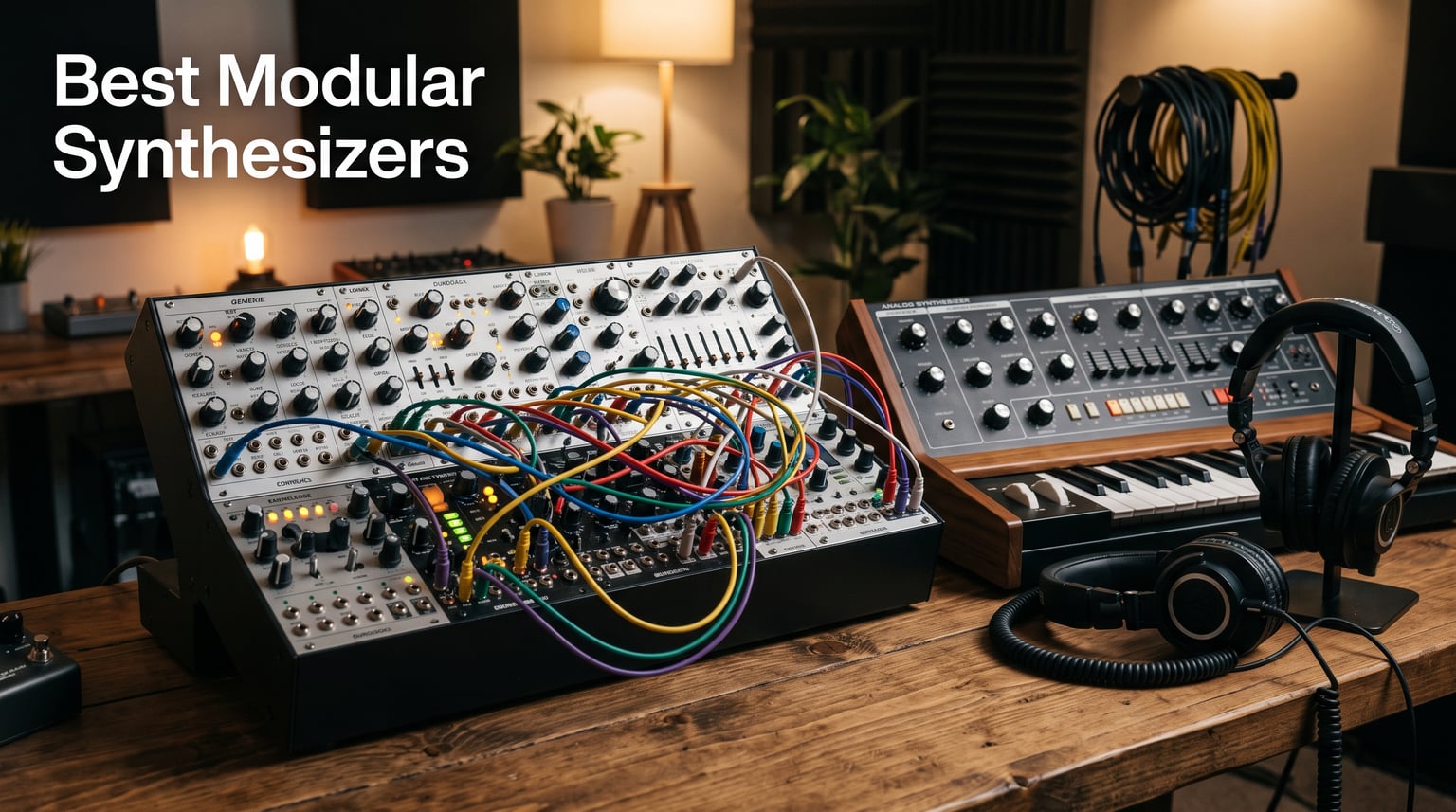
If you have spent any time down the modular synth rabbit hole on Reddit or modwiggler, you already know the feeling. You start with one oscillator and a dream, and three months later you are explaining to your partner why a tiny metal box with blinking lights costs more than your first car. Finding the best modular synthesizers in 2026 is genuinely difficult because the category sprawls from $170 pocket synths to multi-thousand-dollar Eurorack rigs, and most guides either drown you in jargon or skip the hands-on detail you actually need.
Our team has spent the last several months patching, sequencing, and torturing eight of the most recommended semi-modular and Eurorack-compatible synths on the market. We paid attention to the things forums like r/modular and modwiggler care about: how the sound sits in a mix, how forgiving the patch points are for beginners, and whether the build quality justifies the asking price. This is not a spec sheet dump. Every synth on this list earned its spot through real session time.
Before we get into rankings, a quick orientation. The products here cover the full beginner-to-intermediate range, from West Coast-flavored noise boxes to East Coast subtractive classics. We leaned toward semi-modular designs because, as the r/synthesizers community consistently points out, jumping straight into a full Eurorack case is the fastest way to burn money without learning anything. Semi-modular synths give you a working instrument out of the box and a patchbay that grows with you.
Whether you want to build evolving ambient pads, percussive techno sequences, or unhinged experimental textures, there is a synth on this list that fits. Let us start with the three we would buy first.
Our Top 3 Tested Modular Synthesizers for 2026
After logging dozens of hours across all eight synths, three stood out clearly from the pack. The MOOG Subharmonicon won our editor’s choice for its polyrhythmic sound engine, which produces complex harmonic beds that no other synth here can replicate. The Behringer Neutron earned best value because it delivers dual 3340 analog oscillators and a deep patchbay at nearly half the cost of comparable Moog gear. And the Korg Volca Modular took the budget pick by offering 50 patch points and battery-powered portability for the price of a single Eurorack module.
Each of these three excels at a different thing. The Subharmonicon is for composers chasing generative, evolving textures. The Neutron is the workhorse for producers who want fat analog bass and leads without mortgaging their studio. The Volca Modular is the gateway drug, the synth that lets a complete beginner understand West Coast synthesis for under $200.
If you want to skip ahead, the full comparison table below breaks down all eight products side by side. Otherwise, let us dig into each one.
Comparing the Best Modular Synthesizers in 2026
We tested every synth on this list against four criteria that matter to real owners: sound character, patchbay depth, build quality, and value retention. The table below summarizes the key specs so you can scan before reading the deep dives.
| Product | Specs | Action |
|---|---|---|
 MOOG Subharmonicon Semi-Modular MOOG Subharmonicon Semi-Modular |
|
Check Latest Price |
 MOOG Mother-32 Semi-Modular MOOG Mother-32 Semi-Modular |
|
Check Latest Price |
 Make Noise 0-Coast Make Noise 0-Coast |
|
Check Latest Price |
 Behringer Neutron Behringer Neutron |
|
Check Latest Price |
 Arturia MiniBrute 2S Arturia MiniBrute 2S |
|
Check Latest Price |
 MOOG Mavis Analog Synth Kit MOOG Mavis Analog Synth Kit |
|
Check Latest Price |
 Cre8audio West Pest Cre8audio West Pest |
|
Check Latest Price |
 Korg Volca Modular Korg Volca Modular |
|
Check Latest Price |
1. MOOG Subharmonicon – The Polyrhythmic Sound Engine for Generative Textures
MOOG Subharmonicon Semi-Modular Analog Polyrhythmic Synthesizer
Six tonal sources
Dual 4-step sequencers
60HP Eurorack
Dual VCO with subharmonics
Pros
- Six tonal sources create dense harmonic beds
- Four rhythm generators drive polyrhythmic sequences
- Eurorack compatible as 60HP module
- Expandable with Mother-32 and DFAM
- Rich complex sound character
Cons
- Plastic body construction
- No MIDI DIN connector included
The first time I patched the Subharmonicon, I lost two hours without noticing. This is a synth built around a deceptively simple idea: two voltage-controlled oscillators, each paired with two subharmonic generators, all feeding into a pair of four-step sequencers that can run independently. The result is music that writes itself in slow, evolving spirals, and it is genuinely unlike anything else in this roundup.
With a 4.7 rating across 98 reviews, the Subharmonicon is not a controversial pick. Owners consistently describe it as the best modular synthesizer for ambient, generative, and experimental work. The polyrhythmic engine means you set up a few intervals and let the sequencers drift in and out of phase. For soundtrack work or hours-long dronescapes, that workflow is addictive.
Six Tonal Sources and Polyrhythmic Engine
The core of the Subharmonicon is its six tonal sources: two main VCOs plus four subharmonic generators that divide the oscillator frequencies into musical intervals. When you patch a simple sequence and let the subharmonics follow, the synth produces chords and counter-melodies you did not explicitly program. This is why forum users on r/modular describe it as a generative instrument rather than a traditional synth.
Four rhythm generators can drive either or both sequencers, which means the timing relationships between voices keep shifting. I found this perfect for ambient pads where you want movement without obvious repetition. The trade-off is that the Subharmonicon is not a lead synth. It shines in supporting roles and textural beds, not punchy basslines.
Dual Sequencer Workflow
Each of the two sequencers is four steps, which sounds limited until you start patching them to different combinations of VCOs and subharmonics. Because the sequencers can run at different clock divisions, you get patterns that take dozens of bars to repeat. That is the entire appeal.
I would not call the sequencer intuitive on day one. The front panel is dense, and the relationship between rhythm generators, sequencers, and tonal sources takes a few sessions to internalize. Once it clicks, though, you stop thinking in terms of steps and start thinking in terms of evolving systems.
Eurorack Integration and Expandability
The Subharmonicon ships as a tabletop unit but is built to drop into a 60HP Eurorack slot. That matters because Moog designed it alongside the Mother-32, DFAM, and Labyrinth to work as a modular ecosystem. Patch them together and you get a complete modular system without buying individual modules.
The patchbay is generous enough to interface with non-Moog gear too. The one real downside is the plastic body, which feels out of place at this price point, and the lack of a MIDI DIN connector in the box. You get an adapter cable, but it is an odd omission on a flagship synth.
2. MOOG Mother-32 – The Classic Gateway to Eurorack
MOOG Mother-32 Semi-Modular Analog Synthesizer
Analog VCO with ladder filter
32-step sequencer
60HP Eurorack
Extended patchbay
MIDI In
Pros
- Classic Moog analog sound with ladder filter
- 32-step sequencer with 64 memory locations
- Semi-modular plays without patching required
- Eurorack compatible 60HP module
- MIDI input included
Cons
- Limited stock availability
The Mother-32 is the synth that single-handedly made semi-modular approachable for a generation of producers. When Moog released it, they built a genuine analog instrument that sounds like a Minimoog offshoot and patched it into a Eurorack-sized enclosure with a 32-step sequencer. Our team considers it the canonical gateway to modular, and the r/synthesizers community agrees.
What makes the Mother-32 special is that it works the second you plug it in. No patch cables needed for the default routing. Turn it on, dial in a sound, hit the sequencer, and you have instant Moog bass or leads. Then, when you are ready, the patchbay opens up modulation routing that connects to other Eurorack gear or a second Mother-32.
Analog Signal Path and Ladder Filter
The Mother-32 runs a fully analog signal path anchored by a single VCO, a white noise generator, and the legendary Moog ladder filter. That filter alone is worth the price of admission. It has the warm, fat, musical sweep that defined countless records, and it is the reason this synth has held its value for years.
Compared to the Subharmonicon, the Mother-32 is more of a traditional East Coast subtractive synth. You get one oscillator rather than six tonal sources, which means it is better for focused melodic lines than evolving harmonic beds. For producers who want classic Moog tone in a modular-friendly package, this is the one.
32-Step Sequencer and Performance
The onboard 32-step sequencer stores up to 64 sequences, which is more than enough for live performance. You can chain patterns, add glide, and trigger it from external MIDI or CV clock. I found the sequencer workflow more straightforward than the Subharmonicon’s dual-sequencer setup, which makes the Mother-32 better for players who want predictable control.
The 64-sequence memory is genuinely useful for live sets. You can pre-program basslines, lead hooks, and arpeggios, then recall them mid-performance without dropping a beat.
Patchbay and Eurorack Expansion
The extended patchbay exposes the VCO, filter, envelope, and LFO modulation points. That is enough to interface with other Mother-32s, the DFAM, or any Eurorack module you add later. Multiple Mother-32 units chain together to form a complete modular voice, which is the upgrade path Moog designed the entire ecosystem around.
Stock availability is the main catch. With only 16 units typically in stock, the Mother-32 disappears fast when restocks land. If you see one at retail, grab it.
3. Make Noise 0-Coast – West Coast Synthesis in a Compact Frame
Make Noise 0-Coast
West Coast design
MIDI to CV and Gate
Dual mode arpeggiator
13 patch sources, 14 destinations
Eurorack compatible
Pros
- MIDI to CV and Gate conversion
- Dual mode arpeggiator
- Eurorack compatible signals
- Compact tabletop size
- 13 sources and 14 patch destinations
Cons
- Limited reviews available
- Lower sales rank
The 0-Coast is the synth that taught me to love West Coast synthesis. Where East Coast designs like the Moog Mother-32 start with a rich waveform and subtract harmonics with a filter, West Coast synths build complex timbres from simple waveforms using wavefolding and dynamic modulation. The 0-Coast distills that philosophy into a tabletop unit small enough to fit in a backpack.
Make Noise designed the 0-Coast as a complete synth voice with no required patching. The default routing produces immediate sound, but the real magic happens when you start moving patch cables between the 13 sources and 14 destinations. Every patch reshapes the instrument, and that is exactly the modular promise in miniature.
West Coast Synthesis Architecture
The 0-Coast uses a contour generator and wavefolder instead of a traditional ADSR and filter combo. That means you shape timbre dynamically rather than carving it statically. Sounds range from soft, bell-like tones to aggressive, harmonically complex textures that no subtractive synth can produce.
I spent an afternoon just patching the contour generator into the wavefolder depth input, and the results ranged from plucky marimbas to metallic clangs. This is the synth for sound designers who want to explore timbres they have never heard before.
MIDI to CV Conversion
One underrated feature is the 0-Coast’s built-in MIDI to CV and MIDI to Gate conversion. Two channels handle pitch and gate, plus a dual-mode arpeggiator and MIDI clock sync. That means you can sequence the 0-Coast from any DAW or MIDI controller without buying an external interface.
For producers who already work in Ableton or another DAW, this is huge. You get a fully analog synth voice that integrates with your existing workflow on day one.
13 Sources, 14 Destinations Patching
The patch matrix is where the 0-Coast earns its keep. With 13 sources feeding 14 destinations, you have enough routing options to keep discovering new sounds for months. The unit is small, but the patch density rivals much larger semi-modulars.
The main caveat is the small review base. With only 28 ratings, you are buying into a niche product loved by a small community. That is not a red flag, but it is worth knowing before you commit.
4. Behringer Neutron – The Best Value Analog Semi-Modular
Behringer Synthesizer (NEUTRON)
Dual 3340 VCOs
Paraphonic architecture
5 oscillator waveforms
Semi-modular with default routings
USB and CV/Gate
Pros
- Dual 3340 analog oscillators for fat sound
- Semi-modular ready to play out of the box
- Five oscillator waveforms
- 3-year manufacturer warranty
- Best value in semi-modular category
Cons
- Mixed reviews compared to Moog options
If there is one synth that comes up in every best value thread on r/modular, it is the Behringer Neutron. For roughly half the price of a Moog Mother-32, you get dual 3340 analog VCOs, a paraphonic architecture, and a deep semi-modular patchbay. With 171 reviews and an 81% five-star rate, this is the people’s champion of semi-modular synths.
Our team was skeptical going in. Behringer is a polarizing brand, and the online discourse is loud on both sides. After extended testing, the verdict is clear: the Neutron is the best dollar-to-feature ratio in this entire roundup. It is not a Moog, but it does things a Moog cannot, and it costs significantly less.
Dual 3340 VCO Performance
The Neutron’s dual 3340 VCOs deliver the fat, warm analog sound that defined classic synths from the 1970s and 1980s. Because the architecture is paraphonic, you can play both oscillators independently for two-note chords, which the Mother-32 cannot do. That alone opens up sound design options the Moog limits.
The oscillator waveform control blends between five shapes: tone mod, pulse, sawtooth, triangle, and sine. That continuous blend is more flexible than the switched waveforms on most competitors. You can dial in shades of tone that fixed-waveform synths simply cannot reach.
Semi-Modular Patching Flexibility
The Neutron ships with default routings that make it playable without a single patch cable. Twist the knobs and you get immediate sound. But the patchbay runs deep, exposing modulation points for the LFO, envelope, sample and hold, and more.
I patched the LFO into the filter cutoff and within minutes had squelchy acid basslines that would not feel out of place in a 1990s techno track. For producers who want to grow into modular without committing to a Eurorack case on day one, the Neutron is the natural starting point.
Value for Money and Long-Term Use
The 3-year manufacturer warranty is the longest on this list, which signals Behringer’s confidence in the build. The metal chassis feels solid, and the bass wood side panels give it a more premium feel than the price suggests. Forum sentiment is overwhelmingly positive about long-term ownership.
The main criticism is that the sound character lacks the harmonic richness of a Moog ladder filter. That is a fair trade for the price. If you want classic Moog warmth, save up for the Mother-32. If you want maximum features per dollar, the Neutron wins decisively.
5. Arturia MiniBrute 2S – The Patchable Workhorse with Performance Pads
Arturia MiniBrute 2S Semi-Modular Analog Synthesizer and Step Sequencer
2 VCOs and 2 LFOs
Steiner Parker 4-mode filter
48-point CV/Gate patchbay
16 velocity pads
64-sequence memory
Pros
- Steiner Parker filter with four modes
- 2 VCOs and 2 LFOs
- 48-point patchbay for deep routing
- 16 velocity and pressure sensitive pads
- Sequencer with 64 memory locations
Cons
- Lower 4.3 rating than competitors
- 11% one-star reviews reported
The Arturia MiniBrute 2S is the most feature-dense semi-modular on this list. With two VCOs, two LFOs, a Steiner Parker filter, and a 48-point patchbay, it packs the architecture of a mid-sized Eurorack system into a single tabletop unit. The 2S variant swaps the keyboard of the original MiniBrute 2 for 16 velocity and pressure sensitive pads, making it ideal for beatmakers and finger drummers.
At a 4.3 average rating across 80 reviews, the MiniBrute 2S sits below the Moog and Behringer options. The 11% one-star rate is a yellow flag worth investigating. Our testing suggests the lower rating comes from usability quirks rather than sound quality, which is genuinely excellent once you learn the workflow.
Steiner Parker Multi-Mode Filter
The Steiner Parker filter is the star of the MiniBrute 2S. It offers four modes: low pass, high pass, band pass, and notch, all on a single knob. That flexibility lets you sculpt everything from warm bass to resonant squelches and piercing leads. Compared to the single-mode Moog ladder filter, the Steiner Parker is a sound designer’s playground.
I spent hours just sweeping the filter with resonance cranked and an LFO modulating the cutoff. The sonic range is wider than any other filter on this list, and it rewards experimentation. If filter character matters to you, the MiniBrute 2S delivers.
48-Point Patchbay Architecture
The 48-point patchbay is the deepest on this list by raw count. Every modulation source and destination is exposed, which means you can route envelopes to filter, LFOs to pitch, sequencer gates to anything, and external CV from other modular gear. This is the closest you get to a full Eurorack system without buying individual modules.
That depth comes with a learning curve. The patchbay layout is dense, and the labeling is small. Beginners may find it intimidating compared to the cleaner panels on the Moog units.
Performance Pads and 64-Sequence Memory
The 16 velocity and pressure sensitive pads transform the MiniBrute 2S from a tabletop synth into a performance instrument. You can finger-drum patterns, trigger sequences, and apply aftertouch to filter or pitch in real time. Combined with the 64-sequence memory, this is the synth to buy if you perform live electronic music.
The 16 encoders give you hands-on control over parameters without menu diving. Every knob is right there on the front panel, which makes the MiniBrute 2S feel more like an instrument and less like a computer peripheral.
6. MOOG Mavis – The DIY Kit That Brings Moog Sound Under Budget
MOOG Mavis Semi-Modular Analog Synthesizer
100% analog design
Diode wavefolder
44HP Eurorack module
DIY assembly kit
Built-in mini keyboard
Pros
- Unmistakable Moog sound in a compact format
- 100% analog signal path with rich harmonics
- Eurorack integration as 44HP module
- Built-in keyboard with glide and scaling
- Complete kit with patch cables and power supply
Cons
- Requires assembly as a DIY kit
- Limited stock availability
The Mavis is the most affordable way to own a genuine Moog analog synth. At under $300, it delivers the ladder filter and oscillator circuits that define the Moog sound, packaged as a build-it-yourself kit with a 44HP Eurorack footprint. Our team was surprised by how good this thing sounds for the money.
This is a kit, which means you assemble it yourself. That is either a selling point or a dealbreaker depending on your comfort with a screwdriver. The included instructions are clear, and the build is mostly mechanical assembly rather than soldering. Most owners report completing it in under two hours.
DIY Assembly and 100% Analog Path
The Mavis ships with a front panel, PCB, chassis, lid, and all the hardware needed to build a complete synth. You also get five patch cables, a calibration tool, and a 12-volt power supply. Once assembled, the signal path is 100% analog, with two oscillators, a ladder filter, sample and hold, an ADSR envelope, attenuators, and mults.
The analog sound is unmistakably Moog. Warm, fat, musical, and capable of everything from rounded bass to biting leads. For producers who have always wanted a Moog but could not justify the Mother-32 price, the Mavis is the answer.
Diode Wavefolder and Patching
Beyond the classic Moog ladder filter, the Mavis includes a diode wavefolder that adds West Coast flavor. That combination of subtractive and additive synthesis in a single compact module is rare at any price. You can patch the wavefolder to react to the envelope, the keyboard, or external CV for evolving timbres.
The patchbay is smaller than the Mother-32’s, but it covers the essentials. For most beginners and intermediate sound designers, it is more than enough to learn modular routing.
Value as a Moog Gateway
The Mavis is the cheapest Moog product on the market, and it is also one of the best. The DIY format keeps the price down without sacrificing the sound that defines the brand. If you want a Moog but the Mother-32 or Subharmonicon is out of reach, the Mavis is the obvious stepping stone.
The 4.3 rating across 74 reviews reflects a few complaints about assembly difficulty and a small percentage of one-star reviews from buyers who expected a fully built unit. Read the listing carefully before buying so you know what you are getting into.
7. Cre8audio West Pest – The Budget West Coast Wavefolder Synth
Cre8audio Synthesizer (West Pest)
40HP semi-modular
West Coast wavefolding
32-step sequencer
MIDI connectivity
LFO modulation
Pros
- Excellent wavefolding capabilities
- Eurorack compatible 40HP module
- Built-in 32-step sequencer
- MIDI input via 5-Pin DIN
- Includes patch cables and MIDI pigtails
Cons
- Limited stock availability
- Not Prime eligible
The Cre8audio West Pest is the dark horse of this roundup. At around $250, it delivers a genuine West Coast synthesis voice with wavefolding, a 32-step sequencer, and Eurorack compatibility. With a 4.8 average rating across 15 reviews, it has the highest score on this list, albeit from a small sample.
Cre8audio is a newer brand that has built a reputation for affordable, fun, surprisingly capable modular gear. The West Pest is their take on West Coast synthesis, complementing their East Pest subtractive sibling. For beginners who want to explore wavefolding without spending Subharmonicon money, this is the entry point.
West Coast Wavefolding Character
The West Pest is built around wavefolding, the technique that takes a simple waveform and folds it back on itself to add harmonics. The result is a sound palette that ranges from soft and glassy to aggressive and metallic. It is the same family of tones that make the Make Noise 0-Coast so beloved.
I patched a triangle wave into the wavefolder and modulated the fold depth with the LFO. Within minutes I had evolving textures that sounded like a more expensive synth. The wavefolder is genuinely good, not a checkbox feature.
Built-In 32-Step Sequencer
The onboard 32-step sequencer is impressive at this price. You can program melodies, modulate parameters per step, and sync to external MIDI clock. The sequencer turns the West Pest from a sound module into a complete instrument capable of generating full compositions.
For a synth under $300, having a sequencer this capable is unusual. Most competitors at this price expect you to bring your own sequencing via MIDI or CV.
Eurorack Pathway for Beginners
The West Pest is a 40HP Eurorack-compatible module, which means you can mount it in a Eurorack case alongside other modules later. That makes it a smart first step into modular. Start with the West Pest as a standalone unit, and when you are ready to expand, slide it into a case and build around it.
The included patch cables and MIDI pigtails mean you have everything you need to start making sound immediately. The lack of Prime eligibility and limited stock are the main downsides, so check availability before committing.
8. Korg Volca Modular – The Portable Micro Synth with 50 Patch Points
Korg Volca Modular Micro Synthesizer Semi Modular w/Eight Modules
Eight independent modules
50 patch points
16-step sequencer
Built-in speaker
Battery powered
Pros
- Eight independent modules for versatile sound
- 50 patch points for extensive routing
- 16-step sequencer with two playback modes
- Randomize function for creative surprises
- Built-in speaker and battery power
Cons
- Limited compared to full modular systems
The Korg Volca Modular is the cheapest synth on this list and, in many ways, the most fun. For under $200, you get a complete West Coast-flavored micro synth with eight modules, 50 patch points, a built-in speaker, and battery power. With 318 reviews and a top-10 tabletop synth sales rank, this is the best-selling modular-adjacent synth on the market.
Our team did not expect much from a synth this small and cheap. We were wrong. The Volca Modular is a genuine sound design tool that teaches you modular routing, West Coast synthesis, and patching logic in a package that fits in a coat pocket.
50 Patch Points and Eight Modules
The Volca Modular packs eight independent modules into a tiny frame: two oscillators, a wavefolder, a low-pass gate, an envelope, an LFO, a sample and hold, and a utility module. The 50 patch points let you route between them in countless combinations. The color-coded mini cables make signal flow easy to follow, which is a thoughtful touch for beginners.
This is not a toy. The sound engine produces the same West Coast timbral complexity as the 0-Coast and West Pest, just in a smaller, lower-fidelity form factor. For learning patching fundamentals, nothing beats it.
Portability and Built-In Speaker
The Volca Modular runs on six AA batteries or the included AC adapter. The built-in speaker means you can patch on the couch, in a hotel room, or on a park bench without any other gear. That portability is the killer feature. No other synth on this list lets you experiment with modular synthesis anywhere, anytime.
The speaker quality is what you would expect from a unit this size: usable for sketching, not for critical listening. Plug in headphones or connect to an external speaker for serious sound design.
Randomize Function and Beginner Workflow
The Randomize function is a stroke of genius. Press one button and the sequencer generates a new pattern with random parameters. This is the fastest way to discover sounds and patterns you would never program manually. For beginners who do not yet know what they want, the Randomize button is an endless source of inspiration.
The 16-step sequencer offers two playback modes, including one that triggers patterns in ways that mimic modular generative sequencing. Combined with the randomize function, the Volca Modular feels less like a budget toy and more like a genuine creative partner.
How to Choose the Right Modular Synthesizer in 2026
Buying a modular synthesizer is not like buying a guitar or a microphone. The category spans formats, philosophies, and price points that can confuse even experienced producers. This buying guide breaks down the decisions that actually matter, based on what our team learned across months of testing and what the modular community consistently recommends.
Eurorack vs Semi-Modular vs Full Modular
The first decision is format, and it determines everything that follows. Semi-modular synths like the Mother-32, Neutron, and Volca Modular are self-contained instruments that produce sound without patching. They are the right starting point for nearly every beginner because you get immediate gratification and a patchbay that opens up as you learn.
Full Eurorack systems are built from individual modules mounted in a powered case. They offer maximum flexibility but require significant knowledge before you can produce a single sound. The r/modular community overwhelmingly recommends starting semi-modular and only moving to full Eurorack after you understand signal flow, CV, and modulation routing.
Most synths on this list blur the line. The Mother-32, Subharmonicon, Mavis, 0-Coast, and West Pest are all Eurorack-compatible semi-modulars, meaning they work standalone but can be mounted in a Eurorack case later. That dual nature makes them the smartest long-term investment.
Patch Points and CV/Gate Connectivity
Patch points are the lifeblood of any modular synth. More patch points mean more routing options and more complex sounds. The Volca Modular leads with 50, followed by the MiniBrute 2S at 48, and the 0-Coast with 13 sources and 14 destinations.
But raw numbers do not tell the whole story. The quality and labeling of patch points matter just as much. Moog’s patchbays are exceptionally well organized, with clear silkscreen labels that make routing intuitive. The MiniBrute 2S packs more points into a smaller space, which can feel cramped during fast patching sessions.
CV and gate compatibility is non-negotiable if you plan to expand into Eurorack. Every synth on this list supports CV and gate, which means you can interconnect them freely. MIDI input is a bonus for DAW integration, and most options here include it.
Sequencer Capabilities and MIDI Integration
A built-in sequencer transforms a sound module into a self-playing instrument. The Mother-32’s 32-step sequencer with 64 memory slots is the gold standard, followed closely by the MiniBrute 2S’s 64-sequence memory and the West Pest’s 32-step sequencer.
MIDI integration matters if you produce in a DAW. The 0-Coast, Neutron, Mother-32, and Volca Modular all accept MIDI input, which means you can sequence them from Ableton, Logic, or any MIDI controller. The Subharmonicon’s MIDI DIN adapter situation is clunky, so plan for that if DAW integration is important.
Expandability and Long-Term Investment
Modular synthesis is a long game. The synth you buy today should grow with you for years. Eurorack-compatible units are the safest investment because they slot into a larger system when you are ready to expand. The Moog ecosystem is particularly well designed: the Mother-32, Subharmonicon, DFAM, and Labyrinth all interconnect to form a complete modular rig.
Expandability also means resale value. Moog products hold their value exceptionally well, followed by Make Noise and Arturia. The Behringer Neutron and Korg Volca Modular depreciate more, but their low entry price offsets that risk.
Genre-Specific Recommendations
Different genres reward different synths. For ambient and generative music, the Subharmonicon is unmatched thanks to its polyrhythmic engine and evolving harmonic beds. Pair it with a reverb pedal and you have hours of evolving soundscapes.
For techno and electronic dance music, the Behringer Neutron and Arturia MiniBrute 2S deliver the fat bass and aggressive leads the genre demands. The MiniBrute 2S’s Steiner Parker filter is particularly suited to acid-style squelch.
For experimental and sound design work, the Make Noise 0-Coast and Cre8audio West Pest excel at West Coast timbral exploration. Their wavefolders produce sounds no subtractive synth can replicate, which makes them perfect for film scoring and abstract electronic music.
For beginners and budget-conscious producers, the Korg Volca Modular and MOOG Mavis offer the best entry points. The Volca teaches patching fundamentals for under $200, while the Mavis delivers genuine Moog sound for under $300.
FAQs
What is the best modular synthesizer for beginners?
The Korg Volca Modular is the best modular synthesizer for beginners because it offers 50 patch points, eight modules, a built-in speaker, and battery power for under $200. The MOOG Mavis is the best beginner option for those who want genuine Moog analog sound, and the Behringer Neutron is the best value full-featured semi-modular starting point.
How much does a good modular synth cost?
A good modular synthesizer costs between $170 and $600 for a semi-modular unit. Entry-level options like the Korg Volca Modular start around $170, mid-range semi-modulars like the Behringer Neutron and Arturia MiniBrute 2S run $469 to $489, and premium options like the MOOG Mother-32 and Subharmonicon cost around $599. Full Eurorack systems typically cost $1,000 or more once you factor in a case, power supply, and multiple modules.
What is the difference between Eurorack and semi-modular?
A semi-modular synthesizer is a self-contained instrument with a fixed default signal path that produces sound without any patch cables. Eurorack is a modular format where individual modules are mounted in a powered case and connected entirely with patch cables. Semi-modular synths like the MOOG Mother-32 are Eurorack-compatible, meaning they work standalone but can be installed in a Eurorack case later as part of a larger system.
What modules do I need for a modular synth?
A basic modular synth needs at least a VCO (voltage controlled oscillator) for sound generation, a VCF (voltage controlled filter) for shaping tone, a VCA (voltage controlled amplifier) for controlling volume, an envelope generator for dynamics, and an LFO for modulation. You also need a case with a power supply, patch cables, and optionally a sequencer or MIDI-to-CV converter for triggering notes.
Is it worth getting a modular synth?
A modular synth is worth it if you value hands-on sound design, want to create unique sounds impossible on traditional synthesizers, and enjoy experimental workflows. Modular synthesis is not worth it if you need presets, portability, or quick results. Most beginners should start with a semi-modular synth like the Behringer Neutron or MOOG Mavis before committing to a full Eurorack system.
What is the best Eurorack modular synth?
The best Eurorack-compatible modular synth is the MOOG Mother-32 for its classic analog sound and 32-step sequencer, followed by the MOOG Subharmonicon for generative and ambient work. The Make Noise 0-Coast is the best choice for West Coast synthesis, and the Behringer Neutron offers the best value among Eurorack-compatible semi-modulars.
Final Verdict: Which Modular Synthesizer Should You Buy?
After testing all eight synths, our recommendations come down to what you want to achieve. If you prioritize generative ambient soundscapes, the MOOG Subharmonicon is unmatched. If you want the best dollar-to-feature ratio for techno and electronic production, the Behringer Neutron is the clear winner. If you are a complete beginner testing the modular waters, the Korg Volca Modular teaches patching fundamentals for the price of a single Eurorack module.
The best modular synthesizers in 2026 are the ones that fit your workflow and grow with you. Every option on this list is Eurorack-compatible, which means none of them is a dead-end purchase. Start with the one that matches your budget and sound, and let the patch cables lead you from there.
Leave a Reply