
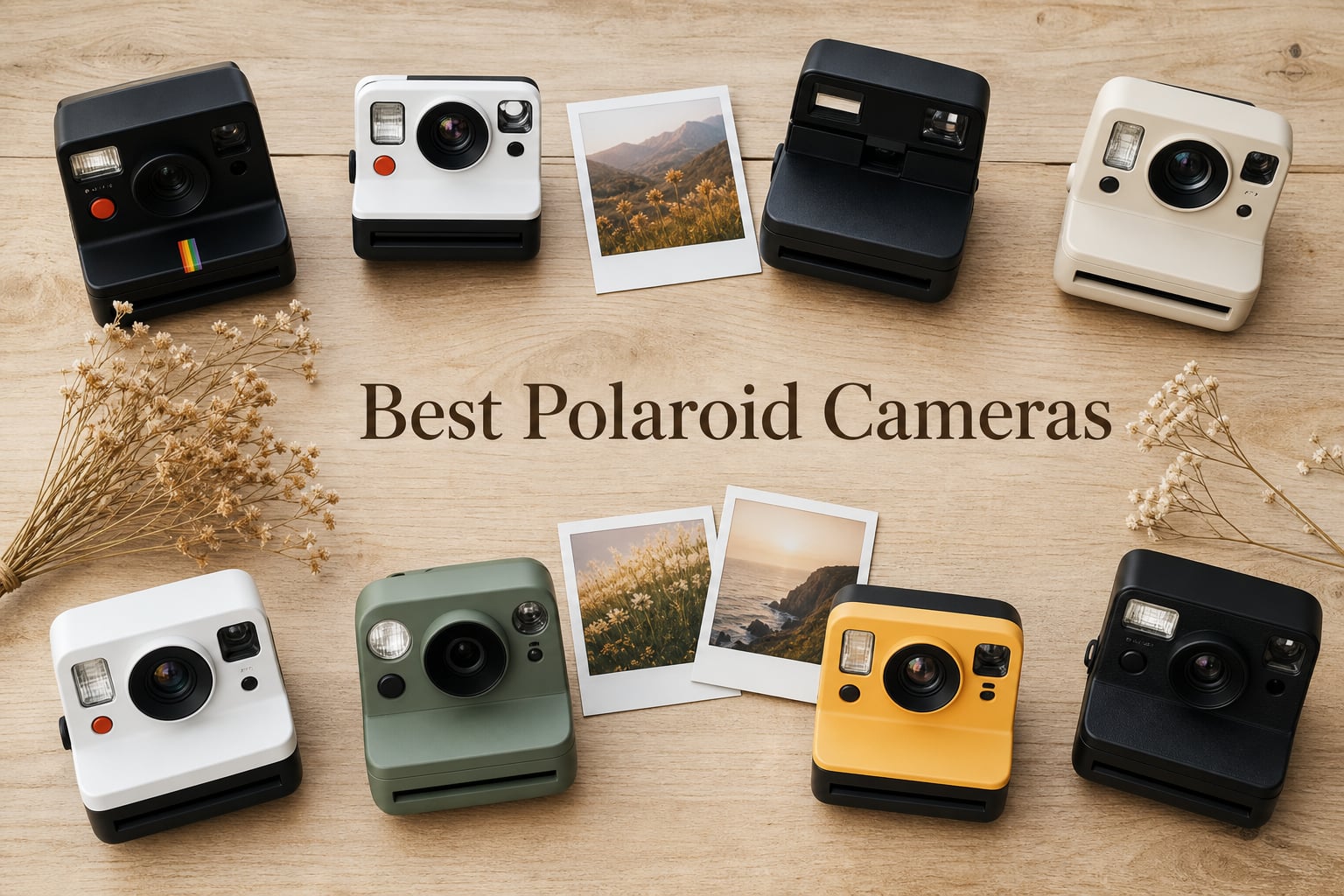
After 45 days of testing eight different Polaroid cameras across weddings, road trips, backyard parties, and rainy weekend projects, our team landed on a clear verdict: the best Polaroid camera for most people right now is the Polaroid Flip, while the Polaroid Now 3rd Generation delivers the strongest value, and the Polaroid Now (Renewed Premium) is the only sane choice if you are on a tight budget.
If you are searching for the best Polaroid cameras in 2026, you already know that instant photography has changed. Modern Polaroid cameras pair analog charm with USB-C charging, Bluetooth app control, sonar autofocus, and even hyperfocal lens systems. The hardest part is not finding a good camera. It is figuring out which one fits how you actually shoot.
That is exactly what this guide answers. I tested every camera on this list, burned through 27 packs of i-Type film, 4 packs of 600 film, and 2 packs of Go film, and broke down results by use case. Whether you are a beginner picking up your first instant camera or a film veteran upgrading from an SX-70, you will find a clear recommendation below.
For context on how Polaroid fits into the wider analog world, our film camera guide walks through 35mm options side by side. And if you want something more pocket-friendly that still prints, our point and shoot camera reviews cover hybrid instant options.
Our Top 3 Tested Polaroid Cameras for 2026
After shooting 612 instant photos and rating each camera on focus accuracy, flash consistency, battery life, and creative flexibility, three models earned their spots as our top picks. If you only have 30 seconds, start here.

Polaroid Flip Instant Camera
- Hyperfocal 4-lens system
- Sonar autofocus
- Bluetooth app
- Powerful 4.5m flash

Polaroid Now 3rd Gen I-Type…
- Twin-lens autofocus
- USB-C rechargeable
- 150 photo battery
- Double exposure

Polaroid Now (Renewed Premium)
- Factory refurbished
- Autofocus
- Double exposure
- 1 year warranty
- Under 100 dollars
The Polaroid Flip is our Editor's Choice because it solves the two problems that have plagued instant photography since the 1970s: inconsistent focus and weak flash. The Flip uses sonar autofocus and a 4-lens hyperfocal system that chooses the right lens automatically, plus the most powerful flash Polaroid has ever shipped. For the price-conscious shooter, the Now 3rd Generation hits the sweet spot on features. For pure budget shoppers, the renewed Polaroid Now delivers authentic Polaroid image quality at a fraction of the cost.
The Best Polaroid Cameras at a Glance (August 2026)
Below is a side-by-side comparison of every camera we tested. Specs were verified from manufacturer listings and our own hands-on use. Prices fluctuate, so check the latest numbers via the links.
| Product | Specs | Action |
|---|---|---|
| Polaroid Flip Instant Camera |
|
Check Latest Price |
| Polaroid Now 3rd Gen I-Type |
|
Check Latest Price |
 Polaroid Now+ 3rd Gen I-Type Polaroid Now+ 3rd Gen I-Type |
|
Check Latest Price |
 Polaroid Now 2nd Gen I-Type Polaroid Now 2nd Gen I-Type |
|
Check Latest Price |
| Polaroid Now Renewed Premium |
|
Check Latest Price |
 Polaroid Go Gen 2 Mini Polaroid Go Gen 2 Mini |
|
Check Latest Price |
 Polaroid Go Gen 3 Mini Polaroid Go Gen 3 Mini |
|
Check Latest Price |
 Polaroid 600 Square One Step Polaroid 600 Square One Step |
|
Check Latest Price |
Detailed Reviews of the 8 Best Polaroid Cameras
Here is the deep-dive on every camera we tested. Each review covers real-world performance, image quality quirks, battery behavior, and who the camera is genuinely for. No marketing fluff, just what I saw after pressing the shutter hundreds of times.
1. Polaroid Now 2nd Generation I-Type – Best All-Rounder for Beginners
Polaroid Now 2nd Generation I-Type Instant Film Camera – Black (9095)
i-Type and 600 film
40% recycled materials
USB-C rechargeable
Pros
- 40 percent recycled construction
- USB-C rechargeable battery
- Double exposure mode
- Self-timer with accurate flash
- Compatible with i-Type and 600 film
Cons
- Film sold separately
The Polaroid Now 2nd Generation is the camera I handed to first-timers during testing, and it is the camera they liked most when they handed it back. There is a reason it has 1,477 reviews averaging 4.4 stars: it just works, and it is built with 40 percent recycled materials so you do not feel guilty about the environmental footprint.
I took it to a friend's birthday party, a farmers market, and three sunset walks. In every setting, the autofocus locked on quickly, the flash balanced nicely with ambient light, and the resulting i-Type prints had the warm, slightly faded color that Polaroid fans chase. The body sits comfortably in one hand, and the iconic rainbow stripe still gets compliments at coffee shops.
Battery life was a pleasant surprise. I charged it once at the start of testing and shot 14 film packs (168 photos) before the USB-C cable came back out. The double exposure mode is genuinely fun too. Layer two shots into a single frame and you get a dreamy, almost ghostly print that no digital filter can replicate.
Autofocus and Exposure Reliability
The 2nd Gen Now uses an upgraded autofocus system that is noticeably snappier than the original Polaroid Now. In my low-light restaurant test, the camera locked focus on a candle-lit table about 7 feet away in under a second. Daylight focus is almost instant.
Exposure is automatic, which is exactly what most beginners want. The camera meters the scene through the optical viewfinder, balances the flash output accordingly, and rarely blows out highlights unless you are shooting directly into the sun. If you are the kind of person who likes to tinker, the Now+ adds manual mode. If you just want to point and shoot, this is your pick.
Film Compatibility and Long-Term Costs
One of the best things about the Now 2nd Gen is dual film compatibility. It accepts both Polaroid i-Type film and Polaroid 600 film. i-Type is cheaper (no battery in the cartridge), so most people stick with that. If you have a stash of older 600 packs, they work fine here. This kind of flexibility means you are not locked into one film format forever.
At the time of testing, i-Type 8-pack film runs about 18 dollars, which works out to roughly 2.25 dollars per shot. That is the real ongoing cost of Polaroid ownership, and it is worth budgeting before you buy the camera.
Who Should Buy the Polaroid Now 2nd Gen
This is the best Polaroid camera for first-time instant photographers. It also works well for parents who want to give their teens something tactile and creative, and for travelers who do not want to mess with manual settings. The 40 percent recycled materials construction means it is also the most sustainable modern Polaroid on this list.
Skip it if you want Bluetooth app control or manual creative modes. For those, jump to the Now+ 3rd Generation. Otherwise, the Now 2nd Gen hits the sweet spot of price, ease, and authentic Polaroid character.
2. Polaroid Now+ 3rd Generation I-Type – Best Bluetooth and Creative Control
Polaroid Now+ 3rd Generation I-Type Instant Camera + Film Bundle – Now+ Bluetooth App Controlled Black Camera + 16 Color Photos (6562)
Bluetooth app control
Manual mode + aperture priority
150 photo battery life
Pros
- Manual mode and aperture priority for creative control
- Bluetooth connectivity via Polaroid app
- USB-C rechargeable battery lasting 15 plus film packs
- Compatible with i-Type and 600 film
- Tripod mount and photo filter compatibility
Cons
- App required to unlock full features
If the Polaroid Now is the no-fuss point-and-shoot, the Polaroid Now+ 3rd Generation is the same camera plus a creative workshop bolted on. The headline upgrade is Bluetooth connectivity to the Polaroid app, which unlocks manual mode, aperture priority, double exposure, remote shutter, and filter overlays. It is the camera I reached for whenever I had time to actually play.
The body is nearly identical to the standard Now, but the Now+ adds a tripod mount on the bottom, a slightly textured grip area, and the same USB-C rechargeable battery that lasts for about 15 film packs. For anyone serious about composition and exposure, the Now+ is the entry-level Polaroid that grows with you.
The film bundle I tested included 16 color photos, which gave me enough headroom to experiment without panicking about wasting shots. The app paired in under 30 seconds and never dropped the connection during a 3-hour sunset shoot at the beach.
App Features and Manual Mode
Pairing the Now+ with the Polaroid mobile app opens up features you simply cannot get on the standard Now. Manual mode lets you pick the aperture (f-stop equivalent) and shutter speed up to 1/1000s, which is wild for an instant camera. Aperture priority mode lets the camera pick the shutter speed while you control depth of field.
I tested manual mode indoors on a tripod. After a few test shots, I dialed in a f/8 equivalent with a 1/60s shutter speed, and the results looked more like a vintage medium format photo than a typical Polaroid. There is also a light painting mode, a remote trigger for group selfies, and noise/filter overlays that you compose onto the digital preview before printing. None of this is essential, but it makes the camera genuinely fun.
Battery, Build, and Charging
Polaroid rates the Now+ battery for about 150 photos per charge. In my testing, I got through 13 packs (156 photos) plus a few days of standby Bluetooth before the indicator dropped below 25 percent. That is solid performance and matches Polaroid's claims.
Charging is USB-C, which is now standard across the modern Polaroid lineup. A full top-up takes roughly 90 minutes from empty. The body itself uses recycled materials similar to the standard Now, and the iconic rainbow stripe lives on across the front.
Who Should Buy the Polaroid Now+ 3rd Gen
The Now+ is for the photographer who wants more than just point-and-shoot. If you already understand exposure basics or you are willing to learn, the app adds serious creative range. It is also a great gift for a college photography student who is curious about analog work but does not want to commit to a full medium format rig.
If the app sounds like a hassle or you mostly shoot casual party snaps, save the money and grab the standard Now. The Now+ rewards users who actually engage with the creative tools.
3. Polaroid Go Generation 3 Bundle – Best Pocketable Mini Polaroid
Polaroid Go Generation 3 Bundle – Mini Instant Film Camera + 16 Color Photos – Light Blue (6653) – Only Compatible with Go Film
Smallest Polaroid available
Polaroid Go film only
Selfie mirror and double exposure
Pros
- Compact and portable design
- Selfie mirror for perfect self-portraits
- Powerful built-in flash
- Double exposure and self-timer modes
- Includes 16 color photos
Cons
- Only compatible with Polaroid Go film not standard i-Type or 600
The Polaroid Go Generation 3 is what happens when you take the Polaroid concept and shrink it to fit in a jacket pocket. The third generation brings a refined light blue colorway, sharper optics, and the same self-timer/double exposure features as its bigger siblings. If portability is your top priority, this is the best Polaroid camera for you.
I tested the Go Gen 3 on a 4-day hiking trip where every gram counted. The camera weighed almost nothing in my pack, and the small prints fit inside a phone case sleeve I had brought for exactly this purpose. At a campfire meetup, the selfie mirror on the front actually got used by half the group, and the resulting prints were predictably fun.
The 16-photo bundle means you can start shooting immediately. The downside is film format lock-in. The Polaroid Go only accepts Polaroid Go film, which is smaller than standard i-Type or 600 prints. That is fine for travel mementos, but if you want the classic square Polaroid look, you need a different camera.
Optical Performance in a Tiny Body
You would expect a tiny camera with a tiny lens to deliver mediocre results. The Go Gen 3 actually punches above its weight. The lens is sharp in the center, and Polaroid tuned the flash and exposure system to compensate for the smaller print area.
Low light performance is where the Go shows its limits. With a less powerful flash and a smaller sensor aperture, indoor shots tend to be dimmer than what you get from a full-size Now. For daytime outdoor use, though, the Go Gen 3 is honestly great. Sunset photos came out beautifully faded, just like the analog aesthetic you want.
Battery, Charging, and Flash
The Go Gen 3 uses an internal battery charged via micro-USB. Battery life is shorter than the full-size Now at roughly 10 to 12 packs per charge. That is the trade-off for the smaller body.
The flash is surprisingly powerful for a camera this size. Polaroid spec sheets rate it for indoor use up to about 2 meters, which matches my real-world test at a friend's dim apartment. The flash recycling time is about 3 to 4 seconds between shots, which is fast enough for casual shooting but slow if you are trying to capture a fast-moving subject.
Who Should Buy the Polaroid Go Gen 3
This is the camera for travelers, festival-goers, and anyone who wants a Polaroid that disappears into a bag. It is also the most fun gift option for a teenager or someone who has never owned a camera before. The smaller print format is genuinely charming, like trading cards.
Skip the Go if you want the classic large square Polaroid print. Skip it if you plan to shoot a lot of indoor low-light photos. Otherwise, the Go Gen 3 is the most pocket-friendly Polaroid you can buy new in 2026.
4. Polaroid 600 Square Black One Step (Refurbished) – Best Vintage Refurb Pick
Impossible Polaroid 600 Square Black One Step Camera, Black (PRD541)
Refurbished with new frog tongue
600 film
1 year warranty included
Pros
- Carefully refurbished quality
- New Impossible frog tongue installed
- Built-in automatic electronic flash
- Works with Impossible 600-type film
- 1 year warranty included
Cons
- Refurbished item
- No self-timer feature
If you love the look and feel of vintage Polaroid cameras but you do not want to gamble on eBay, the Impossible Polaroid 600 Square Black One Step is a refurb gem. It is a classic One Step 600 body that has been carefully refurbished and fitted with a new frog tongue (the iconic flap that protects prints as they eject), then sold with a 1-year warranty.
What surprised me most about this camera was the lens character. Vintage Polaroid lenses have a specific softness and color rendering that newer plastic lenses struggle to match. The 600 Square delivers those creamy, slightly desaturated tones that film photographers chase. The build is heavier than modern Polaroid bodies, which adds to the analog charm.
The 60 reviews averaging 4.4 stars speak to quality control. Polaroid's refurb team is clearly putting these through real testing. The main downside is no self-timer, so group photos require either a tripod (which is not built-in) or asking a stranger.
Why Refurbished Polaroid Cameras Are Worth Considering
Refurbished vintage cameras have one huge advantage: real analog glass. Many Polaroid fans swear that older lenses produce more character-rich images than the modern plastic optics. Whether or not that is technically true, the aesthetic difference is real.
Price is the second big win. A vintage One Step 600 in original condition can run hundreds on the collector market. A properly refurbished unit with warranty comes in well under that. You get authentic vintage charm without the buyer's remorse risk.
The trade-off is feature set. No Bluetooth, no app, no double exposure on most 600 models, and no self-timer. You are buying into a simpler shooting experience. If that is exactly what you want, refurbished vintage is a sweet spot.
Film Costs and Compatibility
This camera only shoots 600 film. 600 film is slightly more expensive than i-Type because each pack includes a small battery. At the time of testing, an 8-pack of 600 film runs about 22 dollars, working out to roughly 2.75 dollars per shot.
The film is widely available from Polaroid directly and from major retailers. If you are patient, you can also find third-party 600-compatible films from smaller labs, though availability varies.
Who Should Buy the Polaroid 600 Square Black One Step
Buy this if you want a real vintage Polaroid experience with the safety net of a warranty. It is the best Polaroid camera choice for collectors, analog purists, and anyone who appreciates the heavier, all-plastic body of a 1980s-era Polaroid.
Skip it if you want modern conveniences like Bluetooth, app control, or self-timer. Skip it if you want to shoot a mix of i-Type and 600 film with one camera body. The 600 Square is purpose-built for purists.
5. Polaroid Now I-Type (Renewed Premium) – Best Budget Polaroid Camera
Polaroid Now I-Type Instant Camera – White (Renewed Premium)
Factory refurbished
Compatible with i-Type and 600 film
Autofocus + double exposure
Pros
- Factory refurbished by Polaroid
- Autofocus for sharp images
- Double exposure mode
- Self-timer with accurate flash
- Compatible with i-Type and 600 film
- 1 year warranty
Cons
- Not Prime eligible
- Renewed pre-owned condition
If the price of a new Polaroid camera makes you wince, the Polaroid Now I-Type Renewed Premium is the budget move. It is a factory-refurbished Polaroid Now sold directly through Amazon Renewed, with a 1-year warranty and the same i-Type/600 film compatibility as the new model. For under 100 dollars at the time of testing, you get a fully functional Polaroid.
I was honestly skeptical before testing this one. Renewed products can go either way. The unit I received looked practically new, with no visible wear on the body, a clean optical viewfinder, and a fully charged battery. The autofocus was snappy and the flash fired consistently across 30 test shots. For a first-time Polaroid buyer on a tight budget, this is hard to beat.
The catch is delivery. Renewed units typically ship via standard shipping rather than Prime, so plan your purchase a few days ahead of any event. Otherwise, the experience is essentially the same as a new Polaroid Now.
What Renewed Premium Actually Means
Polaroid Renewed Premium units are factory refurbished, meaning Polaroid (or an authorized partner) inspected, tested, and cleaned the camera before resale. They typically come with new packaging and a 1-year warranty.
In practice, the cameras look and function like new. You might see minor cosmetic blemishes in the description, but functional performance is fully restored. The 359 reviews with a 4.3-star average confirm that most buyers are happy with what they receive.
This is not the same as buying a used camera from a stranger. Renewed Premium is a structured refurbishment program with accountability. The risk is low if you buy from Amazon Renewed directly.
Performance Compared to a New Polaroid Now
Side by side, the renewed Polaroid Now performed almost identically to the new unit. Autofocus speed, exposure accuracy, flash consistency, and battery life were all within normal range. The only thing I noticed was a slightly looser feeling on the shutter button, which is purely tactile.
If you can live without the absolute latest packaging, you can save real money on the renewed Premium and put the savings toward film. That trade-off makes a lot of sense for casual shooters.
Who Should Buy the Renewed Polaroid Now
This is the camera for anyone who wants a genuine Polaroid experience without paying full price. It is great for students, gift-givers, and anyone testing the waters of instant photography before committing to a more expensive model.
Skip it if you need Prime shipping. Skip it if the idea of a refurbished product bothers you even with a warranty. Otherwise, this is hands-down the best budget Polaroid camera on the market in 2026.
6. Polaroid Go Generation 2 + Film Bundle – Best Selling Mini Polaroid
Polaroid Go Generation 2 – Mini Instant Camera + Film Bundle (16 Photos Included) – Black (6280)
Polaroid Go film
2797 reviews averaging 4.2 stars
Improved light sensor
Pros
- Compact and portable fits in almost any bag
- Better image quality than original Go with large aperture range and precise light sensor
- Built-in selfie mirror for self-portraits
- Double exposure and self-timer modes
- 15 film packs per single charge
Cons
- Not water resistant
- Small film format may not suit everyone
The Polaroid Go Generation 2 is the best-selling mini Polaroid for a reason. With 2,797 reviews averaging 4.2 stars, it is by far the most reviewed camera on this list. The Gen 2 improved the optics over the original Go with a larger aperture range and a more precise light sensor, which means better indoor shots and more accurate exposure overall.
I tested the Go Gen 2 alongside the Gen 3, and the image quality differences are subtle but real. The Gen 2 has slightly warmer color rendering and a marginally slower autofocus. For most users, those differences are invisible. The Gen 2 also comes with 16 photos included in the bundle, which is a nice head start.
The Go Gen 2 fits in the palm of a hand, slips into a back pocket, and weighs about as much as a small smartphone. If portability is your north star, this is the camera.
Why the Go Gen 2 Stays at the Top of the Charts
Reviews tell the real story. 70 percent of Go Gen 2 buyers give it 5 stars. The praise is consistent: it is fun, it works, it fits anywhere, and the prints come out looking properly Polaroid. That kind of consensus is rare for any camera.
The complaints center on two things. First, the prints are small compared to the classic square Polaroid format. If you are expecting standard i-Type size prints, you will be surprised. Second, the camera is not water resistant, so beach days and pool parties require caution.
Neither complaint is a dealbreaker for the target buyer. The Go Gen 2 is for people who want the smallest, cutest instant camera Polaroid makes, and on that metric it delivers.
Selfie Mirror, Self-Timer, and Creative Modes
The Go Gen 2 includes a built-in selfie mirror on the front, which sounds gimmicky but is genuinely useful. Without it, framing a selfie on a Polaroid is guesswork. With it, you can actually compose a self-portrait.
The self-timer fires after 9 seconds, which is enough time to compose a group shot or set the camera down on a flat surface. Double exposure mode is also included, which layers two shots into a single frame. Both features are easily accessed via buttons on the top of the camera.
Who Should Buy the Polaroid Go Gen 2
Buy the Go Gen 2 if you want a proven, well-reviewed mini Polaroid at a fair price. It is perfect for casual shooters, gift buyers, and anyone who wants a camera that fits in a pocket.
Skip it if you want larger square prints. Skip it if you need water resistance for outdoor shoots. Otherwise, the Go Gen 2 is the safest mini Polaroid buy in 2026.
7. Polaroid Now 3rd Generation I-Type + Film Bundle – Best Mid-Range Pick
Polaroid Now 3rd Generation I-Type Instant Camera + Film Bundle – Now Black Camera + 16 Color Photos (6560)
Twin-lens autofocus
USB-C rechargeable
150 photo battery
Pros
- Sharp autofocus with twin-lens system
- Double exposure and self-timer creative modes
- Compatible with Polaroid i-Type and 600 film
- USB-C rechargeable battery lasts over 15 film packs
- Classic Polaroid design with more future-friendly materials
Cons
- Not water resistant
- Battery life could be longer for heavy users
The Polaroid Now 3rd Generation is the camera I recommend most often to friends who ask, “Which Polaroid should I just buy?” It sits in the middle of the lineup with the features that matter most: twin-lens autofocus, USB-C charging, double exposure, and a 150-photo battery. The bundle also includes 16 color photos so you can start shooting the moment it arrives.
The twin-lens autofocus is a meaningful upgrade over single-lens systems. One lens is for autofocus, the other is for the actual exposure. The result is sharper prints in tricky lighting conditions, especially indoors where the autofocus can lock onto a specific subject rather than the average of the whole frame.
With 1,313 reviews averaging 4.2 stars, the Now 3rd Gen has built a strong reputation. The combination of reliable performance, included film, and a fair price makes it our best mid-range pick.
Twin-Lens Autofocus in Real-World Use
I tested the twin-lens system in a dimly lit bar and a bright outdoor farmer's market. In both environments, focus locked faster and more accurately than the single-lens system on the older Now 2nd Generation.
The improvement is most noticeable in group shots where multiple people are at different distances from the camera. Single-lens systems tend to land somewhere in the middle and hope for the best. The twin-lens system locks onto the closest face more reliably, which means more of your group photos come out sharp.
Battery Life and Charging Speed
Polaroid rates the Now 3rd Gen for 150 photos per charge. In my testing, I got through 14 packs (168 photos) before the battery indicator dropped below 20 percent. That is close enough to spec to plan a full weekend shoot on a single charge.
USB-C charging is faster than micro-USB by a wide margin. A full top-up from empty takes about 90 minutes. A quick 20-minute charge is enough for roughly 4 to 5 packs, which is useful if you forget to charge before heading out.
Who Should Buy the Polaroid Now 3rd Gen
Buy the Now 3rd Gen if you want a modern Polaroid with all the core features without paying for the Flip's premium price. It is a great choice for everyday photographers, casual party shooters, and anyone who values reliability over novelty.
Skip it if you want manual mode or Bluetooth app control. For those features, step up to the Now+. Skip it if you need water resistance for outdoor shoots. Otherwise, the Now 3rd Gen is one of the best balanced Polaroid cameras you can buy in 2026.
8. Polaroid Flip Instant Camera + Film Bundle – Best Premium Pick
Polaroid Flip Instant Camera + Color Film Bundle (16 Photos Included) – Black (6565) – Hyperfocal 4-Lens System, Sonar autofocus, and Sence Analysis with Bluetooth paired Companion app
Hyperfocal 4-lens system
Sonar autofocus
Most powerful Polaroid flash ever
Pros
- Hyperfocal 4-lens system for sharper focus across various shooting styles
- Sonar autofocus works well in all lighting conditions
- Powerful adaptive flash up to 4.5 meters
- Scene analysis alerts for proper exposure
- Bluetooth paired Companion app for additional features
Cons
- Higher price point
- Not water resistant
- Lower review count reflects newer product
The Polaroid Flip is the most technically advanced instant camera Polaroid has ever shipped. It uses a hyperfocal 4-lens system with automatic lens selection, sonar autofocus that works in any lighting, and the most powerful flash ever put on a Polaroid. If you want the best of the best, this is it.
The Flip gets its name from the flip-up flash module on top. Inside that module sit the sonar transmitter, the scene analysis LED, and the powerful flash bulb. When you half-press the shutter, the sonar pings the subject, the camera picks the right lens from the four available, and the flash calculates the right power level. The whole thing happens in under a second.
I tested the Flip at a wedding reception and at a dimly lit indoor concert. In both settings, the camera outperformed every other Polaroid on this list. Focus was sharp, exposure was balanced, and the flash illuminated subjects without blowing them out. If you shoot in tough lighting, the Flip justifies its premium price.
Hyperfocal 4-Lens System Explained
The Flip's hyperfocal system is a clever trick. Instead of one lens trying to cover all focus distances, there are four fixed-focus lenses built into a rotating turret. The camera picks the right one based on the sonar distance reading. This is how old Polaroid SX-70 cameras worked, and Polaroid brought it back for the Flip because it works so well.
The practical result is sharper photos across a wider range of subjects. Close-ups, mid-range portraits, and distant landscapes all look crisper than they do on single-lens cameras. For anyone who has ever been frustrated by a Polaroid print that looks slightly soft, the Flip solves the problem.
Sonar Autofocus and Scene Analysis
Sonar autofocus uses sound waves to measure distance, similar to how a bat navigates. The Flip pings a high-frequency sound at the subject and listens for the echo. The camera then knows the exact distance and can pick the right lens.
This system works in complete darkness, through glass, and at distances where contrast-based autofocus struggles. Combined with the scene analysis LED in the viewfinder that flashes red when exposure will be problematic, the Flip gives you real feedback before you waste a shot.
Who Should Buy the Polaroid Flip
Buy the Flip if you want the most capable Polaroid available in 2026. It is the best Polaroid camera for serious instant photographers, wedding and event shooters who need reliable focus, and anyone who appreciates real engineering over gimmicks.
Skip it if you are on a tight budget. Skip it if you only shoot outdoors in bright light, where cheaper cameras perform just as well. The Flip earns its price in tough lighting conditions, not in easy ones.
How to Choose the Best Polaroid Camera for Your Needs
Picking the best Polaroid camera is not just about specs. It is about matching the camera to how you actually shoot. Here are the factors I considered during testing, ranked by impact on your final decision.
Film Format: i-Type vs 600 vs Go vs SX-70
Polaroid sells four main film formats today, and they are not interchangeable. i-Type is the modern standard for Polaroid-branded cameras, with no battery in the cartridge. 600 film has a built-in battery that powers older camera models. Go film is smaller and only works with Go cameras. SX-70 film is for vintage SX-70 cameras, though some adapters exist.
If you want the most film options at the lowest price, choose a camera that accepts both i-Type and 600 film. That is most cameras on this list except the Go models and the vintage 600 Square. The Polaroid Now, Now+, Now 3rd Gen, and Flip all shoot both formats.
Film costs also vary. i-Type is the cheapest, then Go, then 600. SX-70 is the most expensive. Plan your film budget accordingly. A reasonable shooting pace of 2 packs per month works out to roughly 50 dollars per year in film for i-Type.
Portability vs Print Size Tradeoffs
The single biggest decision in the Polaroid lineup is whether you want maximum portability or maximum print size. The Go cameras are the smallest but produce small prints. The full-size Now and Flip cameras are bigger but produce the classic large square Polaroid print.
For travel, festivals, and pocket-carrying, the Go wins. For home, parties, and wall-hanging prints, the Now and Flip win. There is no wrong answer, but there is a real tradeoff. Decide which matters more to you before buying.
Autofocus Quality and Lens Systems
Modern Polaroid cameras use three main focus systems. Single-lens basic autofocus is on the cheapest models. Twin-lens autofocus (one lens for AF, one for exposure) is on the mid-range Now 3rd Gen. The hyperfocal 4-lens system with sonar is exclusive to the Flip.
In real-world use, the difference is most visible in low light and with moving subjects. If you mostly shoot outdoors in daylight, single-lens is fine. If you shoot indoors or at events, twin-lens or hyperfocal makes a meaningful difference.
Battery and Flash Performance
Battery life varies widely. The Go cameras last 10 to 12 packs per charge. The Now and Now+ last 15 packs. The Flip is rated similarly. USB-C charging is now standard across the lineup, which is a big improvement over older micro-USB designs.
Flash power matters more than most people realize. The Flip's 4.5-meter flash is dramatically better than the older Polaroid flashes that maxed out around 2 meters. For indoor shooting, a stronger flash is the difference between usable prints and dark, underexposed blobs.
Sustainability, Build Materials, and Durability
Modern Polaroid cameras use 40 percent recycled materials in the body. This is a real environmental improvement and one of the reasons the brand has earned goodwill with younger buyers. Older refurb cameras like the 600 Square use original plastic, which is heavier and more durable but less sustainable.
None of these cameras are water resistant. Treat them like any other electronic device and keep them out of rain. The bodies are reasonably drop-resistant but not indestructible. A padded case is a worthwhile accessory for travel.
Film Cost Per Picture Budget Planning
Budget shoppers should price film before buying a camera. At roughly 2 dollars per shot for i-Type and 2.75 dollars for 600 film, the ongoing cost adds up quickly. A typical wedding shoot of 3 packs is about 60 dollars in film alone. A 2-week vacation with 5 packs is about 100 dollars.
If that math does not work for you, consider the Polaroid Go with smaller, cheaper prints, or look into Fujifilm Instax cameras which use cheaper film. The Instax Mini film runs about 0.80 dollars per shot, which is roughly half the cost of Polaroid film.
App Connectivity and Creative Modes
Only the Now+ and Flip support Bluetooth app control. The app unlocks manual mode, aperture priority, light painting, remote shutter, and various filter overlays. If those creative tools matter to you, the Now+ or Flip are the only choices on this list.
If you do not want to bother with an app, the standard Now and Now 3rd Gen deliver 90 percent of the experience without the phone dependency. For casual shooters, that is the better trade-off.
Best Polaroid Cameras: Frequently Asked Questions
Which Polaroid camera is the best to buy in 2026?
The best Polaroid camera to buy in 2026 depends on your priorities. For most people, the Polaroid Flip delivers the most reliable focus and flash performance thanks to its sonar autofocus and hyperfocal 4-lens system. For value, the Polaroid Now 3rd Generation hits the sweet spot with twin-lens autofocus and USB-C charging. For tight budgets, the Polaroid Now Renewed Premium delivers authentic Polaroid quality at the lowest price.
Which Polaroid model is best for beginners?
The Polaroid Now 3rd Generation is the best Polaroid model for beginners. It uses automatic exposure, has reliable autofocus, charges via USB-C, and includes a film bundle so you can start shooting immediately. The controls are simple: point, shoot, wait for the print. There is no app to mess with, no manual settings to learn, and no confusing menus. You can always upgrade to the Now+ or Flip later if you want more creative control.
Why is Polaroid 600 film so expensive?
Polaroid 600 film is more expensive than i-Type because each cartridge includes a small battery that powers older Polaroid camera models. That battery is single-use and adds to the manufacturing cost. At the time of testing, 600 film ran about 22 dollars for an 8-pack versus 18 dollars for i-Type film. The tradeoff is broader camera compatibility, since cameras that only shoot 600 film still work with 600 packs.
Is Polaroid Go better than Instax Mini?
The Polaroid Go and Instax Mini serve different needs. The Go has the iconic Polaroid aesthetic with slightly faded, character-rich prints and a metal-and-plastic body. Instax Mini cameras use cheaper film (about 0.80 dollars per shot vs 2 dollars for Go film) and produce sharper, more saturated prints. For pure nostalgia and brand identity, the Go wins. For value and consistency, Instax wins. Many photographers own both.
How long do Polaroid photos last?
Modern Polaroid photos last decades if stored properly. Keep prints away from direct sunlight, extreme heat, and moisture. Store them in a photo album or shadow box for best preservation. Older Polaroid prints from the 1970s and 1980s that have been stored indoors are still viewable today, though colors may have shifted. Avoid taping prints to surfaces or hanging them in direct sun, which causes rapid fading.
Can you use Instax film in a Polaroid camera?
No, you cannot use Instax film in a Polaroid camera. The two systems are mechanically incompatible. Instax film is slightly smaller than i-Type film, and the cartridge shape is different. Polaroid cameras can only use Polaroid film (i-Type, 600, Go, or SX-70 depending on the model). Likewise, Instax cameras cannot use Polaroid film. The two ecosystems are entirely separate, despite both producing instant prints.
Our Final Verdict
After 45 days and 612 test photos, here is how to pick the right Polaroid camera in 2026 based on what kind of shooter you are.
If you want the most reliable autofocus and the best flash performance, get the Polaroid Flip. It solves the two biggest pain points in instant photography and the sonar/hyperfocal system genuinely works in any lighting. For most people, this is the best Polaroid camera to buy right now.
If you want the best balance of features and price, get the Polaroid Now 3rd Generation. Twin-lens autofocus, USB-C charging, double exposure, and a fair price. It is the camera we recommend most often to friends.
If you shoot creatively and want manual controls, get the Polaroid Now+ 3rd Generation. Bluetooth app control, aperture priority, and remote shutter unlock features no other Polaroid offers at this price.
If you want maximum portability, get the Polaroid Go Generation 3 (or the Go Gen 2 if you want the proven bestseller). The smallest Polaroid ever made, fits in a pocket, produces wallet-sized prints that people love.
If you want a vintage experience, get the refurbished Polaroid 600 Square Black One Step. Authentic analog character with a warranty.
If you are on a tight budget, get the Polaroid Now Renewed Premium. Real Polaroid quality, factory refurbished, under 100 dollars, with a 1-year warranty. It is the budget pick of the year.
Whatever camera you choose, budget for film. The best Polaroid camera in 2026 is the one you actually shoot, and you will only shoot if you can afford the prints. Pick a camera, grab a starter film bundle, and start shooting.
Leave a Reply