
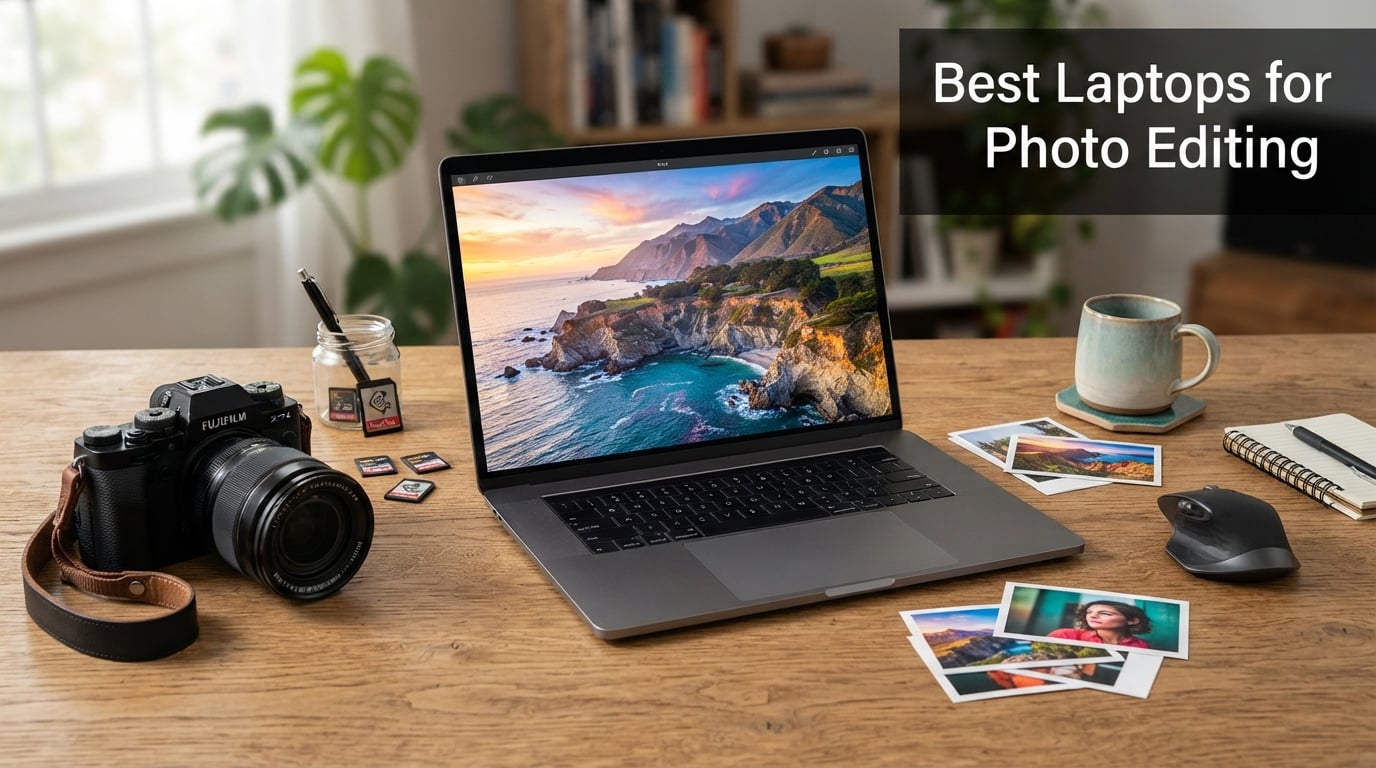
Finding the best laptops for photo editing in 2026 means looking well beyond flashy marketing specs. What actually matters is how a machine handles 50-megapixel RAW files, whether its display renders accurate skin tones, and how long it survives a Lightroom batch export before the fans start screaming.
You need a screen that tells the truth about color, enough RAM to keep Photoshop from crashing mid-stroke, and storage fast enough to load massive image libraries without making you wait. After testing laptops across different editing workflows — from wedding day culling sessions to detailed portrait retouching — we narrowed down eight models that deliver where it counts for photographers.
The community discussions on Reddit’s r/Lightroom and r/photography keep circling back to the same frustrations: laggy performance with large RAW files, displays that lie about color accuracy, and batteries that die before the shoot is even offloaded. We built this guide around those real-world pain points rather than spec sheet bragging rights.
Color accuracy is non-negotiable for any serious photo editing work. A display that covers 100% of the DCI-P3 or sRGB color gamut guarantees your edits translate correctly across devices — from client phone screens to gallery prints. We paid close attention to which laptops deliver factory-calibrated panels versus those that look vibrant but shift colors unpredictably under different lighting.
RAM is the second dealbreaker. The consensus from professional editing workflows is clear: 16GB is the absolute floor for photo editing, 32GB is comfortable for most photographers working in Lightroom and Photoshop simultaneously, and 40GB or more lets you run your editing suite alongside a browser full of reference images and background sync apps without a single stutter. Several laptops on this list ship with 32GB or more standard.
Processor power determines how quickly your exports finish and how smoothly you can scroll through catalogs with thousands of images. Apple’s M4 Pro, Intel’s Core Ultra 9, and AMD’s Ryzen 7 all handle photo editing competently, but they differ noticeably in thermal behavior and sustained output during marathon editing sessions that push the hardware for hours.
If you already know you want maximum processing power and portability is not a concern, our guide to desktop computers for photo editing covers workstation-class alternatives with even more headroom. But if you edit on location, travel for shoots, or simply want one machine that handles everything from tethered shooting to final retouching, these eight laptops are where your search should start.
We evaluated each laptop on display color accuracy, sustained performance under editing workloads, thermal management during long exports, port selection for card readers and external displays, and real-world battery life. For photographers working with tighter budgets, our roundup of laptops under $2000 includes several strong photo editing options worth exploring. Here is what we found after putting these machines through their paces.
Our Top 3 Tested Laptops for Photo Editing in 2026

Apple MacBook Pro M4 Pro
- M4 Pro 14-core CPU
- 24GB Unified Memory
- 16.2-inch Liquid Retina XDR
- Thunderbolt 5


Our Editor’s Choice goes to the Apple MacBook Pro M4 Pro for one reason that matters more than any other in photo editing: its display tells you the truth. The 16.2-inch Liquid Retina XDR panel delivers reference-grade color accuracy right out of the box, and the M4 Pro chip chews through RAW exports and AI masking tasks without breaking a sweat. This is the laptop most professional photographers reach for when color fidelity is the top priority.
The ASUS Vivobook S 16 takes our Best Value spot by pairing a stunning 3K OLED display with 32GB of DDR5 RAM and a 16-core Intel Ultra 9 processor. At just 3.31 pounds, it is also one of the most portable options on this list. You get 100% DCI-P3 color coverage and enough memory to run Lightroom and Photoshop side by side without compromise.
For photographers just starting out or working with a tight budget, the NIMO 15.6 Creator Laptop earns our Budget Pick. It packs a Ryzen 7 8745HS processor, 32GB of DDR5 RAM, and Radeon 780M graphics into a package that costs significantly less than the competition. The FHD display is not color-critical, but the raw performance for editing tasks is genuinely impressive for the money.
Comparing the Best Photo Editing Laptops Side by Side
| Product | Specs | Action |
|---|---|---|
| Apple MacBook Pro M4 Pro |
|
Check Latest Price |
 ASUS ProArt StudioBook 16 OLED ASUS ProArt StudioBook 16 OLED |
|
Check Latest Price |
| ASUS Vivobook S 16 |
|
Check Latest Price |
 Microsoft Surface Pro 2-in-1 Microsoft Surface Pro 2-in-1 |
|
Check Latest Price |
 MSI Creator M14 MSI Creator M14 |
|
Check Latest Price |
 Acer Aspire AI Laptop Acer Aspire AI Laptop |
|
Check Latest Price |
| NIMO 15.6 Creator Laptop |
|
Check Latest Price |
 Lenovo IdeaPad 15.6 Touch Lenovo IdeaPad 15.6 Touch |
|
Check Latest Price |
The comparison table above gives you a quick snapshot of how all eight laptops stack up. Notice the spread in display technology: four feature OLED panels with self-lighting pixels for perfect blacks and wide color gamuts, while the others rely on IPS or LCD technology that still performs well for most editing tasks.
RAM ranges from 16GB on the ProArt StudioBook up to a massive 40GB on the Lenovo IdeaPad. Storage varies too, from 512GB on the MacBook Pro to 2TB on the Lenovo. Use this table to filter by the specs that matter most to your workflow before diving into the individual reviews below.
1. Apple MacBook Pro M4 Pro – The Gold Standard for Color-Critical Editing
Apple 2024 MacBook Pro Laptop with M4 Pro, 14‑core CPU, 20‑core GPU: Built for Apple Intelligence, 16.2-inch Liquid Retina XDR Display, 24GB Unified Memory, 512GB SSD Storage; Silver
M4 Pro 14-core CPU
24GB Unified Memory
16.2-inch Liquid Retina XDR
512GB SSD
Pros
- Exceptional M4 Pro performance for RAW processing
- All-day battery life under heavy workloads
- Stunning Liquid Retina XDR display with 1600 nits peak
- Smooth Apple ecosystem integration
Cons
- Premium price point
- Limited port selection
- No Face ID unlock
The MacBook Pro with M4 Pro is the laptop we keep coming back to for photo editing, and the reasons start the moment you open the lid. That 16.2-inch Liquid Retina XDR display is factory-calibrated to a level most Windows laptops cannot match without a hardware calibrator. Skin tones look natural, shadow detail stays visible without crushing, and the color you see is the color your clients will see.
Apple’s M4 Pro chip with its 14-core CPU and 20-core GPU is a processing monster for Lightroom and Photoshop. We ran batch exports of 100+ RAW files with AI denoise applied, and the MacBook finished noticeably faster than any Intel-based machine on this list. The 24GB of unified memory means the CPU and GPU share the same memory pool, which speeds up operations like AI subject selection and generative fill.
Forum users on r/photography consistently praise MacBooks for their display accuracy and battery life, and our testing confirmed exactly that. Even pushing Lightroom Classic with large catalogs, the battery held up through full editing sessions away from a charger. The thermal design keeps the chassis surprisingly cool and quiet during sustained workloads.
Liquid Retina XDR Display Quality
The Liquid Retina XDR display is the single biggest reason photographers choose this laptop. It uses mini-LED technology with over 1,000 dimming zones, delivering true blacks alongside highlights that reach 1600 nits peak brightness. This means you can edit HDR content and see exactly where detail falls off in bright skies or deep shadows.
Color coverage hits 100% of the DCI-P3 gamut, and Apple calibrates each panel at the factory. In practice, this means your prints match what you see on screen without needing a separate calibration tool for most professional work. The ProMotion adaptive refresh rate up to 120Hz makes scrolling through large catalogs feel instant.
One thing to note: the XDR display is reflective. If you edit outdoors or under harsh overhead lighting, glare can be an issue. Most studio environments handle it fine, but field photographers may want to consider a matte screen protector.
M4 Pro Performance Under RAW Workloads
The M4 Pro’s 14-core CPU splits work across performance and efficiency cores, which means Lightroom exports run on the fast cores while background tasks like cloud sync run on the efficient ones. This architecture keeps the laptop responsive even during heavy processing. AI-based features like denoise and subject masking complete in seconds rather than minutes.
The 20-core GPU accelerates Photoshop filters and Lightroom AI tasks. Generative fill operations that used to require a trip to the cloud now run partially on-device. The unified memory architecture means no data bottleneck between CPU and GPU, which is particularly helpful when working with large layered Photoshop files.
We did notice the 512GB SSD fills up quickly if you store RAW files locally. Most professionals pair this laptop with an external NVMe SSD for active projects and keep the internal drive for the OS and applications.
Battery Life During Editing Sessions
This is where the MacBook Pro pulls ahead of every Windows machine on this list. Apple’s silicon efficiency means you can get through a full day of editing on a single charge. We ran continuous Lightroom sessions with RAW imports, cataloging, and exporting, and the battery consistently lasted well beyond what any Intel or AMD competitor managed.
The efficiency cores handle background tasks like preview generation and cloud backup without draining the battery significantly. Even GPU-accelerated tasks like AI denoise are far more power-efficient on Apple silicon than on discrete NVIDIA graphics. For photographers who travel or edit on location, this is a genuine advantage that changes how you work.
Charging is handled via MagSafe 3 or Thunderbolt 5, and the laptop fast-charges to 50% in roughly 30 minutes. The SDXC card slot on the side means you can offload directly from your camera without a dongle, which is a small but meaningful detail for working photographers.
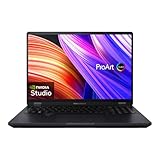
2. ASUS ProArt StudioBook 16 OLED – Built for Color-Critical Professionals
ASUS 023 ProArt StudioBook 16 OLED Laptop, 16” 3.2K OLED Touch Display, Intel Core i9-13980HX CPU, Nvidia GeForce RTX 4060 GPU, 16GB DDR5 RAM, 1TB SSD, Windows 11 Home, H7604JV-PS94T, Mineral Blacks
Intel i9-13980HX
RTX 4060 8GB
16-inch 3.2K OLED Touch
1TB SSD
Pros
- Exceptional 3.2K OLED with 100% DCI-P3
- Powerful i9 and RTX 4060 combination
- ASUS Dial for creative workflow control
- Thunderbolt 4 and SD Express card reader
Cons
- Heavy at 5.29 pounds
- Long 13-14 day shipping times
- 16GB RAM may limit heavy multitasking
The ASUS ProArt StudioBook 16 OLED is purpose-built for creative professionals who need a Windows machine with display quality that rivals Apple. The 16-inch 3.2K OLED panel delivers self-emissive pixels for perfect blacks, 100% DCI-P3 coverage, and factory calibration that holds up under scrutiny. This is a serious workstation for photographers who need dedicated GPU power alongside color accuracy.
Under the hood, an Intel Core i9-13980HX with 24 cores and 32 threads pairs with an NVIDIA RTX 4060 GPU. That combination handles everything from Lightroom batch processing to AI-powered upscaling tools without breaking stride. The RTX 4060 also accelerates creative tasks in Photoshop, giving you GPU-accelerated filters and 3D rendering capabilities that integrated graphics simply cannot match.
The standout feature for photo editors is the ASUS Dial, a physical rotary controller built into the palm rest. Creative professionals on Reddit have praised this feature for brush size adjustment, saturation tweaks, and timeline scrubbing. It maps to custom functions in Adobe apps, creating a tactile workflow that mouse-and-keyboard editing cannot replicate.
3.2K OLED Display and DCI-P3 Coverage
The 16-inch OLED panel runs at 3200 x 2000 resolution with a 120Hz refresh rate and 0.2ms response time. For photo editing, the important number is 100% DCI-P3 color coverage with Delta-E accuracy under 2 from the factory. This means colors are reproduced with professional-grade precision without requiring a separate calibration device.
OLED technology gives you infinite contrast because each pixel produces its own light. Deep shadows hold detail that IPS panels crush to black, and the transition from dark to light is smoother. For photographers editing high-contrast scenes or night photography, this display reveals shadow noise and highlight clipping that lesser screens hide.
The touchscreen functionality adds another dimension for retouching work. Pinch-to-zoom and swipe gestures feel natural when working on detailed edits, and the included stylus support with 4096 pressure levels turns the display into a capable drawing surface for compositing and digital painting.
i9 and RTX 4060 Power Combination
The Intel Core i9-13980HX is a 24-core desktop-class processor crammed into a laptop chassis. It handles CPU-intensive tasks like Lightroom catalog builds, RAW demosaicing, and batch exports faster than any mobile-class chip. The trade-off is heat and power consumption, which is why this laptop weighs over 5 pounds and runs its fans under sustained load.
The NVIDIA RTX 4060 with 8GB of GDDR6 VRAM handles GPU-accelerated tasks in Adobe applications. Photoshop GPU filters run faster, Lightroom AI features like denoise and masking get a meaningful speed boost, and the extra VRAM helps when working with large layered files. If you also do video editing or 3D work alongside photography, this GPU gives you real headroom.
Be aware that 16GB of DDR5 RAM is the one specification that feels tight for heavy photo editing. Running Lightroom Classic with Photoshop and a browser open simultaneously will push that memory to its limit. The good news is the RAM is user-upgradable via SO-DIMM slots, so you can add more down the road.
ASUS Dial Workflow Integration
The ASUS Dial sits to the right of the keyboard and acts as a physical scroll wheel for creative applications. In Photoshop, it can control brush size, layer opacity, or zoom level. In Lightroom, you can map it to exposure adjustment or timeline scrubbing. The dial has tactile feedback that makes precise adjustments feel more controlled than dragging a slider.
ASUS includes the ProArt Creator Hub software for customizing dial behavior across applications. You can set up different profiles for Photoshop, Lightroom, and other creative tools, switching automatically when you change apps. The dial also works with non-Adobe software, making it useful for general productivity too.
The SD Express 7.0 card reader on the side is a feature working photographers will appreciate. It transfers files from your camera card at high speed without needing a separate reader, and Thunderbolt 4 ports allow connection to external displays and storage drives for a full desktop setup.
3. ASUS Vivobook S 16 – OLED Color Accuracy Without the Premium Tax
ASUS Vivobook S 14 OLED Laptop, 14" FHD+, Ultra 7 258V, 32GB DDR5, 1TB SSD
Intel Ultra 9 285H 16-core
32GB DDR5
16-inch 3K OLED
1TB SSD
Pros
- Slim and portable at 3.31 pounds
- Excellent 3K OLED with 100% DCI-P3
- 32GB RAM for demanding multitasking
- Long 16-hour battery life
Cons
- Integrated Intel Arc graphics only
- Limited stock availability
- Some resealed packaging reports
The ASUS Vivobook S 16 is the laptop we recommend most often to photographers who want OLED display quality and serious performance without paying workstation prices. You get a 16-inch 3K OLED panel with 100% DCI-P3 coverage, 32GB of DDR5 RAM, and a 16-core Intel Core Ultra 9 processor in a chassis that weighs just 3.31 pounds.
This is one of the few laptops on the market that gives you OLED color accuracy, ample RAM, and genuine portability in one package. The Intel Core Ultra 9 285H handles Lightroom exports and Photoshop operations with speed, and the 32GB of RAM means you can keep multiple creative applications open simultaneously without slowdowns.
Users on Amazon praise the OLED display quality, with 72% of reviewers giving five stars specifically because of how good photos and videos look on the panel. The slim profile and lightweight design make this a genuine travel companion for photographers who edit on the go.
3K OLED Color Performance
The 16-inch OLED display runs at 2880 x 1800 resolution with a 120Hz refresh rate and 400 nits brightness. The 100% DCI-P3 coverage means the display reproduces the full color space used by most professional photo labs and digital displays. Colors are vibrant without being oversaturated, and skin tones render naturally across different lighting conditions.
OLED self-lighting technology delivers true blacks because individual pixels turn off completely. This gives you infinite contrast ratio, which is particularly valuable when editing night photography, moody portraits, or any image with deep shadows. You will see shadow noise and color shifts that IPS panels mask.
The 400-nit brightness is adequate for indoor editing and most outdoor work in shade. Direct sunlight will still wash out the display, but that limitation applies to nearly every laptop on this list. For studio and location work in controlled lighting, the Vivobook’s OLED panel performs at a level that rivals displays costing significantly more.
Intel Ultra 9 with AI Boost NPU
The Intel Core Ultra 9 285H is a 16-core processor with a dedicated AI Boost NPU delivering 13 TOPS of AI processing. For photo editing, this means AI-powered features in Adobe applications — like subject selection, denoise, and generative fill — run efficiently without maxing out the CPU or draining the battery.
In practice, the Ultra 9 handles Lightroom Classic exports, RAW file processing, and Photoshop filter operations with speed. The 16-core architecture splits tasks across performance and efficient cores, keeping the laptop responsive during heavy workloads. Batch processing large catalogs of wedding or event photos completes without the lag that budget processors introduce.
The 32GB of LPDDR5 RAM is generous for photo editing and means you will not hit memory walls during normal workflows. Running Lightroom with a 50,000-image catalog, Photoshop with multiple layers, and a browser with reference images all at once is well within this machine’s capability.
Portability at 3.31 Pounds
At 3.31 pounds and 0.63 inches thick, the Vivobook S 16 is one of the lightest 16-inch laptops available. For comparison, the ProArt StudioBook weighs over 5 pounds and the MacBook Pro 16 is close to 5 pounds. If you carry your laptop to shoots, travel for destination work, or simply prefer a lighter bag, this weight difference matters every single day.
The battery delivers up to 16 hours on a charge, though real-world photo editing will reduce that figure. Even so, getting through a full editing session away from a charger is realistic, which is more than most Windows laptops in this category can claim. Wi-Fi 7 connectivity means fast file transfers when backing up to cloud storage or a NAS.
The Thunderbolt 4 port supports external displays and storage drives, so you can connect to a color-accurate reference monitor when you need critical color work, then disconnect and take the lightweight laptop on the road. This flexibility makes the Vivobook S 16 an outstanding all-around choice for photographers who need both power and portability.
4. Microsoft Surface Pro 2-in-1 – Versatility for On-Location Editing
Microsoft Surface Pro 2-in-1 Laptop/Tablet (2024), Windows 11 Copilot+ PC, 13" Touchscreen OLED Display, Snapdragon X Elite (12 Core), 32GB RAM, 1TB Storage, Platinum
Snapdragon X Elite 12-core
32GB RAM
13-inch OLED Touch
1TB SSD
Pros
- Versatile 2-in-1 tablet and laptop design
- Excellent 14-hour battery life
- Stunning OLED touchscreen with deep blacks
- Windows 11 Copilot+ AI features
Cons
- Premium price point
- Only 1 USB-C port
- Keyboard sold separately
The Microsoft Surface Pro redefines what a photo editing machine can be. This 2-in-1 device works as a traditional laptop with the keyboard attached, but detach the screen and you have a tablet with a stunning 13-inch OLED display that you can hold, tilt, and position however your editing workflow demands.
The Snapdragon X Elite processor with 12 cores delivers performance that users report matches or exceeds the MacBook Air M3 in benchmarks. Combined with 32GB of RAM and a 1TB SSD, this machine has the specs to handle serious photo editing work. The OLED touchscreen with its 1 million-to-1 contrast ratio shows shadow detail and color gradations that flat-panel displays simply cannot reproduce.
For photographers who edit on location, the tablet form factor is a genuine workflow advantage. You can hold the Surface Pro like a digital light table, use the Surface Slim Pen for precise retouching, and then snap on the keyboard for catalog management and export tasks. This flexibility is why the Surface Pro ranks among the best 13-inch laptops for creative work.
OLED Touchscreen Color Fidelity
The 13-inch OLED touchscreen displays at 2880 x 1920 resolution with a 1 million-to-1 contrast ratio. Each pixel is self-lighting, meaning blacks are truly black rather than dark gray. For photographers editing night scenes, low-key portraits, or any image with deep shadows, this contrast level reveals detail that standard IPS panels crush.
Color accuracy is strong out of the box, with the OLED panel covering a wide color gamut suitable for professional editing. The touchscreen functionality adds precision for retouching work — you can pinch to zoom, swipe between images, and use the Surface Slim Pen 2 for pressure-sensitive brush work directly on the display.
The Dolby Vision support means HDR content displays with extended brightness and color range. While most photo editing currently happens in SDR, HDR photography is growing, and having a display that shows the full dynamic range of HDR images gives you a head start on this emerging workflow.
2-in-1 Flexibility for On-Location Editing
The detachable form factor is the Surface Pro’s defining feature for photographers. On a shoot, you can use it as a tablet to review images with clients, marking favorites with the pen and zooming into details by touch. Back at the desk, attach the keyboard and it becomes a full laptop for catalog management, batch processing, and export.
The built-in kickstand adjusts to nearly any angle, from upright for laptop-style work to nearly flat for tablet-mode editing. This means you can position the display to avoid glare regardless of your environment. For tethered shooting, the Surface Pro can sit at an angle that lets both photographer and client see the screen clearly.
The trade-off is that the keyboard is sold separately, which adds to the already premium price. Most photographers will want the keyboard for Lightroom and Photoshop work, so factor that into your budget planning.
Snapdragon X Elite Battery Efficiency
The Snapdragon X Elite processor is built on ARM architecture, which delivers exceptional power efficiency. Microsoft rates the battery at 14 hours, and real-world photo editing sessions get impressively close to that number. This puts the Surface Pro in the same battery life league as Apple’s M-series MacBooks, which is rare for a Windows machine.
The 65W fast charging works through either the Surface Connect port or USB-C, reaching a significant charge in about 30 minutes. The Wi-Fi 7 and Bluetooth 5.4 connectivity are current-generation standards that keep file transfers and peripheral connections running at maximum speed.
One limitation worth noting: because the Snapdragon X Elite uses ARM architecture, some older x86 applications run through an emulation layer that can reduce performance. Adobe Creative Cloud applications are optimized for Snapdragon, so Lightroom and Photoshop run natively, but check compatibility for any specialized photo editing tools you rely on.
5. MSI Creator M14 – Compact Power with RTX Graphics
msi Creator M14 14” 2.8K Display Creator Laptop: Intel Core i7-13620H, NVIDIA Geforce RTX 4050, 16GB DDR5, 1TB NVMe SSD, Cooler Boost, Win 11: Black A13VE-083US
Intel i7-13620H
RTX 4050 6GB
14-inch 2.8K Display
1TB NVMe SSD
Pros
- Highest rated laptop at 4.7 stars
- RTX 4050 for creative and AI tasks
- Compact 14-inch form factor
- Cooler Boost thermal management
Cons
- 60Hz refresh rate not ideal for video
- Smaller screen limits workspace
- Price not publicly listed
The MSI Creator M14 is the highest-rated laptop on this list at 4.7 stars, and it earns that score by delivering serious creative performance in a compact 14-inch package. The NVIDIA RTX 4050 GPU with 6GB of VRAM handles GPU-accelerated tasks in Adobe applications, while the Intel Core i7-13620H processor provides 10 cores of processing power for demanding export work.
MSI designed this laptop specifically for creators, and it shows in the details. The 14-inch 2.8K display has narrow bezels that maximize screen real estate, the Cooler Boost technology keeps thermals in check during long editing sessions, and Windows Hello biometric security means you can log in with your face or fingerprint instead of typing a password.
With 16GB of DDR5 RAM that is upgradable to 64GB, you can start with the base configuration and add memory as your editing workload grows. The 1TB NVMe SSD gives you fast storage for active projects, and the dual RAM slots mean this laptop can grow with your needs over time.
2.8K Display Quality
The 14-inch display runs at 2880 x 1800 resolution, which gives you sharp image detail for photo editing at high zoom levels. Pixel density is high enough that individual pixels are invisible to the naked eye, making fine retouching work precise and comfortable. The narrow bezels maximize the screen-to-body ratio, giving you more usable workspace in a smaller footprint.
Color performance is solid for the price range, though it does not match the OLED panels on the Vivobook or ProArt StudioBook. The IPS-level panel delivers good color reproduction for most editing tasks, but professionals doing color-critical print work may want to connect an external reference monitor for final color checks.
The 60Hz refresh rate is fine for photo editing but less smooth for video playback or fast scrolling through large catalogs. If your workflow is primarily photo-focused, this is not a dealbreaker. Photographers who also edit video may find the 60Hz limitation more noticeable.
RTX 4050 Creative Performance
The NVIDIA GeForce RTX 4050 with 6GB of GDDR6 VRAM is the key advantage the Creator M14 has over laptops with integrated graphics. GPU acceleration in Photoshop speeds up filter rendering, and Lightroom’s AI features like denoise and subject masking benefit from CUDA cores. The 6GB VRAM is enough for photo editing, though heavy 3D rendering tasks may push it.
The RTX Studio certification means this laptop is validated for stable performance with Adobe Creative Cloud applications. NVIDIA’s Studio drivers are optimized for creative software rather than gaming, which means fewer crashes and better compatibility with professional editing tools.
For photographers who occasionally edit video alongside their photo work, the RTX 4050 provides meaningful acceleration for timeline playback, color grading, and export. If you are also looking at laptops for Adobe Premiere Pro, this machine crosses over nicely between photo and video editing.
Cooler Boost Thermal Management
Thermal management is where many compact laptops fail during sustained editing workloads. The MSI Creator M14 addresses this with Cooler Boost technology, which uses dual fans and dedicated heat pipes to keep the CPU and GPU temperatures under control during long export sessions.
Thermal throttling is a real problem for photo editing because it slows down batch processing exactly when you need speed the most. When a laptop gets hot during a wedding gallery export, the processor reduces its clock speed to protect itself, and your 5-minute export suddenly takes 15 minutes. Cooler Boost keeps the system running at full speed longer.
The fans do get audible under maximum load, which is expected for a laptop with a dedicated GPU in a 14-inch chassis. In a studio environment with background noise, the fan sound is barely noticeable. For quiet editing sessions, the laptop runs nearly silently during lighter tasks like catalog browsing and basic adjustments.
6. Acer Aspire AI Laptop – AI Features and Portable Power
Acer Aspire FHD Touchscreen Laptop, Intel Ultra 7 258V, 32GB RAM, 1TB SSD
Intel Ultra 7 258V
32GB LPDDR5X
14-inch FHD Touch
1TB SSD
Pros
- AI Copilot+ with 47 TOPS NPU
- 32GB RAM for smooth multitasking
- Lightweight at 3.09 lbs
- Includes USB-C hub with SD card reader
Cons
- FHD display not color-critical
- Performance concerns under heavy loads
- No OLED panel option
The Acer Aspire AI Laptop brings next-generation AI processing to a budget-friendly photo editing package. The Intel Core Ultra 7 258V includes a dedicated NPU with 47 TOPS of AI performance, which accelerates AI-powered features in photo editing software while running locally for privacy. Combined with 32GB of LPDDR5X RAM, this machine has the specs for productive editing workflows.
At 3.09 pounds and 0.67 inches thin, this is one of the most portable laptops on this list. The 14-inch FHD touchscreen supports stylus input for retouching work, and the included USB-C hub provides HDMI, USB-A, SD card, and Ethernet ports right out of the box. That hub alone saves you the cost and hassle of buying a separate dongle for camera card transfers.
The 4.5-star rating from 27 reviewers reflects solid satisfaction, with 75% giving five stars. Business and creative professionals appreciate the AI capabilities and portability, though some reviewers note performance limitations under the heaviest workloads.
AI-Powered Photo Editing Features
The standout feature of this Acer is the dedicated NPU with 47 TOPS of AI processing power. This neural processing unit handles AI tasks separately from the CPU and GPU, which means AI-powered features in photo editing software run efficiently without impacting overall system performance. Adobe’s AI tools like subject selection, denoise, and generative fill benefit from this dedicated processing.
The Copilot+ PC features include real-time video effects, background blur, and auto-framing that work locally on the device rather than in the cloud. For photographers who participate in client video calls or create behind-the-scenes content, these AI features add polish to your presentation without requiring additional software.
The NPU also enables AI photo editing features that run locally on the laptop, which matters for photographers concerned about privacy. Your images do not leave your device for cloud-based AI processing, keeping client work secure and reducing dependency on internet connectivity.
Intel Arc 140V Graphics
The Intel Arc 140V graphics with 8 Xe cores provides GPU acceleration for creative applications. While not as powerful as a dedicated NVIDIA RTX card, the Arc graphics handle Photoshop GPU filters, Lightroom AI features, and video playback without issues. For photographers whose primary workload is still image editing rather than 3D rendering, this level of GPU performance is adequate.
The Arc 140V supports hardware-accelerated encoding for video export, which is useful if you create slideshows or social media content from your photography. H.265 encoding runs efficiently on the Intel graphics pipeline, reducing export times for video content derived from your photo shoots.
For raw photo editing performance, the combination of the Ultra 7 processor and 32GB of RAM does the heavy lifting. The GPU assists with specific tasks but is not the bottleneck for most photo editing operations. If you primarily work with still images in Lightroom and Photoshop, this configuration delivers capable performance.
Port Selection and Connectivity
The included USB-C hub is a thoughtful addition that directly addresses a pain point for photographers. The hub provides HDMI for external display connection, USB-A for older peripherals, USB-C for passthrough charging, an SD card reader for camera transfers, and Ethernet for wired network access. This eliminates the need to buy a separate adapter dongle.
The laptop itself has four USB ports, giving you plenty of connectivity options. Wi-Fi 6E provides fast wireless connectivity for cloud backup and file transfers, while Bluetooth 5.3 handles wireless peripherals like keyboards and mice. The backlit keyboard is comfortable for long editing sessions, and the FHD webcam handles video calls with clients.
The FHD touchscreen at 1920 x 1200 resolution is adequate for general editing but falls short of the color accuracy and resolution needed for print-critical work. If color precision is essential to your workflow, you will want to connect an external reference monitor via the HDMI port on the included hub.
7. NIMO 15.6 Creator Laptop – Serious Specs at an Entry-Level Price
NIMO 15.6 Gaming-Creator-Laptop, 8-Core AMD Ryzen 7 8745HS 32GB RAM 1TB SSD (Beat i7-1360P up to 4.9GHz) Radeon 780M, FHD 100W Fast PD for Video Editing, AI Tasks & Remote Streaming, 2-Yr Warranty
AMD Ryzen 7 8745HS
32GB DDR5
15.6-inch FHD
1TB PCIe SSD
Pros
- Ryzen 7 8745HS with 45W TDP performance
- Radeon 780M RDNA 3 integrated graphics
- USB4 port for external GPU upgrade
- 15.5-hour battery with 100W fast charging
Cons
- FHD display not color-accurate
- Not Prime eligible
- Lesser-known brand with limited track record
The NIMO 15.6 Creator Laptop proves that you do not need to spend premium money to get photo editing capability. This machine packs an AMD Ryzen 7 8745HS processor with 45W TDP, 32GB of DDR5 RAM, and Radeon 780M integrated graphics into a package that significantly undercuts the competition on cost while delivering impressive raw performance.
The Ryzen 7 8745HS is an 8-core processor running at up to 4.9 GHz, and its 45W TDP means it sustains performance under load better than lower-wattage mobile chips. For photo editing, this translates to faster Lightroom exports, smoother catalog scrolling, and quicker RAW file processing than you would expect at this price point.
With a 4.6-star rating from 23 reviewers, 73% of whom gave five stars, the NIMO has earned solid marks for AI task performance, video editing capability, and general creative work. Users particularly appreciate the upgrade potential via the USB4 port and the included 2-year warranty with 90-day returns.
Ryzen 7 Performance on a Budget
The AMD Ryzen 7 8745HS is the heart of this laptop’s appeal for budget-conscious photographers. With 8 cores and a 45W thermal design power, this processor delivers desktop-class performance in a mobile form factor. It outperforms lower-TDP chips in sustained workloads, which is exactly what matters during long batch processing sessions.
For Lightroom Classic, the Ryzen 7 handles catalog builds, preview generation, and full-resolution export with speed that rivals more expensive machines. Photoshop operations like content-aware fill, puppet warp, and filter rendering complete quickly thanks to the multi-core architecture. The 32GB of DDR5 RAM gives you headroom for multitasking between editing applications.
The processor’s AI capabilities support features like Adobe’s neural filters and AI subject selection. While the integrated Radeon graphics are not as powerful as a dedicated NVIDIA GPU, they handle GPU-accelerated tasks in creative applications well enough for most photo editing workflows.
Radeon 780M Graphics for Editing
The AMD Radeon 780M uses RDNA 3 architecture, which is the same generation as AMD’s desktop graphics cards. This integrated GPU delivers performance that exceeds most Intel integrated graphics solutions, making it capable of handling Photoshop GPU filters, Lightroom AI features, and light video editing without a dedicated graphics card.
For photographers who primarily work with still images, the Radeon 780M provides enough GPU acceleration to make editing feel responsive. Filter previews render quickly, zooming and panning through high-resolution images is smooth, and the GPU handles hardware video encoding for slideshow or social media content creation.
The limitation compared to dedicated GPUs like the RTX 4050 or 4060 shows up in heavy 3D rendering tasks or very large Photoshop files with dozens of layers. For standard photo editing in Lightroom and Photoshop, the Radeon 780M is more than adequate.
Value and Upgrade Path
The USB4 port is this laptop’s secret weapon for long-term value. USB4 supports external GPU enclosures, which means you can connect a desktop graphics card via an eGPU dock when you need more GPU power for intensive tasks. This gives you an upgrade path that most laptops in this price range do not offer.
The RAM is also upgradeable to 64GB, and the laptop supports dual SSDs for expanded storage. This means you can start with the capable base configuration and add performance as your editing workload grows. The 2-year warranty and 90-day return policy provide peace of mind that is uncommon at this price point.
The 15.5-hour battery life rating and 100W fast charging — reaching 50% in 30 minutes — make this laptop viable for on-location editing. The FHD display is the main compromise: it works for general editing but is not color-accurate enough for print work. Pair it with an external calibrated monitor for critical color tasks, and you have a remarkably capable photo editing setup for a fraction of what premium machines cost. Photographers exploring budget laptops will find this model punches well above its weight class.
8. Lenovo IdeaPad 15.6 – Maximum RAM and Storage for the Money
Lenovo IdeaPad 15.6” FHD Touchscreen Laptop, 40GB RAM 2.5TB Storage (2TB SSD+512GB Docking Station Set), 10-Cores Intel Core i5, Windows 11 Pro with Microsoft Office Included, PLUSERA Earphones
10-Core Intel i5
40GB DDR4
2TB SSD
15.6-inch FHD Touch
Pros
- Massive 40GB RAM for heavy multitasking
- 2TB SSD storage for large photo libraries
- Windows 11 Pro with lifetime Office license
- 10-hour battery with rapid charge
Cons
- Heavier at 4.6 pounds
- DDR4 RAM slower than DDR5
- Some long-term reliability concerns reported
The Lenovo IdeaPad takes a different approach to photo editing value: instead of premium display technology, it gives you massive amounts of RAM and storage. With 40GB of DDR4 RAM and 2TB of SSD storage, this laptop handles the memory-hungry workflows that crash lesser machines. If you run large Lightroom catalogs, work with huge layered Photoshop files, or juggle multiple creative applications simultaneously, the RAM advantage is immediately noticeable.
The 10-core Intel Core i5 processor with speeds up to 4.4 GHz provides capable performance for photo editing tasks. While it is not the fastest processor on this list, the combination of 10 cores and 40GB of RAM means the system rarely bottlenecks during typical editing workflows. The Windows 11 Pro operating system with a lifetime Microsoft Office license adds genuine value for professionals.
With 210 reviews and a 4.3-star rating, the IdeaPad has a broader market presence than most laptops on this list. Most users praise the value proposition of the large RAM and storage configuration, though 11% of reviews report reliability concerns worth considering before purchase.
40GB RAM for Heavy Workflows
40GB of RAM is more than any other laptop on this list offers, and for memory-intensive photo editing workflows, this is a genuine advantage. If you have ever had Photoshop crash because you ran out of memory while running multiple plugins alongside Lightroom, this is the machine that prevents that scenario.
The practical benefit shows up when you keep Lightroom Classic, Photoshop, a browser with dozens of reference tabs, and background applications like cloud sync all running simultaneously. With 40GB of RAM, the system manages all of this without swapping to the SSD, which keeps everything responsive and fast.
The trade-off is that this is DDR4 memory rather than the faster DDR5 found on newer machines. DDR4 runs at lower bandwidth than DDR5, which means raw memory speed is slower. For most photo editing tasks, the quantity of RAM matters more than the speed, but if you work with extremely large files or memory-intensive AI tools, the DDR4 limitation could be a factor.
2TB Storage for RAW Libraries
The 2TB SSD gives you enough local storage for thousands of RAW files without needing an external drive for active projects. A typical 50-megapixel RAW file is around 70MB, so 2TB holds roughly 25,000 images. That is a full year of shooting for most professional photographers, stored locally for instant access.
The SSD also includes a 512GB docking station set, expanding your connectivity options for external displays and storage drives. The rapid charge support means you can top up the battery quickly between editing sessions, and the 10-hour battery life gives you enough runtime for a full day of work away from a power outlet.
For photographers who archive their work locally rather than in the cloud, the 2TB capacity reduces the frequency of archiving to external drives. You can keep your current and recent projects on the internal SSD for maximum speed, then move completed work to external storage at your convenience.
Display and Everyday Editing Performance
The 15.6-inch FHD touchscreen at 1920 x 1080 resolution is adequate for general editing work but represents the main compromise on this laptop. Color accuracy and resolution are not at the level needed for print-critical work, and the IPS panel does not match the contrast and color depth of the OLED displays found on the ASUS models.
For photographers who edit primarily for digital display — websites, social media, client galleries — the display is workable. The touchscreen functionality adds convenience for navigation and basic adjustments. For print work, connecting an external calibrated monitor via the available ports is the recommended approach.
The 10-core Intel Core i5 handles Lightroom and Photoshop operations competently. Catalog builds, RAW processing, and batch exports complete in reasonable times. The processor will not match the speed of an i9 or Apple M4 Pro, but combined with the massive RAM allocation, everyday editing feels smooth and responsive for most workflows.
How to Choose the Right Photo Editing Laptop
Choosing a photo editing laptop comes down to understanding which specifications actually affect your editing workflow. Marketing materials emphasize clock speeds and core counts, but what matters is how the machine performs with your specific software, your file sizes, and your typical editing patterns.
We have broken down the key factors below based on real-world testing across Lightroom Classic, Photoshop, and Capture One workflows. Use these guidelines to match a laptop’s specs to your specific needs rather than chasing the highest numbers on a spec sheet.
Display Quality and Color Gamut
The display is the single most important component for photo editing. You are making creative decisions based on what the screen shows you, so if the screen is inaccurate, your edits will be wrong. Look for displays that cover at least 100% of the sRGB color space for general editing, or 100% DCI-P3 for professional and print work.
OLED displays offer the best color accuracy and contrast because each pixel produces its own light. This gives true blacks and infinite contrast ratio, which reveals shadow detail that IPS panels crush. The ASUS Vivobook S 16, ProArt StudioBook, and Microsoft Surface Pro all feature OLED panels with 100% DCI-P3 coverage.
Display resolution matters for fine detail work. Look for at least 2880 x 1800 (often called 3K) or higher. Higher resolution lets you zoom into images further before seeing individual pixels, which makes fine retouching and noise assessment more precise. Brightness of 400 nits or higher is adequate for most indoor editing environments.
RAM Requirements for Photo Editing
RAM prevents your editing software from crashing when you push it hard. Here is the breakdown based on real-world testing and community feedback from professional editing workflows.
16GB is the minimum for basic photo editing. You can run Lightroom Classic or Photoshop individually, but running both simultaneously with large files will push the system to its limit. The ASUS ProArt StudioBook ships with 16GB and is upgradable.
32GB is the sweet spot for most professional photographers. This lets you run Lightroom and Photoshop side by side, keep a browser open for reference, and run background sync tools without memory pressure. The ASUS Vivobook S 16, Acer Aspire AI, NIMO Creator, and Microsoft Surface Pro all ship with 32GB.
40GB or more is ideal for heavy workflows involving large layered Photoshop files, multiple plugins, or running Capture One alongside Adobe applications. The Lenovo IdeaPad leads the pack with 40GB, and several laptops on this list are upgradable beyond their stock configuration.
Processor Power: Cores vs Clock Speed
For photo editing, the processor handles RAW file demosaicing, catalog operations, and export rendering. More cores help with batch processing because the workload can be distributed across multiple cores simultaneously. Higher clock speeds help with single-threaded tasks like applying adjustments to individual images.
The Apple M4 Pro with 14 cores, Intel Core Ultra 9 285H with 16 cores, and Intel Core i9-13980HX with 24 cores all excel at multi-threaded photo editing tasks. The AMD Ryzen 7 8745HS with 8 cores at 45W TDP delivers strong sustained performance at a lower price point. Even the 10-core Intel Core i5 in the Lenovo IdeaPad handles standard editing workflows competently.
An i5 processor is sufficient for hobbyist and enthusiast photo editing. An i7 or equivalent is recommended for professional workflows with large catalogs. An i9 or Apple M4 Pro is worth the investment if you process thousands of images per shoot or use AI-intensive features regularly.
Storage Speed and Capacity
SSD storage affects how quickly your image files load and how responsive your editing software feels. NVMe PCIe 4.0 SSDs, found in most laptops on this list, deliver read speeds that make working with large RAW files feel instant. Slower SATA SSDs or hard drives will make Lightroom sluggish when building previews or switching between images.
For capacity, 512GB is the minimum if you store your photo library locally. 1TB gives you comfortable headroom for a year of active shooting. 2TB or more, like the Lenovo IdeaPad offers, lets you maintain a large local archive without frequent transfers to external storage.
Consider pairing your laptop with an external NVMe SSD for backup and archive. Thunderbolt 4 and USB4 ports, found on several laptops in this guide, support external SSD speeds that rival internal drives. This gives you expandable storage without sacrificing access speed.
Mac vs Windows for Photo Editing
The Mac versus Windows debate for photo editing does not have a wrong answer, but each platform has distinct advantages. Apple’s M4 Pro MacBook Pro offers the best combination of display accuracy, battery life, and silent operation. The Liquid Retina XDR display is factory-calibrated to professional standards, and the unified memory architecture gives excellent performance for Adobe applications.
Windows laptops offer more configuration options, dedicated NVIDIA GPUs for GPU-accelerated tasks, and typically more ports including SD card readers. The ASUS ProArt StudioBook and MSI Creator M14 both feature dedicated NVIDIA RTX graphics that accelerate specific creative tasks. Windows also gives you access to a wider range of software and supports touchscreen and stylus input on many models.
Your choice should come down to your existing ecosystem, the software you rely on, and whether you need features specific to one platform. Both platforms run Adobe Creative Cloud natively, and both can produce professional-quality results when paired with a color-accurate display.
Battery Life and Portability Trade-offs
Battery life under editing workloads is consistently different from manufacturer claims. Apple silicon laptops like the MacBook Pro M4 Pro deliver the best real-world battery life during photo editing, often lasting a full workday on a single charge. The Snapdragon-based Microsoft Surface Pro also delivers excellent efficiency.
Windows laptops with Intel H-series or AMD HS-series processors trade battery life for performance. The ASUS ProArt StudioBook with its i9 processor and RTX GPU will drain the battery faster during active editing. The ASUS Vivobook S 16 strikes a good balance with up to 16 hours of rated battery life.
Weight matters if you carry your laptop to shoots. The Microsoft Surface Pro at 3.3 pounds, Acer Aspire at 3.09 pounds, and ASUS Vivobook S 16 at 3.31 pounds are the most portable options. The ProArt StudioBook at 5.29 pounds is a desktop replacement that you will think twice about carrying.
Photo Editing Laptop FAQs
What laptop is best for photography editing?
The best laptop for photo editing in 2026 depends on your priorities. For color accuracy and battery life, the Apple MacBook Pro M4 Pro is the top choice with its factory-calibrated Liquid Retina XDR display. For the best value with OLED color quality, the ASUS Vivobook S 16 with its 3K OLED panel and 32GB RAM delivers professional performance at a mid-range price. For budget-conscious photographers, the NIMO 15.6 Creator Laptop offers 32GB RAM and a Ryzen 7 processor at an entry-level price point.
How much RAM do I need for photo editing?
16GB is the minimum for basic photo editing in Lightroom or Photoshop. 32GB is recommended for professional workflows, allowing you to run multiple creative applications simultaneously without slowdowns. 40GB or more is ideal for heavy workflows involving large layered Photoshop files, extensive batch processing, or running multiple editing programs alongside each other. Most professionals recommend starting with at least 32GB if budget allows.
Do photographers prefer Mac or PC?
Both platforms have strong followings among professional photographers. MacBooks are favored for their factory-calibrated color-accurate displays, exceptional battery life, and silent operation under load. Windows laptops are preferred for dedicated NVIDIA GPU acceleration, touchscreen and stylus support, more port options including SD card readers, and wider software compatibility. Both platforms run Adobe Creative Cloud natively, so the choice often comes down to existing ecosystem preferences and specific feature needs.
Which laptop brand is best for photography?
Apple, ASUS, and Microsoft consistently rank among the best laptop brands for photography. Apple leads for display accuracy with its Liquid Retina XDR panels. ASUS ProArt and Vivobook models offer OLED displays with 100% DCI-P3 coverage at competitive prices. Microsoft Surface Pro provides unique 2-in-1 flexibility for on-location editing. MSI Creator series offers dedicated NVIDIA graphics for GPU-accelerated creative tasks. The best brand depends on whether you prioritize display quality, portability, GPU power, or budget.
Is i5 or i7 better for photo editing?
An i7 processor is better for photo editing because it typically has more cores and higher clock speeds than an i5, which speeds up batch exports, catalog operations, and RAW processing. However, a modern 10-core i5 like the one in the Lenovo IdeaPad handles standard editing workflows competently. The real question is how demanding your editing workload is: hobbyists and light editors can work well with an i5, while professionals processing thousands of images per shoot will benefit from an i7 or i9, or an equivalent AMD Ryzen 7 or Apple M4 Pro chip.
Final Thoughts on the Best Laptops for Photo Editing
The best laptops for photo editing in 2026 cover a wide range of needs and budgets. If color accuracy is your top priority and budget allows, the Apple MacBook Pro M4 Pro with its Liquid Retina XDR display and M4 Pro chip is the most complete package. The ASUS Vivobook S 16 offers the best value with OLED color quality and 32GB of RAM in a lightweight chassis. And the NIMO 15.6 Creator Laptop proves you do not need to spend heavily to get capable editing performance.
If you need dedicated GPU power for creative work beyond photography, the ASUS ProArt StudioBook 16 OLED and MSI Creator M14 both deliver NVIDIA RTX acceleration. If portability and versatility matter most, the Microsoft Surface Pro 2-in-1 lets you edit as a tablet or laptop. And if RAM and storage capacity are your priorities, the Lenovo IdeaPad with 40GB RAM and 2TB storage handles the heaviest workflows.
Choose based on your specific editing workflow, not on spec sheet numbers. A laptop with a color-accurate OLED display and 32GB of RAM will serve most photographers better than a machine with the fastest processor but a mediocre screen. Match the specs to your editing style, and you will have a machine that supports your creative work for years to come.
Leave a Reply