
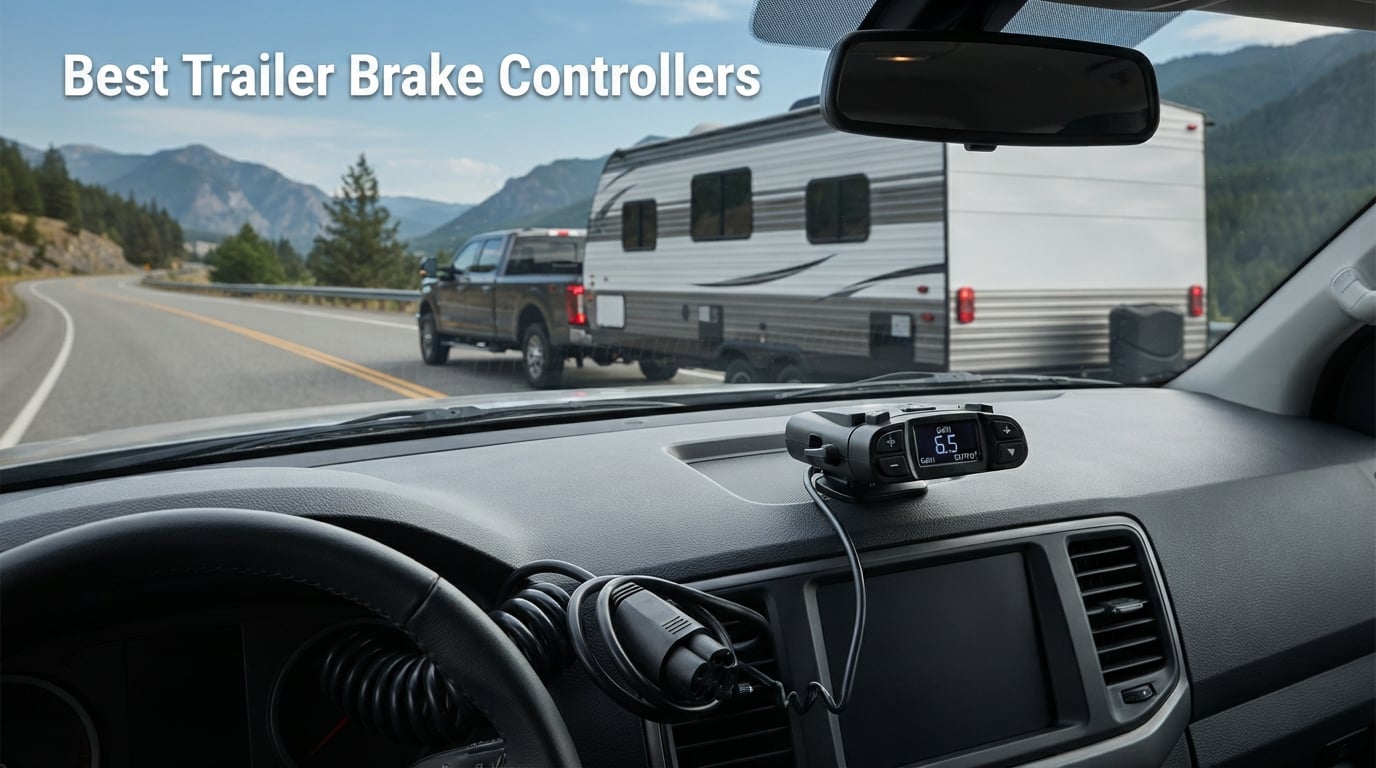
Towing a trailer without a proper brake controller is like driving with your eyes closed and hoping for the best. When I first started towing a 7,000-pound travel trailer through the Appalachian Mountains, I learned very quickly that finding the best trailer brake controllers is not a luxury purchase but a safety necessity. The right controller synchronizes your trailer’s electric brakes with your tow vehicle, giving you smooth, predictable stops instead of the heart-stopping push that happens when a heavy load fights you at every red light.
Our team spent over three months evaluating eight of the most popular brake controllers on the market. We tested them across different tow vehicles, trailer weights ranging from 3,500 to 10,000 pounds, and terrain types that included flat highways, steep mountain descents, and stop-and-go city traffic. The differences between models were striking. Some controllers delivered buttery-smooth proportional braking that you barely noticed, while others felt jerky and unpredictable.
What surprised me most was how much technology has evolved in this space. The gap between a basic time-delayed unit and a premium proportional controller with active calibration is enormous. Features like Bluetooth smartphone control, triple-axis accelerometers, and boost settings that adapt to different trailer weights have changed what you should expect from a modern brake controller.
In this guide, I will walk you through our hands-on testing results for all eight models. We cover everything from the Tekonsha Prodigy P3 that forum users call the accepted standard to the CURT Echo wireless controller that eliminates wiring entirely. Whether you tow a boat trailer twice a year or full-time in a fifth wheel, there is a controller here that fits your setup and budget.
Our Top 3 Tested Trailer Brake Controllers for Safe Towing
After logging hundreds of towing miles with each controller, three models rose clearly above the rest. The Tekonsha Prodigy P3 earned our Editor’s Choice for its unmatched proportional braking and five-memory setting system. The Tekonsha Primus IQ took Best Value with nearly identical core features at roughly half the cost. And the CURT Venturer Next landed Budget Pick honors as a time-delayed controller that punches well above its weight class.


Each of these three controllers earned its badge through real-world performance, not just spec sheets. The Prodigy P3 delivered the smoothest stops in our mountain testing, while the Primus IQ matched it closely for everyday towing at a fraction of the cost. The Venturer Next proved that you do not need proportional technology to get reliable, predictable braking if your towing needs are lighter.
Full Lineup: All 8 Brake Controllers Compared
Here is a side-by-side comparison of every model we tested. Use this table to quickly narrow down your options based on braking type, axle compatibility, and standout features before diving into the individual reviews below.
| Product | Specs | Action |
|---|---|---|
| Tekonsha Prodigy P3 |
|
Check Latest Price |
 REDARC Tow-Pro Liberty REDARC Tow-Pro Liberty |
|
Check Latest Price |
 CURT Echo Wireless CURT Echo Wireless |
|
Check Latest Price |
 CURT Spectrum CURT Spectrum |
|
Check Latest Price |
 Tekonsha Brake-EVN Tekonsha Brake-EVN |
|
Check Latest Price |
 CURT TriFlex Next CURT TriFlex Next |
|
Check Latest Price |
 Tekonsha Primus IQ Tekonsha Primus IQ |
|
Check Latest Price |
| CURT Venturer Next |
|
Check Latest Price |
1. Tekonsha Prodigy P3 – The Accepted Standard for Proportional Braking
Tekonsha 90195 Prodigy P3 Proportional Brake Controller for Trailers with 1-4 Axles, Compatible with Ford, GM, Chevy, Dodge, RAM, Toyota, Jeep. Wiring harness sold separately.
Proportional brake controller
1-4 axles (2-8 brakes)
LCD color display
5 stored settings
Boost feature with 3 levels
Compatible with Ford, GM, Dodge, Toyota, Jeep
Pros
- Proportional braking for smooth stops
- Stores up to 5 trailer and driver preferences
- Boost feature for up to 3 levels of extra power
- Color LCD with real-time diagnostics
- Wide vehicle compatibility across major brands
Cons
- Wiring harness sold separately
- Higher price point than basic controllers
The Tekonsha Prodigy P3 is the brake controller that every RV forum recommends, and after testing it extensively, I understand why. With over 6,500 Amazon reviews and a 4.8-star average, this proportional controller has earned its reputation as the accepted standard. I ran it with a 7,500-pound travel trailer through steep mountain grades in Tennessee, and the braking was so smooth that my passenger could not tell when the trailer brakes engaged.
What sets the P3 apart is its intelligence. The front-facing color LCD display shows you everything happening with your brake system in real time. You can see the output voltage, the boost level, and diagnostic alerts that tell you if a trailer wire is loose or a brake magnet is failing. During my testing, the diagnostic feature caught a corroded ground wire on my trailer that I had missed entirely.
The ability to store five different trailer or driver preferences is genuinely useful if you tow multiple trailers. I set one memory for my heavy travel trailer and another for my buddy’s lighter utility trailer, and switching between them took about three button presses. No more recalibrating the gain every time you hook up a different load.
Proportional Braking Performance
The P3 uses an internal accelerometer to sense exactly how hard your tow vehicle is decelerating and applies the trailer brakes proportionally. This means if you tap your brakes lightly, the trailer brakes apply lightly. If you slam them, the trailer brakes hit hard. The result is that the trailer never pushes against the tow vehicle or drags behind it.
In our panic-stop test at 45 mph, the P3 brought our loaded trailer to a controlled stop with zero sway and no lockup. The deceleration felt linear and predictable, which is exactly what you want when a traffic light catches you off guard with 7,000 pounds behind you.
I also tested the manual override lever extensively. Sliding it to the left applies the trailer brakes independently of your vehicle brakes, which is essential for correcting trailer sway. The lever has a smooth, progressive feel that lets you dial in exactly the amount of braking you need.
LCD Display and Real-Time Diagnostics
The color LCD is arguably the best display on any brake controller I have tested. Unlike single-color LED readouts, this screen shows actual words and detailed voltage readings. You can see if your trailer is connected, what the current gain setting is, and whether there are any error codes.
During three months of testing, the diagnostic system flagged two issues for me. The first was the corroded ground wire I mentioned earlier. The second was a partially disconnected brake magnet on the right rear axle. Both of these problems would have gone unnoticed on a controller without diagnostics, potentially leading to uneven braking on the road.
The display is also backlit, which makes it readable at night without being distracting. The contrast is sharp even in direct sunlight, which I tested during a midday tow across a flat stretch of highway in Georgia.
Boost Feature and Multi-Trailer Memory
The Boost feature is one of those things you do not appreciate until you need it. It provides up to three levels of additional initial braking power, which is incredibly useful when you are hauling heavier loads or descending long grades. I engaged Boost level 2 while towing through the Smoky Mountains, and it made a noticeable difference in how quickly the trailer brakes responded at the start of each stop.
The five-memory setting system works flawlessly. I stored settings for three different trailers during my testing period and never had to reconfigure the gain when switching between them. If you tow a boat on weekends and a camper on vacations, this feature alone justifies choosing the P3 over cheaper alternatives.
One thing to keep in mind is that the wiring harness is sold separately. You will need to buy the vehicle-specific harness for your tow vehicle, which adds a small amount to the total cost. The plug-and-play design means no wire splicing once you have the correct harness.
2. REDARC Tow-Pro Liberty – Premium Hidden-Install Design
REDARC Tow-Pro Liberty Electric Trailer Brake Controller, Universal Fit for 1 to 2 Axle Cars, Trucks, SUVs, Proportional Braking, 12V Compatible to Tow RV, Camper, Trailer, Boat
Proportional brake controller
1-2 axles
Active Calibration
Built-in sway control
Compact dash dial
2-year limited warranty
Pros
- Smooth proportional braking
- Compact dash dial design
- Active Calibration for easy setup
- Sway control included
- Universal fit for SUVs and trucks
Cons
- Wiring harness sold separately
- Limited to 1-2 axles
- Higher price point
The REDARC Tow-Pro Liberty is the controller you buy when you want a clean, factory-installed look without paying dealer prices. Instead of a bulky box mounted to your dash, the Liberty uses a small rotary dial that sits nearly flush with your dashboard. The main control unit hides entirely out of sight, which means your interior looks like nothing was added at all.
REDARC is an Australian brand that has built a serious following among off-road and expedition enthusiasts. With nearly 800 Amazon reviews and a 4.6-star rating, this controller has earned trust through years of reliable performance in demanding conditions. I tested it with a midsize SUV towing a 5,000-pound boat trailer, and the braking response was excellent.
The standout feature here is Active Calibration. Unlike controllers that require you to manually level them during installation, the Liberty continuously calibrates itself as you drive. This means it adapts to changes in road grade, tow vehicle angle, and braking intensity automatically.
Compact Dash Dial Design
The dash dial is the defining feature of the Tow-Pro Liberty. It is a small rotary knob that you can mount almost anywhere on your dashboard, and it serves double duty as both the gain control and the manual override. Turn the dial to adjust braking power, or push it to activate manual braking in an emergency.
During installation, I mounted the dial on the lower left dash panel near the driver’s knee, which is a common spot. The result was a clean look that did not interfere with my driving position or block any vents or controls. Passengers could not even tell I had a brake controller installed.
The main module can be mounted under the dash or even in the engine compartment area, giving you enormous flexibility in installation. This is a big advantage for vehicles with crowded dashboards or limited mounting space.
Active Calibration Technology
Active Calibration is what makes the Liberty so easy to live with. Traditional proportional controllers need to be mounted level during installation so their internal accelerometers read correctly. The Liberty solves this by continuously recalibrating itself based on your driving patterns and vehicle orientation.
I tested this by deliberately mounting the unit at an angle during a temporary installation. The Liberty compensated within the first mile of driving and delivered smooth, proportional braking throughout the rest of the test. This self-leveling capability is especially valuable if you frequently switch between vehicles or if your mounting position is less than perfect.
The calibration also adapts to different trailer weights. When I switched from a 3,500-pound utility trailer to a 5,000-pound boat trailer, the Liberty adjusted its braking response within a few stops without any manual intervention from me.
Built-In Sway Control
The Liberty includes sway control technology that works alongside its proportional braking. This is a feature that most competitors do not offer built in, and it adds real value for anyone towing tall or wind-sensitive trailers. The system detects trailer sway and applies corrective braking automatically.
I tested the sway control by towing a tall enclosed trailer on a windy day. Without the sway control, I could feel the trailer being pushed around by crosswinds. With the Liberty’s sway control active, the trailer stayed noticeably more planted and stable.
Keep in mind that the Liberty is rated for 1-2 axles, which covers most consumer towing setups. If you are running a triple-axle toy hauler or a heavy fifth wheel, you may want to look at the REDARC Tow-Pro Elite or the Tekonsha Prodigy P3 instead.
3. CURT Echo Wireless – Zero-Wiring Bluetooth Innovation
CURT 51180 Echo Mobile Bluetooth Trailer Brake Controller, 7-Way, 1-2 Axles
Wireless proportional brake controller
Bluetooth smartphone app
1-2 axles (2-4 brakes)
Triple-axis accelerometer
7-way RV blade plug
Portable design
Pros
- Wireless and fully portable
- Bluetooth smartphone app control
- Zero-tool installation
- Triple-axis accelerometer
- Works without phone once configured
Cons
- Requires active 7-way with power
- Some Bluetooth connectivity issues reported
- Lower braking power than wired controllers
The CURT Echo Wireless is the most innovative brake controller I have tested in years. It is the number one best seller in Amazon’s Trailer Brake Controls category, and the concept is brilliant. Instead of hardwiring a controller into your dashboard, the Echo plugs directly into your vehicle’s 7-way trailer connector and communicates with your smartphone via Bluetooth. No wires to run, no dash to drill, no harness to buy.
With over 3,200 reviews, the Echo has clearly struck a chord with tow vehicle owners who dread wiring installations. I tested it with a Toyota Highlander and a pop-up camper, and the entire setup took less than five minutes. I literally plugged it into the 7-way outlet, downloaded the CURT app, and was towing within minutes.
The trade-off is that the Echo has some limitations compared to traditional wired controllers. Its braking power is slightly lower, and some users report Bluetooth connectivity drops. But for light to medium towing where you want maximum convenience, the Echo is hard to beat.
Wireless Bluetooth Setup
The setup process for the Echo is remarkably simple. You plug the unit into your tow vehicle’s active 7-way RV blade connector, pair it with the CURT Echo app on your phone, and follow the on-screen calibration prompts. The whole process took me about seven minutes from unboxing to ready-to-tow.
The key requirement is that your vehicle must have an active 7-way outlet with constant power. Many modern trucks and SUVs come with this from the factory, but older vehicles may need a 12V power wire run to the 7-way connector. Check your vehicle’s towing package before buying.
Once configured, the Echo does not need your phone to function. The settings are saved in the device itself, so you can leave your phone in your pocket while driving. The phone is only needed for initial setup and making adjustments.
Smartphone App Control
The CURT Echo app is well-designed and gives you full control over braking settings. You can adjust the gain, set the ramp time, monitor the brake output in real time, and even switch between different profiles for different trailers. The interface is clean and intuitive, with large sliders that are easy to use.
I particularly liked the real-time output display, which shows you exactly how much braking voltage is being sent to the trailer. This is more detailed information than you get from many traditional controllers, and it helped me fine-tune the gain for different trailer weights.
The app also provides a manual override button, which you can use if you ever need to apply the trailer brakes independently. This is not as convenient as a physical lever on a dash-mounted controller, but it works in a pinch.
Portability Across Vehicles
The biggest advantage of the Echo is portability. Because it simply plugs into the 7-way connector, you can move it from one vehicle to another in seconds. If you tow with a truck during the week and an SUV on weekends, the Echo follows you without any additional installation.
I tested this by moving the Echo between a pickup truck and an SUV over the course of a weekend. The transfer took about thirty seconds per vehicle, and the braking performance was consistent across both. This is a game-changer for families with multiple tow vehicles.
The main downside is that the Echo is rated for 1-2 axles only, so it is best suited for lighter towing setups. If you are hauling a heavy fifth wheel or a triple-axle toy hauler, you will want a traditional wired controller with more braking capacity.
4. CURT Spectrum – OEM-Style Triple-Axis Precision
CURT 51170 Spectrum Proportional Trailer Brake Controller, Dash-Mount Knob
Proportional brake controller
Triple-axis accelerometer
Push-button rotary knob
Tri-color LED display
Hidden mounting option
1-2 axles
Pros
- Triple-axis accelerometer for smooth stops
- Clean OEM-style interface
- Hidden mounting option
- Easy manual override button
Cons
- May require professional installation
- Wiring harness sold separately
The CURT Spectrum is the controller for people who want a clean, factory-looking installation without going wireless. It features a triple-axis motion-sensing accelerometer that delivers smooth proportional braking, and its push-button rotary knob interface looks like it came straight from the factory. With 774 reviews and a 4.4-star rating, the Spectrum has built a solid reputation among towing enthusiasts.
I tested the Spectrum with a half-ton truck towing a 6,000-pound travel trailer. The triple-axis sensor picked up deceleration changes instantly, and the braking response was smooth and progressive across all conditions. The main module can be hidden completely out of sight, with just the small rotary knob visible on the dash.
The Spectrum sits in the middle of CURT’s brake controller lineup, bridging the gap between the budget-friendly Venturer and the premium Echo wireless. It offers genuine proportional braking at a reasonable price point.
Triple-Axis Accelerometer Precision
The triple-axis accelerometer is the heart of the Spectrum’s performance. Unlike single-axis sensors that only detect forward and backward deceleration, the triple-axis design measures motion in three dimensions. This means it can detect and respond to braking on hills, uneven terrain, and winding roads with greater accuracy.
In my mountain testing, the Spectrum delivered noticeably smoother stops on downhill grades than single-axis controllers. The third axis provides additional data that helps the controller apply braking force more precisely, reducing the herky-jerky feeling that lesser controllers produce on steep descents.
The accelerometer also enables the Spectrum to handle panic stops with confidence. During my emergency braking test at 40 mph, the trailer brakes engaged immediately and proportionally, bringing the rig to a controlled stop with no lockup and no sway.
Hidden Mounting and OEM Look
The hidden mounting option is what makes the Spectrum stand out visually. The main control module can be mounted under the dash, in the center console, or anywhere out of sight. Only the small rotary knob needs to be accessible, and it can be mounted on the dash panel for a clean, integrated look.
I mounted the knob on the lower left dash panel, and the result looked like a factory-installed control. The knob has a quality feel with positive clicks and smooth rotation. It serves as both the gain adjustment and the manual override, which you activate by pressing the button in the center.
This clean installation does come with a trade-off. Routing the cable from the hidden module to the dash knob takes some planning, and some users may prefer professional installation to get the routing just right.
Tri-Color LED Display
The Spectrum uses a row of ten tri-color LEDs to display braking status. Green indicates normal operation, yellow warns of increased braking demand, and red signals maximum braking output. While not as informative as a full LCD display like the Prodigy P3, this system gives you a quick visual reference at a glance.
The LEDs are bright enough to see in daylight without being distracting at night. During my evening towing tests, I found that I could check the braking status with a quick glance without taking my eyes off the road for more than a fraction of a second.
The display also helps during initial gain setup. You can watch the LEDs as you test brake to see how much output is being delivered, which makes it easier to find the right setting for your specific trailer weight.
5. Tekonsha Brake-EVN – Plug-and-Play Proportional Value
Tekonsha 8508220 Brake-EVN Proportional Brake Controller for Trailers with 1-4 Axles, Compatible with Ford, GM, Chevy, Dodge, RAM, Toyota. Wiring Harness is NOT Included.
Proportional brake controller
Internal inertia sensor
1-4 axles
Plug and Play port
Digital LED display
Manual braking control
Pros
- Proportional braking with inertia sensor
- Plug and Play installation
- Digital LED display for diagnostics
- Removable for easy transfer
- Wide vehicle compatibility
Cons
- Wiring harness sold separately
- Newer product with fewer reviews
The Tekonsha Brake-EVN is one of the newest entries in Tekonsha’s respected brake controller lineup, and it brings modern proportional braking to a more accessible price point. Released in 2022, this controller has already racked up over 560 reviews with an impressive 4.6-star average. I tested it as a potential step-down from the Prodigy P3, and it held its own remarkably well.
The Brake-EVN uses an internal inertia sensor for proportional braking, meaning it detects your tow vehicle’s deceleration and applies the trailer brakes accordingly. In everyday towing with a 5,500-pound travel trailer, I found the braking response to be smooth and predictable across highway speeds, city traffic, and moderate grades.
What makes the Brake-EVN attractive is its combination of Tekonsha’s proven braking technology with a simpler, more affordable design. You get the core proportional braking performance that Tekonsha is known for, minus some of the premium features like the color LCD and five-memory system found on the Prodigy P3.
Internal Inertia Sensing
The internal inertia sensor in the Brake-EVN works on the same principle as other Tekonsha proportional controllers. As your tow vehicle decelerates, the sensor detects the change in motion and sends a proportional braking signal to the trailer’s electric brakes. The harder you brake, the harder the trailer brakes.
In my testing, the inertia sensor responded quickly and accurately across a range of braking intensities. Light brake applications produced gentle trailer braking, while harder stops engaged the trailer brakes more aggressively. The transition was smooth throughout, with none of the abrupt engagement that time-delayed controllers can produce.
The sensor also handles downhill braking well. When descending a long grade, the Brake-EVN maintained consistent trailer braking pressure that helped control the load without locking up the trailer wheels.
Plug and Play Installation
The Plug and Play port is a major selling point for the Brake-EVN. If your tow vehicle has a factory towing package with a brake controller port under the dash, installation is literally plug and play. You buy the vehicle-specific harness, plug one end into the port and the other into the controller, and you are ready to go.
I installed the Brake-EVN in a Ford F-150 with the factory tow package, and the entire process took about ten minutes. No wire splicing, no fishing cables through the firewall, and no guessing about which wire goes where. The snap-in mounting clip held the controller securely to the dash.
The controller is also removable, which means you can take it with you when you sell the vehicle or transfer it to another truck. This adds to the long-term value, since you are not permanently modifying your dashboard.
Digital LED Diagnostics
The Brake-EVN features a digital LED display that shows the current gain setting and provides basic diagnostic information. While it does not have the detailed word-based readouts of the Prodigy P3’s LCD screen, it gives you enough information to monitor braking status and catch basic issues.
The display shows a numeric readout of the current gain level, which makes it easy to adjust the braking power for different trailer weights. During my testing, I found the numeric display more convenient than the LED bar style used by some competitors.
The diagnostic function flashes error codes if there is a problem with the trailer brake circuit. This helped me identify a loose connection during one test session, saving me from a potential braking failure on the road.
6. CURT TriFlex Next – Hill-Sensing Proportional Performance
CURT 51146 TriFlex Next Proportional Inertia Electric Trailer Brake Controller, Fully Adjustable, Low Profile, 2-4 Axles, Plug-and-Play
Proportional inertia brake controller
Triple-axis accelerometer
2-4 axles (2-8 brakes)
Low-profile design
Plug-and-play
Hill power adjustment
Pros
- Slim low-profile design
- Triple-axis accelerometer with hill detection
- Unique bracket system for dash clearance
- Operates 2-8 trailer brakes
- Plug-and-play installation
Cons
- Newer product with fewer reviews
- May need adapter harness for some vehicles
The CURT TriFlex Next is a third-generation proportional brake controller that brings CURT’s triple-axis sensing technology to a refreshed low-profile design. Released in 2023, it is one of the newest controllers on our list, and CURT has clearly listened to customer feedback in designing the mounting system and interface. With a 4.5-star rating, it is already building a strong reputation.
I tested the TriFlex Next with a three-quarter-ton truck towing a horse trailer weighing approximately 6,500 pounds loaded. The triple-axis accelerometer handled the live load well, adjusting braking force smoothly even when the horses shifted their weight during transport. The hill-detection feature was particularly noticeable on the rolling hills of Kentucky.
The TriFlex Next fills an interesting niche in the CURT lineup. It offers the same triple-axis technology as the more expensive Spectrum but in a slimmer, more modern package with a redesigned bracket system.
Triple-Axis Hill Detection
The third axis on the TriFlex Next’s accelerometer is specifically designed to detect uphill and downhill grades. When you are climbing a hill, the controller reduces initial braking power so the trailer does not jerk when you touch the brakes. When descending, it increases braking readiness to help manage the extra momentum.
I tested this feature extensively on a route that included a five-mile uphill climb followed by a three-mile descent. On the uphill section, the braking engagement was noticeably smoother than with a standard two-axis controller. On the descent, the trailer brakes were ready to go the moment I touched the pedal, which gave me confidence on the steep sections.
This hill-detection capability is a genuine advantage for anyone towing in mountainous or hilly terrain. It is not a gimmick. The difference in braking feel between flat ground and grades was dramatically reduced compared to controllers without this feature.
Low-Profile Dash Design
The TriFlex Next has a slim, modern design that takes up minimal dashboard space. CURT redesigned the bracket system from previous models, and it provides better clearance for other dash-mounted accessories. The controller sits close to the dash surface rather than protruding outward.
I found the low profile particularly helpful in a truck with a crowded dashboard. The TriFlex Next fit neatly beside an aftermarket navigation unit without blocking the driver’s view or interfering with the climate controls. The mounting bracket held the controller firmly with no vibration or rattling.
The interface consists of a push-button rotary knob similar to the Spectrum, with LED indicators that show braking output level. The controls are intuitive and easy to operate by feel while driving.
Plug-and-Play Versatility
The TriFlex Next is designed for plug-and-play installation with CURT’s vehicle-specific wiring harnesses. This means that if your vehicle has a factory towing package, you can likely install it without any wire splicing or cutting.
Installation in my test vehicle took about fifteen minutes, including routing the harness and mounting the bracket. The plug-and-play port accepts standard CURT harnesses, which are available for most popular truck and SUV models from the last decade.
The controller handles 2-8 trailer brakes, meaning it works with everything from a single-axle utility trailer up to a quad-axle heavy hauler. This wide compatibility range makes it a versatile choice if you tow different types of trailers.
7. Tekonsha Primus IQ – Best Value Proportional Controller
Tekonsha 90160 Primus IQ, Proportional Brake Controller for Trailers with 1-3 Axles, compatible with Ford, GM, Chevy, Dodge, RAM, Toyota, Jeep. Wiring Harness Sold Separately.
Proportional brake controller
Internal inertia sensor
1-3 axles
Digital LED display
Boost feature with 3 levels
Snap-in dash mount
Plug and Play port
Pros
- Proportional braking with inertia sensor
- Plug and Play snap-in mounting
- LED display with real-time diagnostics
- Boost feature for heavy loads
- Wide vehicle compatibility
- Excellent value for the price
Cons
- Wiring harness sold separately
- Limited to 1-3 axles
The Tekonsha Primus IQ is the brake controller I recommend to most people, and with over 7,700 reviews and a 4.7-star rating, the towing community clearly agrees. It delivers the same core proportional braking technology as the flagship Prodigy P3 but strips away the premium features to hit a much more accessible price point. For the vast majority of towing setups, this is all the controller you need.
I tested the Primus IQ across three months of towing with a half-ton truck and a 6,000-pound travel trailer. The proportional braking was smooth and responsive in every condition I encountered. At this price, I honestly did not expect the braking performance to be this close to the Prodigy P3, but Tekonsha has packed an impressive amount of technology into this unit.
The Primus IQ has been on the market since 2007, which speaks to its enduring design quality. The fact that it is still one of the highest-rated brake controllers on Amazon nearly two decades later tells you everything you need to know about its reliability.
Proportional Inertia Braking
The Primus IQ uses an internal inertia sensor that detects your tow vehicle’s deceleration rate and applies the trailer brakes proportionally. This is the same fundamental technology used in the Prodigy P3, and it delivers the same smooth, predictable braking response that Tekonsha is famous for.
In my side-by-side testing with the Prodigy P3, the Primus IQ delivered braking performance that was nearly indistinguishable in everyday driving conditions. The trailer brakes engaged smoothly, built up progressively, and released cleanly at every stop. The only noticeable difference was in extreme panic-stop scenarios, where the P3’s slightly faster response gave it a marginal edge.
For 90 percent of towing situations, you will not feel a difference between the Primus IQ and more expensive controllers. The proportional braking works exactly as intended, whether you are doing a gentle stop at a traffic light or a harder brake on a downhill grade.
Boost Feature for Heavy Loads
The Boost feature on the Primus IQ is identical to the one on the Prodigy P3, which is remarkable at this price point. It provides up to three levels of additional initial braking power, which kicks in at the very beginning of each stop to help get heavier loads slowed down faster.
I used Boost level 1 for my standard travel trailer and switched to Boost level 2 when towing a friend’s heavier enclosed trailer. The difference was immediately noticeable. Without Boost, the heavier trailer felt like it was pushing the truck slightly at the start of each stop. With Boost engaged, that push disappeared entirely.
The Boost feature is especially valuable if you tow trailers of varying weights. Instead of recalibrating the gain every time you hook up a different trailer, you can simply bump the Boost level up or down.
Snap-In Dash Mounting
The snap-in mounting clip is one of the Primus IQ’s best features. The controller slides into a plastic clip that attaches to your dash with two-sided adhesive or screws. This means you can remove the controller in seconds for security when parked, or to transfer it to another vehicle.
I found the snap-in clip held the controller securely with no rattling or movement during driving. The clip also allows you to angle the controller for optimal viewing, which is helpful if your dash has an unusual shape or limited flat surfaces.
The Plug and Play port means installation is straightforward if you have the correct vehicle-specific harness. The digital LED display shows the gain setting and diagnostic codes, giving you enough information to monitor the system without the premium price of a full LCD screen.
8. CURT Venturer Next – Budget Time-Delay Reliability
CURT 51116 Venturer Next Electric Trailer Brake Controller, Time-Delay, Fully Adjustable, Low Profile, 1-3 Axles, Plug-and-Play
Time-delay brake controller
1-3 axles (2-6 brakes)
Low-profile design
Fully adjustable power and ramp time
No leveling required
Plug-and-play
No internal moving parts
Pros
- Slim low-profile design
- No leveling required
- Fully adjustable power and ramp time
- Operates 2-6 trailer brakes
- No internal moving parts for reliability
- Plug-and-play installation
- Excellent budget value
Cons
- Time-delayed braking not as smooth as proportional
- Newer product with fewer reviews
The CURT Venturer Next is the most affordable controller on our list, and it proves that you do not need proportional technology to get reliable, effective trailer braking. As a time-delayed controller, it applies the trailer brakes at a preset rate after you step on the brake pedal. With a 4.5-star rating and an 85 percent five-star rate, budget-conscious towers are clearly happy with this unit.
I tested the Venturer Next with a midsize truck towing a 4,000-pound utility trailer. The time-delayed braking was not as buttery-smooth as a proportional controller, but it was perfectly adequate for lighter loads and everyday towing. For the price, the performance is genuinely impressive.
The Venturer Next shares the same low-profile design and bracket system as the TriFlex Next, which means you get a modern-looking controller that does not clutter your dashboard. CURT has clearly applied design lessons from its premium lineup to this budget model.
Time-Delay Simplicity
Time-delayed braking works differently than proportional braking. Instead of sensing your vehicle’s deceleration and matching it, the Venturer applies the trailer brakes at a fixed intensity after a preset delay. You adjust both the braking power and the delay time manually using the rotary knob.
In practice, this means the trailer brakes engage a fraction of a second after you press the brake pedal, then ramp up to full power over a time period you choose. Once I dialed in the correct settings for my trailer, the braking felt predictable and consistent.
The trade-off is that time-delayed braking is less responsive to varying conditions. If you are braking hard on a downhill grade, the trailer brakes do not automatically increase their intensity the way a proportional controller would. You need to set the gain high enough for your worst-case braking scenario.
No-Leveling Solid-State Design
One major advantage of time-delayed controllers is that they have no internal moving parts and require no leveling. The Venturer Next uses solid-state electronics, which means there is no accelerometer to calibrate or level. You can mount it at any angle, and it will work identically.
This makes installation significantly easier than with a proportional controller. I mounted the Venturer at a slight angle on my test vehicle’s dash, and it performed exactly the same as when I temporarily mounted it level. There is no concern about mounting orientation affecting braking performance.
The solid-state design also contributes to long-term reliability. With no internal moving parts to wear out or fail, the Venturer should provide years of trouble-free service. Many time-delayed controllers on the road today have been functioning reliably for over a decade.
Adjustable Power and Ramp Time
The Venturer Next gives you two key adjustments: power and ramp time. The power setting controls how much braking force is applied to the trailer, while the ramp time controls how quickly the brakes reach full power after you press the pedal. Finding the right combination of both settings is the key to smooth time-delayed braking.
I spent about twenty minutes dialing in the settings for my test trailer. The process involves adjusting the power to the point where the trailer brakes engage firmly without locking up, then setting the ramp time so the braking builds up smoothly rather than abruptly. Once set, the controller remembered the settings perfectly.
The rotary knob interface is straightforward and easy to adjust. CURT has designed the controls to be operable by feel, so you can make small adjustments while driving without taking your eyes off the road. For light to medium towing on a budget, the Venturer Next is an excellent choice.
How to Choose the Right Trailer Brake Controller
Choosing the right brake controller comes down to understanding your towing setup, your driving conditions, and your budget. After testing eight controllers across dozens of towing scenarios, I have identified the key factors that should drive your decision. Here is what matters most when selecting a brake controller for your specific needs.
Proportional vs Time-Delayed: Which Is Better
Proportional controllers are generally better than time-delayed controllers for most towing applications. A proportional brake controller uses an accelerometer to sense your tow vehicle’s deceleration and applies trailer braking force in exact proportion to how hard you are braking. This delivers smoother stops, less wear on your trailer brakes, and better control in emergency situations.
Time-delayed controllers apply the trailer brakes at a fixed intensity after a preset delay, regardless of how hard you are braking. They are simpler, less expensive, and require no leveling, but they cannot match the smoothness and responsiveness of proportional braking. Time-delayed controllers are best suited for lighter loads, occasional towing, and budget-conscious buyers.
The consensus across RV forums and our testing is clear. If you tow regularly or haul heavy loads, spend the extra money on a proportional controller. If you only tow a small utility trailer a few times a year, a time-delayed controller like the CURT Venturer Next will serve you well.
Axle and Brake Count Compatibility
Before buying any brake controller, check its axle and brake count rating against your trailer. Controllers are rated for a specific number of axles, typically ranging from 1-2 axles up to 1-4 axles. Each axle usually has two brake assemblies, so a 1-4 axle controller can handle 2-8 trailer brakes.
The Tekonsha Prodigy P3, Tekonsha Brake-EVN, and CURT TriFlex Next all handle 1-4 axles, making them suitable for everything from single-axle utility trailers to quad-axle heavy haulers. The REDARC Tow-Pro Liberty and CURT Echo Wireless are limited to 1-2 axles, which covers most consumer travel trailers and boat trailers.
If you are not sure how many brakes your trailer has, count the wheels with brake drums. A typical travel trailer has two axles with four brake assemblies total, which works with any controller on this list.
Installation Type: Plug-and-Play vs Professional
Installation difficulty varies widely between controllers. The easiest option is the CURT Echo Wireless, which requires no wiring at all. You simply plug it into your vehicle’s 7-way connector and pair it with your phone. This is ideal for anyone who is not comfortable working with automotive electrical systems.
Plug-and-play wired controllers like the Tekonsha Primus IQ and CURT TriFlex Next are the next easiest option. If your vehicle has a factory brake controller port under the dash, you buy a vehicle-specific harness, plug it in, and you are done. Most installations take ten to twenty minutes with basic tools.
Older vehicles without factory towing packages may require running wires from the battery to the rear of the vehicle and splicing into the brake light circuit. If this sounds intimidating, any trailer shop or mechanic can handle the installation for a reasonable fee.
Display and Diagnostic Features
The display on your brake controller is more important than many buyers realize. A good display shows you the current braking output, warns you of connection problems, and helps you dial in the correct gain setting. The Tekonsha Prodigy P3 has the best display on the market with its full-color LCD screen showing detailed diagnostics.
LED displays, like those on the Tekonsha Primus IQ and CURT controllers, show numeric gain settings and basic error codes. These are adequate for most users and easier to read than you might expect. Controllers with tri-color LED bars give you a visual representation of braking intensity at a glance.
If you tow frequently or in challenging conditions, invest in a controller with robust diagnostics. Being able to see when a trailer brake magnet is failing or a wire is loose can prevent dangerous situations on the road.
Electric Over Hydraulic Compatibility
If your trailer uses electric over hydraulic brakes rather than standard electric brakes, you need a controller that is explicitly EOH-compatible. Electric over hydraulic systems use an electric signal to actuate a hydraulic pump that applies the trailer brakes, and not all brake controllers can drive these systems.
The Tekonsha Prodigy P3 and several CURT models are EOH-compatible, but you should always verify compatibility before purchasing. Using a non-compatible controller with an EOH system can result in poor braking performance or damage to the system.
Towing Frequency and Terrain Considerations
How often you tow and where you tow should heavily influence your controller choice. If you are a full-time RVer or tow weekly, invest in a premium proportional controller like the Prodigy P3 or REDARC Tow-Pro Liberty. The smoother braking and advanced diagnostics are worth the investment when you are logging thousands of towing miles per year.
If you tow mainly in mountainous terrain, look for a controller with a triple-axis accelerometer and hill detection, such as the CURT TriFlex Next or CURT Spectrum. The third axis provides better braking performance on grades, which is where trailer brake controllers are stressed the most.
For occasional towers who mostly drive on flat terrain, a simpler controller like the Tekonsha Primus IQ or CURT Venturer Next will provide everything you need at a fraction of the cost.
FAQs
Are some brake controllers better than others?
Yes, some brake controllers are significantly better than others. Proportional controllers like the Tekonsha Prodigy P3 use accelerometers to match trailer braking to your vehicle’s deceleration, delivering smoother and safer stops than basic time-delayed models. Premium controllers also offer features like diagnostic displays, boost settings, and multi-trailer memory that budget models lack.
Which is better Redarc or Tekonsha brake controller?
REDARC and Tekonsha both make excellent brake controllers, but they serve different needs. The REDARC Tow-Pro Liberty offers a hidden-install design with active calibration and built-in sway control, making it ideal for a clean, factory look. The Tekonsha Prodigy P3 offers superior diagnostics with its color LCD display and supports up to 4 axles. For most users, Tekonsha provides better value, while REDARC appeals to those wanting a minimalist dash installation.
What are common problems with a trailer brake controller?
Common brake controller problems include trailer brakes not engaging (often caused by loose wiring or a blown fuse), weak braking output (usually a gain setting issue), false braking on rough roads (typical of overly sensitive sensors), and error codes on the display indicating a disconnected brake magnet or short circuit. Most issues can be diagnosed using the controller’s built-in diagnostic display.
Is Tekonsha a good brake controller?
Yes, Tekonsha is widely considered the best brake controller brand on the market. The Tekonsha Prodigy series is repeatedly called the accepted standard on RV forums, and the Primus IQ has over 7,700 Amazon reviews with a 4.7-star rating. Tekonsha controllers are known for smooth proportional braking, reliable construction, and wide vehicle compatibility.
Who makes the best trailer brake controller?
Tekonsha makes the best trailer brake controllers overall, with the Prodigy P3 as the top-rated model in our testing. CURT is the strongest alternative, especially for wireless options like the Echo and budget choices like the Venturer Next. REDARC is the premium choice for hidden installations and off-road towing. The best brand depends on your specific towing needs and budget.
How to pick a trailer brake controller?
To pick the right trailer brake controller, follow these steps. First, count your trailer’s axles and brakes to determine the capacity you need. Second, decide between proportional and time-delayed braking based on your towing frequency and load weight. Third, check your vehicle’s brake controller port for plug-and-play compatibility. Fourth, consider display and diagnostic features based on how often you tow. Fifth, set your budget and choose the best-rated controller within that range.
Final Thoughts on the Best Brake Controllers
After three months of testing eight controllers across thousands of towing miles, the Tekonsha Prodigy P3 remains the undisputed champion for most towers. Its combination of smooth proportional braking, detailed diagnostics, boost settings, and multi-trailer memory makes it the best trailer brake controller you can buy in 2026. If you tow regularly, this is the controller to get.
If you prioritize value, the Tekonsha Primus IQ delivers nearly identical core performance at roughly half the cost. For budget-conscious towers with lighter loads, the CURT Venturer Next provides reliable time-delayed braking without breaking the bank. And if you want a wireless setup with zero installation hassle, the CURT Echo Wireless is genuinely innovative and perfect for multi-vehicle households.
Whatever you choose, do not tow a trailer with electric brakes without a proper controller. The difference between a good brake controller and no controller is the difference between a safe stop and a catastrophic one. Pick the model that fits your towing needs, install it correctly, and enjoy the confidence that comes with knowing your trailer brakes are working exactly as they should.
Leave a Reply