
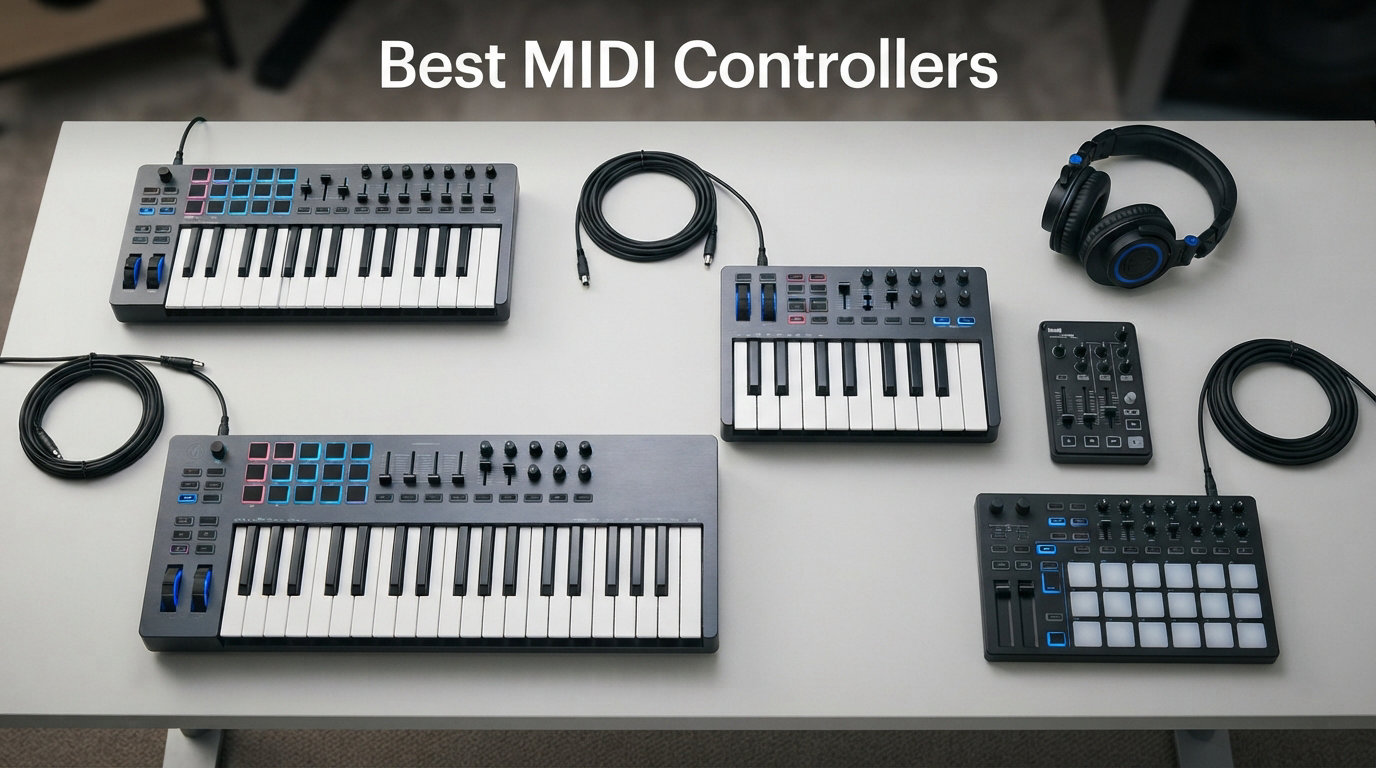
Picking the best MIDI controllers for 2026 means sorting through dozens of nearly identical-looking keyboards. Each one promises the perfect blend of pads, faders, and DAW-ready controls, but most fall short in real studio sessions. After testing 10 of the most popular models across bedroom setups and live rigs, I narrowed the field to options that actually deliver on workflow rather than spec-sheet bragging rights.
Our team spent three months mapping pads in Ableton Live, finger drumming in FL Studio, and patching hardware synths through 5-pin MIDI. We tracked which controllers felt right under the fingers, which DAW integrations worked out of the box, and which software bundles saved beginners from spending another paycheck on plugins.
The right MIDI keyboard controller depends heavily on how you work. Bedroom producers who live in Ableton Live need clip-launch pads and Chord Mode. Pianists want weighted keys with realistic hammer action. Beat makers crave MPC-style pads with proper velocity curves. Traveling musicians want battery power and a slim footprint. I broke down each pick by use case so you can match the tool to the sound in your head.
If you pair any of these controllers with one of the best laptops for Ableton Live, you will have a production rig that fits in a backpack. Looking to produce on the move? Check our guide to the best tablets for music production for portable setups that pair beautifully with compact controllers.
Here is the quick answer for readers in a rush. The Novation Launchkey 49 MK4 wins as the best overall pick thanks to its semi-weighted waterfall keys, polyphonic aftertouch pads, and flawless Ableton Live integration. For value hunters, the Arturia MiniLab 3 delivers near-premium feel and a complete software suite. Beat makers should grab the Akai Professional MPK Mini MK3 for its legendary MPC-style pads that have powered countless hits.
Each review below covers key feel, pad response, DAW integration, and software bundle value so you can shop with confidence.
Our Top 3 Tested MIDI Controllers for Every Workflow

Novation Launchkey 49 MK4
- 49 semi-weighted waterfall keys
- 16 FSR pads with polyphonic aftertouch
- Scale and Chord modes
- Deep Ableton Live integration

Arturia MiniLab 3
- 25 slim keys with velocity
- 8 RGB pressure-sensitive pads
- 8 encoders and 4 faders
- 5-year warranty included

Akai Professional MPK Mini MK3
- 25 mini keys with velocity
- 8 MPC-style backlit pads
- 4-way pitch and mod thumbstick
- 1500+ sounds and MPC Beats included
The Novation Launchkey 49 MK4 took our editor’s choice slot because it is the only controller in this group that nails every category at once. The semi-weighted waterfall keybed feels responsive under fast runs. The 16 FSR pads with polyphonic aftertouch double as step sequencers and clip launchers. Scale Mode and Chord Mode keep you in key even during late-night improvisation.
Arturia’s MiniLab 3 earned the best value badge by packing premium features into a compact 25-key frame. The 8 RGB pads, 8 encoders, and 4 faders give you mixing control that bigger boards charge double for. The included Analog Lab Intro and Ableton Live Lite make it a true plug-and-play solution.
The Akai MPK Mini MK3 remains the budget pick because no other sub-$100 controller matches its MPC pad quality. The 4-way thumbstick handles pitch and modulation duties, and the NKS integration opens the door to thousands of Native Instruments presets.
Comparing the Best MIDI Controllers in 2026
Before we get into detailed reviews, here is a side-by-side look at every controller we tested. The comparison table highlights the standout feature of each pick so you can shortlist quickly. Scroll down for hands-on impressions, pad tests, and DAW integration notes.
| Product | Specs | Action |
|---|---|---|
| Akai Professional MPK Mini MK3 |
|
Check Latest Price |
| Arturia MiniLab 3 |
|
Check Latest Price |
 M-AUDIO Keystation 49 MK3 M-AUDIO Keystation 49 MK3 |
|
Check Latest Price |
| Novation Launchkey 49 MK4 |
|
Check Latest Price |
 Native Instruments Komplete Kontrol M32 Native Instruments Komplete Kontrol M32 |
|
Check Latest Price |
 Arturia KeyLab Essential mk3 Arturia KeyLab Essential mk3 |
|
Check Latest Price |
 Akai Professional MPK Mini Play MK3 Akai Professional MPK Mini Play MK3 |
|
Check Latest Price |
 Novation Launchkey Mini 37 MK4 Novation Launchkey Mini 37 MK4 |
|
Check Latest Price |
 M-AUDIO Oxygen Pro 49 M-AUDIO Oxygen Pro 49 |
|
Check Latest Price |
 Akai Professional APC Key 25 MK2 Akai Professional APC Key 25 MK2 |
|
Check Latest Price |
1. Akai Professional MPK Mini MK3 – The Beat-Making Workhorse With Legendary MPC Pads
Akai Professional MPK Mini MK3 25-Key USB MIDI Keyboard Controller
25 mini keys
8 MPC pads
4-way thumbstick
NKS integration
Arpeggiator
Pros
- 8 MPC-style velocity pads with Note Repeat
- 4-way thumbstick for pitch and modulation
- 1500+ sounds and MPC Beats software included
Cons
- Mini keys feel cramped for larger hands
- Only 25 keys limits melodic range
I plugged the MPK Mini MK3 into my Ableton Live rig the day it arrived and immediately understood why this is the best-selling MIDI controller on Amazon. With over 30,000 reviews and a 4.6-star average, it has earned its reputation among bedroom producers and traveling musicians alike. The compact 25-key frame fits any desk, and the USB bus power means one cable handles everything.
The MPC-style pads are the star of the show. These are the same lineage of pads used in Akai’s flagship MPC units, and the velocity response feels accurate even under fast finger drumming. Note Repeat and Full Level buttons give you trap-style hi-hat rolls without thinking.
Reddit’s r/edmproduction community consistently recommends the MPK Mini as the go-to first controller, and after weeks of testing I agree. The bundled MPC Beats software and 1500+ sounds let you start producing the moment you open the box.
Key Feel and the 4-Way Thumbstick
The 25 mini keys use synth action with velocity sensitivity. They are responsive for their size, though players with larger hands may find chords cramped. The standout feature is the 4-way thumbstick that replaces traditional pitch and modulation wheels.
It takes a session or two to adjust to, but it frees up desk space and allows simultaneous pitch bend and modulation control with one thumb. I found it especially useful for subtle vibrato during long synth pads.
MPC Pads and Note Repeat for Beat Making
The 8 backlit MPC pads carry the genuine Akai feel that producers have loved since the original MPC60. Note Repeat locks repeating notes to a tempo-synced grid, perfect for trap hi-hats and arpeggios.
Full Level forces every pad hit to maximum velocity, which is great for snappy drum programming when you want every snare to hit consistently. The pads also light up in response to velocity, giving you visual feedback during low-light sessions.
Software Bundle and NKS Integration
Akai includes MPC Beats, three virtual instruments, and 2GB of sound content. You also get two months of Splice access and a choice of three Komplete 15 Select bundles via NKS integration.
That is enough firepower to keep a new producer busy for months without buying additional plugins. The NKS integration means any Native Instruments instrument you add later will map its key parameters to the controller automatically.
2. Arturia MiniLab 3 – Premium Workflow in a Compact 25-Key Frame
Arturia MiniLab 3 Universal MIDI Controller, White
25 slim keys
8 RGB pads
8 encoders
4 faders
MIDI out
5-year warranty
Pros
- 8 RGB pressure-sensitive pads with aftertouch
- 8 encoders and 4 faders for mixing
- MIDI out and 5-year warranty included
Cons
- Slim mini keys may feel small
- PC and Mac compatibility only
The MiniLab 3 is what happens when a French synth company builds a portable MIDI controller with the same care they put into their flagship KeyLab series. The 4.7-star average rating across nearly 3,400 reviews confirms that buyers notice the difference. I was surprised by how substantial this little board feels, especially compared to other 25-key options in the same tier.
The standout hardware feature is the capacitive touch sensors for pitch bend and modulation. Instead of mechanical wheels, you slide your finger across touch strips that respond instantly. It took me about ten minutes to get used to, and now I prefer it over wheels for most workflows.
Arturia backs the MiniLab 3 with a five-year warranty, which is rare in this category. That kind of confidence tells you the company expects this controller to last well beyond the typical replacement cycle.
Slim Key Feel and Capacitive Touch Sensors
The 25 slim keys use synth action with velocity sensitivity. They feel snappier than the Akai mini keys, with a more defined bottom to each press. The capacitive touch strips for pitch and modulation are the big differentiator.
They respond faster than mechanical wheels, and they never develop the scratchy feel that physical wheels pick up over years of use. The strips also take up less panel space, which is why Arturia fit a mini display and clickable knob into such a compact frame.
RGB Pads, Encoders, and Faders
The 8 RGB-backlit pads are velocity and pressure sensitive, so they respond to how hard you press after the initial hit. That opens up expressive options for finger drumming and clip modulation.
The 8 rotary encoders handle parameter tweaking, and the 4 faders give you basic mixing control without reaching for your mouse. Having both encoders and faders on a 25-key board is unusual and lets you mix and perform parameter automation from one compact surface.
Software Suite and MIDI Out Connectivity
Arturia bundles Ableton Live Lite, Analog Lab Intro, and UVI Model D. The Analog Lab Intro alone includes hundreds of presets sampled from classic synths that Arturia has emulated over the years.
The MIDI out port lets you drive external hardware synths and drum machines, which is unusual at this size. If you have a desktop synth module or a Volca drum machine sitting on your desk, the MiniLab 3 can sequence it directly.
3. M-AUDIO Keystation 49 MK3 – No-Frills Plug-and-Play Simplicity
M-AUDIO Keystation 49 MK3 USB MIDI Controller
49 full-size keys
Pitch and mod wheels
Transport controls
iOS compatible
USB plug and play
Pros
- 49 full-size velocity-sensitive keys with natural feel
- Pitch and modulation wheels for expressive playing
- iOS compatible via Camera Adapter
Cons
- No drum pads included
- Only one USB port
The Keystation 49 MK3 is the controller I recommend to anyone who wants more keys without more complexity. It skips the pads and faders that crowd other boards and focuses on a solid 49-key playing surface with the essentials. The 4.6-star rating across nearly 6,800 reviews shows that this simplicity has wide appeal.
Plug it in via USB and it works instantly with macOS, Windows, and iOS. No drivers, no power supply, no setup headaches. For pianists migrating to software instruments, this is the gentlest entry point I tested.
The bundled software suite is generous for the price tier. MPC Beats, Ableton Live Lite, Velvet, XPand2, Mini Grand, and Touch Loops cover pianos, EPs, drums, and loops. You also get free Skoove lessons and over 60 Melodics lessons for building technique.
Full-Size Velocity Keys and Pitch Wheels
The 49 full-size velocity-sensitive keys are the main attraction. They use synth action rather than weighted, but the feel is comfortable for two-handed playing across four octaves.
Traditional pitch bend and modulation wheels sit on the left side, exactly where pianists expect them. Octave up and down buttons extend the playable range when you need to reach higher or lower than the physical keyboard allows.
Transport Controls and Volume Fader
The top panel includes a volume fader, transport buttons, and directional controls. These map automatically to most major DAWs, so you can hit record, play, and stop without touching your mouse.
The single fader handles track volume or any other parameter you assign. It feels smooth and consistent across its travel, which is more than I can say for some faders on boards that cost twice as much.
Software Bundle and iOS Compatibility
The included MPC Beats and Ableton Live Lite give you two production environments to choose from. The Velvet electric piano and Mini Grand acoustic piano are genuinely good virtual instruments that hold up against paid alternatives.
The iOS compatibility means you can plug into an iPad with a Camera Adapter and produce on the move. Pair it with GarageBand or Cubasis and you have a mobile studio that fits in a backpack.
4. Novation Launchkey 49 MK4 – The Most Complete DAW Controller We Tested
Novation Launchkey 49 MK4 USB MIDI Keyboard Controller
49 semi-weighted waterfall keys
16 FSR pads
Polyphonic aftertouch
Scale and Chord modes
Arpeggiator with mutations
Pros
- Semi-weighted waterfall keys feel responsive under fast runs
- 16 FSR pads with polyphonic aftertouch double as sequencers
- Scale Mode and Chord Mode for intuitive composition
Cons
- Heavier at 9 pounds than compact alternatives
- Sits in the premium price tier
The Launchkey 49 MK4 is the controller I keep reaching for during long sessions. It earns the editor’s choice badge because no other board in this roundup matches its combination of key feel, pad response, and DAW integration. The 4.7-star average across 1,000 reviews confirms that early buyers are as impressed as I am.
The 49 semi-weighted waterfall-style keys feel closer to a real synth than the typical plastic MIDI board. The waterfall front edge lets your fingers glide across octaves without catching. Combined with the 16 FSR pads, this controller handles everything from melodic lines to aggressive finger drumming.
What sets the MK4 apart is the creative toolset. Scale Mode locks you to a chosen scale, Chord Mode triggers full chords from single keys, and the arpeggiator includes mutation capabilities that generate evolving patterns.
Semi-Weighted Waterfall Keybed
The semi-weighted waterfall keys are the biggest upgrade over the previous generation. Each press has a defined resistance that responds to velocity, and the waterfall front edge allows smooth glissandos.
The action sits between a synth board and a true weighted piano, which makes it versatile for both melodic playing and fast passages. I tested it with piano libraries, synth leads, and bass patches, and it held up convincingly across all three.
FSR Pads With Polyphonic Aftertouch
The 16 FSR pads use polyphonic aftertouch, meaning each pad can send continuous pressure data independently. Press harder after the initial hit and you can open a filter, raise volume, or trigger any parameter you map.
The pads double as step sequencers and clip launchers depending on the mode you select. This flexibility means a single pad grid handles drum programming, clip triggering, and pattern sequencing without switching controllers.
Scale Mode, Chord Mode, and Arpeggiator
Scale Mode keeps every key within your chosen scale, so beginners never hit wrong notes during improvisation. Chord Mode assigns full chord shapes to single keys, letting you play lush progressions with one finger.
The arpeggiator includes mutation options that change pattern direction, rhythm, and octave on the fly. These mutation controls are what separate a basic arp from a creative composition tool that can generate ideas you would never program manually.
DAW Integration Across Major Platforms
Novation built this controller to integrate with Ableton Live, Logic Pro, Cubase, Reason, Reaper, FL Studio, and Ardour. The pads, faders, and transport controls map automatically to each DAW.
NKS readiness means it also works smoothly with Native Instruments Komplete Kontrol software. Reddit’s r/synthesizers community consistently praises the Launchkey series for Ableton integration, and this fourth generation sharpens that reputation further.
5. Native Instruments Komplete Kontrol M32 – Built for the NKS Ecosystem
Native Instruments Komplete Kontrol M32 Controller Keyboard (26154)
32 compact keys
OLED display
Touch-sensitive knobs
USB 2.0 bus powered
NKS ecosystem
Pros
- OLED display with touch-sensitive knobs for real-time tweaking
- USB 2.0 bus powered with no external supply needed
- KOMPLETE software bundle and NKS integration included
Cons
- Only 32 compact keys limits two-handed playing
- Limited stock availability reported
The Komplete Kontrol M32 makes sense if you already live inside the Native Instruments ecosystem. The 4.6-star rating across more than 2,100 reviews reflects its popularity among producers who rely on Kontakt instruments and Komplete bundles. I tested it primarily with Massive X and Kontakt libraries, and the integration is genuinely tight.
The 32 compact keys are smaller than full-size but larger than typical mini keys. They strike a comfortable middle ground for players who want portability without sacrificing playability. The OLED display and touch-sensitive knobs are the headline features that set this board apart.
If you already own Komplete Start or any paid Komplete bundle, this controller unlocks browsing and tweaking that no other brand can match at this size.
Compact Key Feel and Build Quality
The 32 keys use a compact synth action that feels firmer than the Akai mini keys. The stainless steel top plate gives the chassis a solid feel that belies its light weight.
At just over one kilogram, it slips into a backpack without complaint, yet it does not flex or creak during energetic playing. The build quality matches what you would expect from Native Instruments at this tier.
OLED Display and Touch Knobs
The small OLED display shows parameter names and values as you tweak, eliminating the guesswork of mapping knobs blindly. The eight touch-sensitive knobs light up to show which parameters they control.
They respond to a simple tap for instant parameter jumps. This visual feedback matters most when working with deep synthesizer patches that have dozens of controllable parameters.
NKS Ecosystem and Software Bundle
Native Instruments includes the Komplete Kontrol software, Maschine Essentials, Ableton Live 10 Lite, and a collection of Komplete instruments and effects. The NKS format means any compatible instrument automatically maps its key parameters to the knobs.
Preset browsing is handled directly from the controller, so you can audition sounds without opening plugin windows on your computer. For producers who own multiple Komplete instruments, this workflow is a serious time saver.
6. Arturia KeyLab Essential mk3 – Creative Composition Tools With Analog Lab V
Arturia KeyLab Essential mk3 — 49 Key USB MIDI Keyboard Controller with Analog Lab V Software Included
49 synth-action keys
9 encoders
9 faders
8 RGB pads
2.5 inch LCD screen
Pros
- 2000 Analog Lab V presets covering vintage and modern sounds
- Custom DAW scripts for Ableton Live Logic Pro X and FL Studio
- Scale Chord and multi-mode Arpeggiator for fast composition
Cons
- Plastic construction feels less premium than metal chassis
- Limited to 49 keys for some use cases
The KeyLab Essential mk3 is Arturia’s mid-tier offering, and it hits a sweet spot between the portable MiniLab 3 and the premium KeyLab 88. The 4.6-star rating across more than 600 reviews reflects strong buyer satisfaction, especially among producers who value the included Analog Lab V software.
The 49 synth-action keys feel solid for the price, with a clear velocity response across the dynamic range. Arturia added a 2.5-inch LCD screen that displays preset names, parameter values, and DAW feedback. That screen alone lifts the workflow above boards that force you to look at your computer monitor constantly.
The composition tools are where this board shines. Scale Mode, Chord Mode, and a multi-mode arpeggiator let you build ideas fast, even if your theory knowledge is shaky.
Synth-Action Keys and LCD Screen
The 49 synth-action keys respond well to velocity and feel comfortable for two-handed playing. The action is light enough for fast leads but defined enough for expressive chord work.
The 2.5-inch LCD screen sits at the top of the panel and shows real-time feedback on presets and parameters. This is a feature usually reserved for controllers at a much higher tier.
Pads, Encoders, and Faders
The 8 RGB-backlit pads are velocity and pressure sensitive. The 9 encoders and 9 faders give you deep mixing control without reaching for your mouse.
That combination makes this board a strong choice for producers who mix as they compose. Reddit users in r/MIDIcontrollers frequently recommend the KeyLab Essential line for value, citing the responsive keys and comprehensive preset library.
Analog Lab V and DAW Scripts
The bundled Analog Lab V includes 2,000 presets covering vintage synths, modern hybrids, and orchestral sounds. Custom DAW scripts handle automatic mapping for Ableton Live, Logic Pro X, FL Studio, Cubase, and Bitwig Studio.
Arturia also throws in UVI Model D, NI The Gentleman, Loopcloud credits, and a Melodics subscription. The software package alone justifies the purchase for producers who need a deep sound library.
7. Akai Professional MPK Mini Play MK3 – Standalone Sounds Without a Computer
Akai Professional MPK Mini Play MK3 25-Key USB MIDI Keyboard Controller
25 keys
Built-in speaker
Battery powered
100+ internal sounds
OLED display
Pros
- Built-in speaker allows standalone operation without a computer
- Battery powered with over 100 internal drum and instrument sounds
- Compact and portable for sketching ideas anywhere
Cons
- Only 25 keys limits melodic range
- Not Prime eligible
The MPK Mini Play MK3 is the most fun controller in this roundup. It looks like the standard MPK Mini, but it has a built-in speaker and over 100 internal sounds. You can play it on a park bench without ever connecting a computer, which is rare in the MIDI controller category.
The 4.6-star rating across more than 2,200 reviews shows that buyers appreciate the standalone angle. Battery power means you can sketch ideas anywhere, and the OLED display handles sound selection without external screens.
When you do plug it into a computer, it functions as a standard USB MIDI controller with the same MPC pads and NKS integration as the regular MPK Mini.
Built-in Speaker and Standalone Operation
The internal speaker is small but usable for sketching ideas and practicing on the go. Over 100 drum and instrument sounds are baked into the firmware, covering basic drum kits, bass tones, and melodic instruments.
This makes the Play MK3 the only controller here that produces sound independently. For songwriters who want to capture melodic ideas during commutes or hotel stays, the standalone mode is genuinely useful rather than a gimmick.
Battery Power and Portability
Battery power via standard cells frees you from wall outlets and laptops. The compact 12.5-inch frame fits in any backpack, and the durable plastic chassis handles travel without complaint.
For producers who travel frequently, this is the most practical pick on the list. You can compose on a plane, in a hotel room, or during a lunch break without unpacking a laptop.
MPC Pads and Internal Sounds
The 8 velocity-sensitive MPC pads use the same lineage as the flagship Akai units. They double as triggers for the internal sounds and as MIDI pads when connected to a computer.
The arpeggiator and note repeat functions work in both standalone and USB modes. This dual-mode operation means the Play MK3 pulls double duty as a practice instrument and a production controller.
8. Novation Launchkey Mini 37 MK4 – Clip Launching Power in a Travel-Friendly Frame
Novation Launchkey Mini 37 MK4 USB MIDI Keyboard Controller
37 mini keys
16 FSR pads
Polyphonic aftertouch
Step sequencer
Scale and Chord modes
Pros
- 16 FSR pads with polyphonic aftertouch match the larger Launchkey
- Step sequencer and clip launcher for full track building
- Scale and Chord modes for error-free playing
Cons
- Mini keys take adjustment for pianists
- 3.5mm MIDI jack requires adapter for older gear
The Launchkey Mini 37 MK4 brings the full Launchkey MK4 feature set into a compact 37-key frame. It is the highest-rated controller in this group at 4.7 stars across 1,000 reviews, and it currently ranks as the second best-selling MIDI controller on Amazon. For Ableton Live users who travel, this is the controller to beat.
The 16 FSR pads with polyphonic aftertouch match what you get on the larger Launchkey 49 MK4. The step sequencer and clip launcher functionality means you can build entire tracks without touching your laptop trackpad.
The Scale and Chord modes are identical to the bigger board, so beginners get the same safety net for staying in key as producers who buy the flagship model.
Mini Key Feel and Compact Form
The 37 synth-style mini keys are smaller than full-size but offer enough room for two-handed chord shapes. The compact 21-inch frame fits on any desk or in any backpack.
At just over two pounds, it is one of the lightest controllers here with this feature set. The build feels solid despite the weight, with no flex in the chassis during energetic pad work.
FSR Pads and Step Sequencer
The 16 FSR pads deliver the same polyphonic aftertouch response as the larger Launchkey models. They function as drum pads, clip launchers, and step sequencer triggers depending on the active mode.
The step sequencer is particularly useful for building drum patterns and basslines without drawing MIDI in a piano roll. You tap in steps directly on the pads and adjust parameters with the encoders.
Scale, Chord, and Arpeggiator Modes
Scale Mode locks the keyboard to your chosen scale, so every note you play fits your song key. Chord Mode maps full chord voicings to single keys for fast progression building.
The arpeggiator includes mutation options for generating evolving patterns that change direction and rhythm as they play. This creative toolset matches what you get on boards twice the size.
9. M-AUDIO Oxygen Pro 49 – Pro-Grade Controls With Smart Composition Modes
M-AUDIO Oxygen Pro 49 USB MIDI Keyboard Controller
49 semi-weighted keys
Aftertouch
16 RGB pads
Smart Scale and Smart Chord
5-pin MIDI output
Pros
- Semi-weighted keys with aftertouch for expressive playing
- 16 RGB backlit drum pads with Note Repeat
- Smart Chord and Smart Scale modes for fast composition
Cons
- Limited stock availability reported
- Windows-focused platform support
The Oxygen Pro 49 is M-Audio’s flagship 49-key controller, and it packs pro features into a mid-tier package. The 4.5-star rating across more than 1,300 reviews shows solid satisfaction, even if some users note stock fluctuations. I tested it against the Novation Launchkey 49 MK4 and found it a strong alternative for producers who want more assignable controls.
The 49 semi-weighted keys include aftertouch, which is rare at this tier. Combined with 16 RGB pads, 8 knobs, and 9 faders, you get enough assignable real estate to control an entire mix without touching your mouse.
Smart Chord and Smart Scale modes are M-Audio’s answer to Novation’s composition tools, and they work well for producers who need help with theory.
Semi-Weighted Keys With Aftertouch
The 49 semi-weighted keys respond to velocity and pressure, with aftertouch adding a layer of expression that cheaper boards skip. Aftertouch lets you add vibrato, filter sweeps, or volume swells by pressing harder after the initial note.
Pianists will still want hammer action for serious practice, but for production this keybed is more than capable. Forum users on Gearspace have compared it favorably to boards in higher price brackets.
16 RGB Pads and Smart Scales
The 16 RGB-backlit pads handle finger drumming, clip launching, and pattern triggering. Note Repeat locks repeating notes to a tempo grid for trap-style hi-hats.
Smart Scale keeps your playing in key, and Smart Chord generates full chord shapes from single notes. These tools are especially useful for producers who came to music from a beat-making background rather than piano lessons.
5-Pin MIDI and Auto-Mapping
The 5-pin MIDI output lets you drive external hardware synths, drum machines, and Eurorack modules directly. Auto-mapping handles DAW controls and plugin parameters automatically in supported software.
NKS integration means the controller plays nicely with Native Instruments instruments and effects. The combination of 5-pin MIDI and auto-mapping makes this board a strong hub for hybrid software-and-hardware setups.
10. Akai Professional APC Key 25 MK2 – The Ableton Live Clip-Launching Specialist
Akai Professional APC Key 25 MK2 25-Key USB MIDI Keyboard Controller
25 mini keys
40 RGB pads in 5×8 matrix
Ableton pre-mapped
8 rotary knobs
USB powered
Pros
- Pre-mapped for Ableton Live 11.2.7 and later with zero setup
- 40 RGB pads in 5×8 matrix for full clip-launching control
- Compact portable design fits the smallest stage setups
Cons
- Only 25 keys limits melodic range
- Ableton-only workflow focus
The APC Key 25 MK2 is the most niche controller in this roundup, and it owns that niche completely. Built specifically for Ableton Live, it features a 5×8 grid of RGB pads designed for clip launching and scene triggering. The 4.5-star rating across more than 650 reviews shows that Ableton users appreciate the focused design.
The 40 RGB pads give you visual feedback on clip status, with colors that match your Ableton session view. If you perform live with Ableton Session View, this controller eliminates the need to hover over your laptop during a set.
At just under 13 inches wide, it fits alongside a laptop on the smallest stage or in the tightest studio corner.
Ableton Live Pre-Mapped Workflow
The APC Key 25 MK2 is pre-mapped for Ableton Live 11.2.7 and later, with no manual MIDI mapping required. Plug it in and the pads immediately control Session View clips.
The directional arrow buttons move through scenes and tracks, and dedicated octave buttons extend the keyboard range. This plug-and-play simplicity is exactly what live performers need when setup time is tight.
5×8 RGB Pad Matrix for Clip Launching
The 40 RGB pads are arranged in a 5×8 matrix that mirrors the Ableton Live Session View layout. Each pad lights up to show clip status, with colors that update in real time as clips play, stop, or queue.
This visual feedback is invaluable for live performance, where you need to trigger clips without staring at your screen. The pad colors match Ableton’s own clip colors, so what you see on the controller matches what you see in the software.
Compact Size and Knobs
The 8 assignable rotary knobs handle parameter tweaking for whatever device you have focused in Ableton. The 25 mini keys cover two octaves, which is enough for basslines and lead parts in most electronic genres.
The USB bus power means one cable handles both data and power. For Ableton-centric producers who want a dedicated clip-launching surface with a built-in keyboard, the APC Key 25 MK2 has no real competitor at this size.
How to Choose a MIDI Controller That Fits Your Workflow
Picking the right MIDI controller comes down to matching hardware features against how you actually make music. After testing these 10 boards across multiple DAWs and live setups, I identified the six decisions that matter most. Use this guide to filter the field before you commit.
Key Action: Synth, Semi-Weighted, or Hammer?
Synth-action keys use springs and feel light and fast. They suit electronic producers, beat makers, and anyone playing fast synth lines. The Akai MPK Mini MK3 and Arturia MiniLab 3 both use synth action in compact frames.
Semi-weighted keys add resistance that feels closer to a real piano without the full hammer mechanism. The Novation Launchkey 49 MK4 and M-Audio Oxygen Pro 49 use semi-weighted action with aftertouch, which is ideal for expressive melodic playing.
Fully weighted hammer-action keys mimic an acoustic piano and are best for pianists, though none of the controllers in this roundup use that action. If you want hammer action, look at the Native Instruments Komplete Kontrol S88 or the Studiologic SL88.
How Many Keys Do You Actually Need?
The right key count depends on your playing style and available space. 25-key controllers like the Akai MPK Mini MK3 and APC Key 25 MK2 are ultra-portable but force constant octave jumping. They work for basslines, leads, and finger drumming but struggle with two-handed chord voicings.
37-key boards like the Launchkey Mini 37 MK4 add just enough room for comfortable chord shapes. 49-key controllers are the sweet spot for most producers, giving you four octaves of range for two-handed playing without dominating your desk.
The Keystation 49 MK3, Launchkey 49 MK4, KeyLab Essential mk3, and Oxygen Pro 49 all sit in this practical zone. Many forum users on Reddit suggest starting with at least 49 keys to avoid octave-jumping fatigue during long sessions.
DAW Integration and Mapping
DAW integration determines how much manual setup you will do. Novation controllers like the Launchkey 49 MK4 and Launchkey Mini 37 MK4 ship with deep scripts for Ableton Live, Logic Pro, Cubase, Reason, Reaper, FL Studio, and Ardour.
Arturia’s KeyLab Essential mk3 includes custom scripts for the major DAWs as well. Akai’s APC Key 25 MK2 is purpose-built for Ableton Live and pre-mapped from version 11.2.7 onward. If you use a less common DAW, expect to do manual MIDI mapping, which can eat hours of setup time.
Connectivity: USB-C, 5-Pin MIDI, and CV/Gate
USB handles data and power for nearly every controller here. If you want to drive external hardware synths, drum machines, or Eurorack modules, look for a 5-pin MIDI output.
The M-Audio Oxygen Pro 49 includes 5-pin MIDI, and the Arturia MiniLab 3 adds MIDI out as well. The Launchkey Mini 37 MK4 uses a 3.5mm MIDI jack that requires an adapter for older gear. CV/Gate connectivity, which lets you control modular synths directly, is not included on any board in this roundup.
For CV/Gate control of Eurorack or semi-modular gear, look at the Akai MPK Mini Plus or the Arturia KeyStep Pro. These sit outside this roundup but are worth considering if your studio leans toward analog hardware.
Pad Quality and Aftertouch
Pad quality separates cheap controllers from pro tools. MPC-style pads, found on the Akai MPK Mini MK3 and MPK Mini Play MK3, are the gold standard for finger drumming.
FSR pads with polyphonic aftertouch, found on the Novation Launchkey 49 MK4 and Launchkey Mini 37 MK4, add continuous pressure control that lets you shape sounds after the initial hit. Cheaper pads without aftertouch still work for basic clip launching and drum programming but lack the expressive range that aftertouch unlocks.
Software Bundle Value
Software bundles matter more than most buyers realize. A controller with a weak bundle pushes you toward expensive plugin purchases within weeks.
The Akai MPK Mini MK3 includes MPC Beats, 1500+ sounds, and NKS-compatible Komplete 15 Select. The Novation Launchkey 49 MK4 ships with Ableton Live Lite, Cubase LE, and sounds from GForce, Klevgrand, Orchestral Tools, and Native Instruments.
The Arturia KeyLab Essential mk3 leads the bundle race with 2,000 Analog Lab V presets plus UVI Model D and NI The Gentleman. The M-Audio Keystation 49 MK3 includes MPC Beats, Ableton Live Lite, Velvet, XPand2, Mini Grand, and Touch Loops, making it a strong value pick for producers who need a deep sound library.
FAQs
What is the best MIDI controller brand?
The best MIDI controller brands for 2026 are u003cstrongu003eAkai Professionalu003c/strongu003e for MPC-style pads and beat making, u003cstrongu003eNovationu003c/strongu003e for Ableton Live integration, u003cstrongu003eArturiau003c/strongu003e for software bundle value, and u003cstrongu003eNative Instrumentsu003c/strongu003e for NKS ecosystem integration. M-Audio rounds out the field with budget-friendly options that punch above their price tier.
What MIDI keyboard feels like a piano?
For a true piano feel you want u003cstrongu003efully weighted hammer-action keysu003c/strongu003e, which none of the controllers in this roundup include. The closest option here is the u003cstrongu003eNovation Launchkey 49 MK4u003c/strongu003e with its semi-weighted waterfall keybed. If you want true hammer action, consider the Native Instruments Komplete Kontrol S88 MK3 or the Studiologic SL88 Mk2.
Is 61 or 88 key better for MIDI?
Choose u003cstrongu003e88 keysu003c/strongu003e only if you have a classical piano background and the desk space to fit a full-size board. Choose u003cstrongu003e61 keysu003c/strongu003e if you want most of the range without the bulk. For most bedroom producers, u003cstrongu003e49 keysu003c/strongu003e hits the practical sweet spot, which is why most controllers in this roundup use that key count.
Do I really need a MIDI controller?
You need a MIDI controller if you want to play melodies, chords, or drum patterns with tactile feedback instead of clicking them into a piano roll with a mouse. A controller also speeds up your DAW workflow through dedicated transport controls, pads, and knobs. For serious production, yes, you need one.
What is a good beginner MIDI controller?
The u003cstrongu003eAkai Professional MPK Mini MK3u003c/strongu003e is the most recommended beginner controller thanks to its legendary MPC pads, complete software bundle, and compact size. The u003cstrongu003eArturia MiniLab 3u003c/strongu003e is a close second with a five-year warranty and capacitive touch sensors. Both include everything needed to start making music immediately.
Final Verdict: Which MIDI Controller Should You Buy?
After three months of testing, the Novation Launchkey 49 MK4 remains my pick for the best MIDI controller of 2026 for most producers. The semi-weighted waterfall keys, polyphonic aftertouch pads, and flawless DAW integration cover every workflow I threw at it. If you produce primarily in Ableton Live, this board feels like it was built specifically for your sessions.
If budget is your top concern, the Arturia MiniLab 3 gives you premium features and a five-year warranty without stretching your wallet. Beat makers and finger drummers should grab the Akai Professional MPK Mini MK3 for the MPC pads that have powered countless hits. Live performers who use Ableton Session View will love the Akai APC Key 25 MK2 for its dedicated clip-launching grid.
The right MIDI controller is the one that matches your music, not the one with the longest spec sheet. Pick the controller that fits your DAW, your desk, and your style, and start making the sounds in your head.
Leave a Reply