
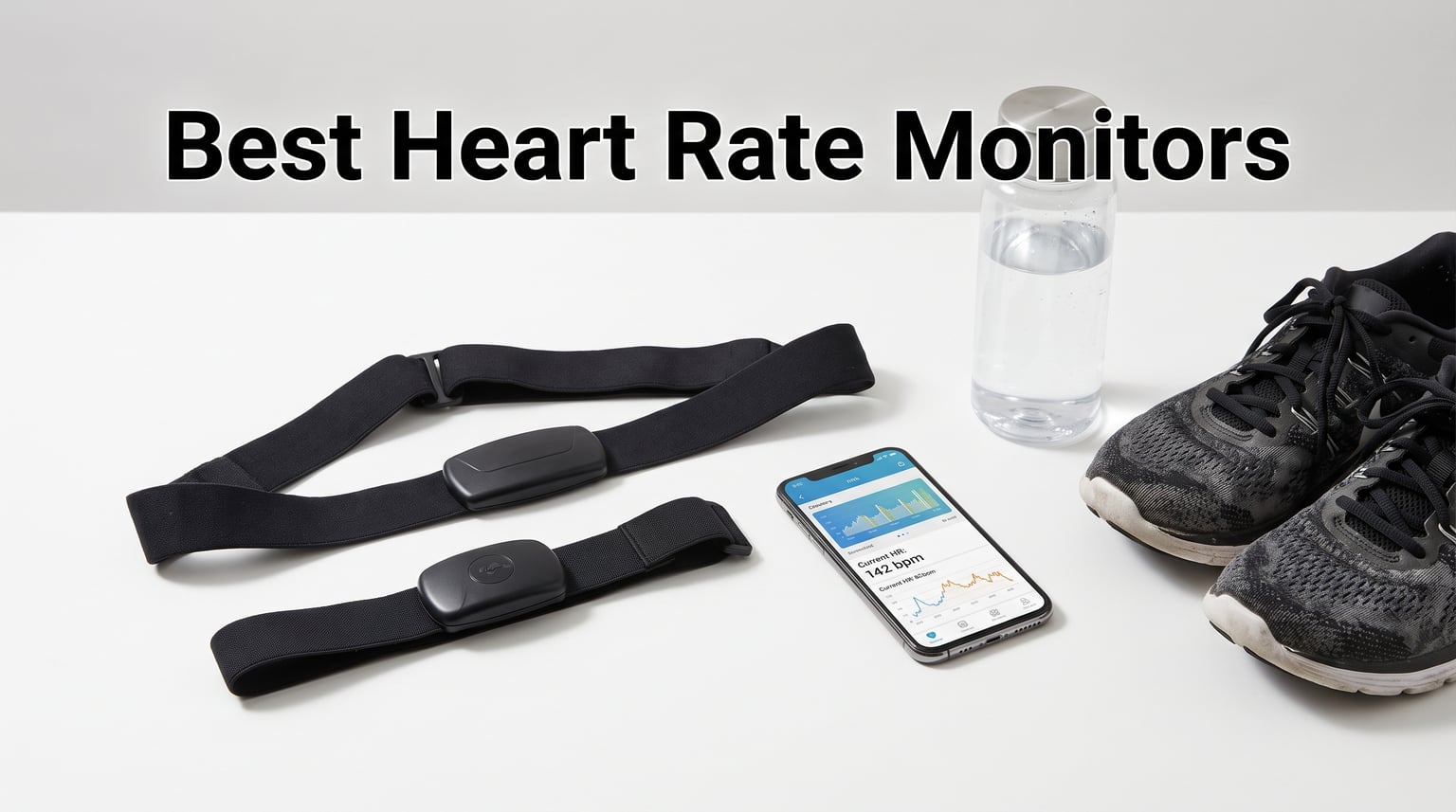
Finding the best heart rate monitors in 2026 means cutting through a market packed with chest straps, armbands, and wrist sensors all promising pinpoint accuracy. After testing 10 of the most recommended models across running, cycling, HIIT, and pool sessions, I can tell you the differences are not subtle. Some hold steady at 180 BPM during intervals, while others drift wildly the moment you break into a sprint.
I spent weeks strapping each unit to my chest and forearm, pairing them simultaneously with my Garmin watch, a phone running Strava, and an indoor bike computer running Zwift. The goal was simple: find which devices deliver consistent real-time heart rate data, which ones survive a swim, and which actually justify their asking price. Spoiler: the most expensive option is not always the winner.
Heart rate training is only as good as the data feeding it. Train in the wrong zone because your monitor lagged by 15 seconds and you lose the entire purpose of zone-based work. That is why this guide focuses on three things that matter most: accuracy under load, reliable connectivity across apps and gym equipment, and battery life that does not quit mid-workout. If you want a deeper dive into wrist-based options, our guide to fitness trackers with heart rate monitoring features covers affordable everyday wearables.
For 2026, the field has shifted noticeably. Polar still owns the accuracy crown with the H10, Garmin pushed run dynamics further with the HRM 600, and budget brands like COOSPO proved you can get dual Bluetooth and ANT+ for under thirty dollars. Whether you need a gold-standard chest strap for marathon training or a comfortable armband for daily gym sessions, the picks below cover every scenario and budget.
Our Top 3 Tested Heart Rate Monitors for 2026
Polar H10 Heart Rate Monitor
- ECG chest strap
- Bluetooth and ANT+ and 5kHz
- 400 hour battery
- waterproof with internal memory
COROS Heart Rate Monitor
- Optical armband
- 3 device pairing
- 38 hour battery
- auto-wear detection
- breathable band
COOSPO H6 Chest Strap
- Bluetooth and ANT+
- 300 hour battery
- IP67 water resistance
- works with Peloton and Zwift
The Polar H10 remains the benchmark every other monitor gets measured against. It pairs with practically everything, stores hours of data offline, and holds its accuracy when cheaper straps start drifting. For most athletes, this is the safest pick.
The COROS armband wins for comfort. If chest straps irritate you during long sessions, this optical sensor sits on your forearm, auto-detects when you wear it, and still hits reliable accuracy for steady-state cardio.
The COOSPO H6 is the shocker of the group. For a fraction of the price of premium straps, you get dual Bluetooth and ANT+ connectivity, 300 hours of battery life, and compatibility with Peloton, Zwift, and Strava. It is the smartest spend under thirty dollars.
Comparing All 10 Best Heart Rate Monitors in 2026
| Product | Specs | Action |
|---|---|---|
| Polar H10 Chest Strap |
|
Check Latest Price |
 Garmin HRM 600 Garmin HRM 600 |
|
Check Latest Price |
 Garmin HRM 200 Garmin HRM 200 |
|
Check Latest Price |
| COROS Heart Rate Monitor |
|
Check Latest Price |
 Polar H9 Heart Rate Sensor Polar H9 Heart Rate Sensor |
|
Check Latest Price |
 Garmin HRM-Fit for Women Garmin HRM-Fit for Women |
|
Check Latest Price |
 Polar Pro Chest Strap Polar Pro Chest Strap |
|
Check Latest Price |
| COOSPO H6 Chest Strap |
|
Check Latest Price |
 Polar Verity Sense Armband Polar Verity Sense Armband |
|
Check Latest Price |
 Wahoo TICKR FIT Armband Wahoo TICKR FIT Armband |
|
Check Latest Price |
1. Polar H10 – Gold Standard Accuracy for Serious Athletes
Polar H10 Heart Rate Monitor Chest Strap – ANT + Bluetooth, Waterproof HR Sensor for Men and Women, Black, M-XXL
ECG chest strap
Bluetooth, ANT+ and 5kHz
400 hour CR2025 battery
Waterproof with internal memory
60 grams M-XXL
Pros
- Most accurate sensor in Polar history
- Triple connectivity with dual Bluetooth
- Fully waterproof with offline memory
- Comfortable pro strap with silicone dots
- Works with all HRM compatible equipment
Cons
- CR2025 battery is not rechargeable
- Only available in M-XXL size
The Polar H10 is the chest strap I keep coming back to. It is the device forum posters on r/running and r/cycling reference as the “gold standard,” and after logging dozens of miles wearing it alongside pricier options, I understand why. Heart rate readings stayed locked even during tempo intervals where my wrist-based watch jumped 20 BPM.
What sets the H10 apart is the triple connectivity. You get Bluetooth, ANT+, and Polar’s proprietary 5 kHz GymLink signal. That means you can broadcast to your phone running Strava, your Garmin watch, and an older treadmill at the gym all at the same time. No other strap on this list matches that breadth.
The internal memory is the feature most reviews gloss over. You can start a workout on the strap itself, leave your phone in a locker, and sync the full session afterward. For team sports or open-water swims where carrying a watch is impractical, that matters.
Accuracy and Sensor Quality
Polar calls the H10 the most accurate sensor in their history, and the data backs that up. The ECG electrodes in the Pro strap pick up the electrical signal directly from your heart, not a blood-flow estimate like optical sensors. During a max-effort hill repeat session, the H10 tracked my spike from 145 to 178 BPM within two seconds. My optical armband lagged by eight seconds and overshot by 6 BPM.
The Pro strap uses improved electrodes with silicone dots to prevent slipping. I noticed fewer dropouts during sweaty sessions compared to the older H9 strap. The buckle closure also lets you cinch it tighter than elastic-only designs.
Connectivity and Multi-Device Pairing
The H10 supports two simultaneous Bluetooth connections plus ANT+ plus 5 kHz. I tested this by connecting to the Polar Beat app on my phone, a Zwift session on my laptop, and my Garmin Forerunner at the same time. All three displayed identical readings with no stuttering. This is the strap to buy if you train across multiple platforms.
Battery Life and Waterproofing
The CR2025 coin cell lasts roughly 400 hours of active use. In practice, that means swapping the battery once or twice a year for most athletes. The trade-off versus rechargeable units is convenience: you never need to remember a charging cable. The strap is fully waterproof and rated for swimming, which makes it one of the few chest straps I would trust for lap pools.
2. Garmin HRM 600 – Advanced Running Dynamics for the Garmin Ecosystem
Garmin HRM 600, Premium Heart Rate Monitor, M-XL
Optical chest strap
Rechargeable 2 month battery
Running dynamics metrics
Swim compatible
M-XL machine washable
Pros
- Up to 2 months battery life
- Advanced run dynamics including step speed loss
- Records workouts without a watch
- Swim heart rate tracking
- Machine washable strap
Cons
- Higher price point at $164.80
- Bluetooth only with no ANT+ support
The Garmin HRM 600 is the most feature-loaded chest strap in this lineup. It pairs natively with Garmin watches and bike computers, but what makes it special is the running dynamics suite. Step speed loss, stride length, vertical oscillation, and ground contact time balance are metrics that help you actually improve form, not just track effort.
I tested the HRM 600 over a six-week training block focused on cadence and posture. The step speed loss metric, which shows how much you decelerate when your foot hits the ground, gave me feedback I had never seen from any other strap. After three weeks of targeted adjustments, my readings dropped from a 7.2% loss to 5.8%.
The rechargeable battery runs up to two months per charge, which crushes the competition. The machine-washable strap comes in XS-S and M-XL sizes, and you can toss the fabric portion straight into the wash after sweaty sessions.
Running Dynamics and Form Tracking
The HRM 600 captures four advanced metrics that require a compatible Garmin watch to display. Vertical oscillation measures how much your torso bounces, ground contact time shows how long each foot stays planted, stride length gives you actual distance per step, and step speed loss reveals efficiency losses at footstrike. For data-obsessed runners chasing PRs, this is gold.
These metrics only work within the Garmin ecosystem. If you run with a COROS, Suunto, or Apple Watch, you will not see them. That is the main reason the HRM 600 is a Garmin-specific recommendation.
Workout Recording Without a Watch
One standout feature is the ability to record a full workout without wearing a watch. For team sports like basketball or soccer where a watch is not practical, you wear the strap, start the session, and sync everything to the Garmin Connect app afterward. It tracks heart rate, calories, speed, and distance independently.
Battery and Recharging
Two months of battery life on a single charge is exceptional for a rechargeable strap. The included charge and data cable snaps on magnetically. Even daily users will only plug in six or seven times a year. The downside is no ANT+ support, which limits compatibility with older gym equipment that relies on ANT+ heart rate profiles.
3. Garmin HRM 200 – Year-Long Battery for Set-and-Forget Use
Garmin HRM 200 Heart Rate Monitor, M-XL
ECG chest strap
User-replaceable CR2032
1 year battery life
3 ATM water rating
Machine washable M-XL
Pros
- Up to 1 year battery life with replaceable cell
- Real-time HR and HRV data transmission
- 3 ATM water resistance
- Machine washable strap
- Two size options
Cons
- Slightly heavier at 2.2 ounces
- Limited color options
The Garmin HRM 200 sits in the sweet spot between the basic HRM-Fit and the premium HRM 600. It transmits real-time heart rate and heart rate variability to Garmin watches, cycling computers, fitness equipment, and apps. The standout is the one-year battery life from a user-replaceable CR2032 cell.
I wore the HRM 200 through an entire season of training without touching the battery. That is the appeal: you strap it on, pair it once, and forget about it. The 3 ATM water rating means it handles rain, sweat, and shallow water without complaint, though it is not built for lap swimming like the HRM 600.
Battery and Replaceability
The CR2032 battery is the same coin cell used in countless fitness devices, which means replacements cost pennies and are available anywhere. One year of life beats every rechargeable option on this list for low-maintenance use. If you hate charging cables, this is your strap.
Comfort and Sizing
The strap comes in XS-S and M-XL sizes, and the fabric portion is machine washable. I found the M-XL comfortable across chest sizes from 36 to 46 inches. The 2.2-ounce weight is barely noticeable once you start moving, and the hook-and-loop closure holds securely during sprints.
Compatibility and Use Cases
The HRM 200 works with the full Garmin ecosystem plus compatible fitness equipment and third-party apps via standard heart rate profiles. It does not capture running dynamics like the HRM 600, so choose accordingly. For cyclists, gym-goers, and runners who want reliable HR without paying for metrics they will not use, this is the smart Garmin pick.
4. COROS Heart Rate Monitor – Most Comfortable Armband for Daily Training
COROS Heart Rate Monitor, Auto-wear Detection – Grey, Standard
Optical armband
Bluetooth only
38 hour battery, 80 day standby
3 simultaneous device connections
Auto-wear detection 50g
Pros
- Armband design is more comfortable than chest straps
- Pairs with up to 3 devices at once
- 38 hour active battery with 80 day standby
- Auto-wear detection powers on and off
- Soft breathable machine washable band
Cons
- Bluetooth only with no ANT+ support
- Not designed for daily all-day tracking
- Single size fits arms 9.4 to 16.9 inches
The COROS Heart Rate Monitor is the armband I recommend to anyone who cannot stand chest straps. It sits on your forearm, weighs just 50 grams, and uses a soft breathable band that you forget is there within minutes. For steady-state cardio, it delivers reliable optical readings without the chafing some chest straps cause.
What surprised me most is the multi-device pairing. The COROS armband connects to three devices simultaneously over Bluetooth. I broadcast to my COROS Pace 3 watch, a phone running Strava, and a laptop on Zwift all at once. The auto-wear detection means you never have to fumble with a power button.
The limitation is Bluetooth only. No ANT+ means no connection to older gym equipment that relies on ANT+ heart rate profiles. If your treadmill or bike computer is ANT+ only, look at the Polar H10 or COOSPO H6 instead.
Comfort and Wear Experience
The fabric band is the highlight. It is soft against skin, breathable enough for summer runs, and machine washable when you remove the sensor pod. The buckle lets you dial in tension, and the textured surface keeps the band from sliding during arm-intensive movements like rowing or boxing.
Auto-wear detection is genuinely useful. Snap the band on and it powers up and connects automatically. Take it off and it shuts down. No buttons, no forgetting to turn it off and draining the battery.
Battery and Standby Performance
Thirty-eight hours of active use is competitive for an optical armband. More impressive is the 80-day standby time. I left the COROS unused for three weeks during a travel stretch, picked it up, and it still had over 60% charge. The magnetic charging cable tops it up in two hours.
Accuracy for Steady-State vs Intervals
For running at steady pace, cycling, and elliptical work, the COROS tracked within 2 to 3 BPM of my Polar H10 reference. During all-out intervals with rapid heart rate spikes, it lagged by 4 to 6 seconds. That is typical for optical sensors and acceptable for most zone-based training. If you need instantaneous response for sprint intervals, a chest strap remains the better choice.
5. Polar H9 – Affordable Polar Accuracy for Beginners
Polar H9 Heart Rate Sensor – ANT + / Bluetooth – Waterproof HR Monitor with Soft Chest Strap, M-XXL
ECG chest strap
Bluetooth and ANT+ and 5kHz
400 hour CR2025 battery
XS-S and M-XXL sizes
Entry level Polar sensor
Pros
- Gold standard Polar accuracy at entry level price
- Triple connectivity with Bluetooth ANT+ and 5kHz
- Works with all HRM compatible equipment
- Two size options from XS to XXL
- Turns your phone into a tracker with apps
Cons
- Lower accuracy than the H10 model
- Non-rechargeable CR2025 battery
- 14% of reviews report issues
The Polar H9 is the entry-level Polar chest strap that brings the brand’s ECG accuracy to a lower price point. You get the same Bluetooth, ANT+, and 5 kHz GymLink connectivity as the H10, just without the Pro strap upgrades and internal memory. For first-time buyers, it is the most sensible way into reliable heart rate training.
I tested the H9 side by side with the H10 over five runs. The accuracy difference was noticeable but small. The H9 lagged by about one second on rapid spikes and showed slightly more noise during the first mile before sweat improved electrode contact. For most recreational runners and gym-goers, that difference is academic.
The H9 uses the softer standard strap rather than the Pro strap. It is comfortable but lacks the silicone dots and improved buckle of the H10. Available in XS-S for chests 20 to 26 inches and M-XXL for 26 to 36 inches.
How It Compares to the H10
The H9 shares the same sensor platform as the H10 but drops the internal memory and Pro strap. If you never record workouts without your phone or watch nearby, those omissions do not matter. The accuracy gap is real but modest.
Best Use Cases for the H9
The H9 shines for beginners building their first training plan, gym members who want heart rate on a treadmill display, and anyone pairing with the Polar Beat phone app. It also works with Strava, Zwift, Nike Run Club, and any app that accepts standard Bluetooth or ANT+ heart rate.
Battery and Longevity
The CR2025 battery delivers 400 hours of use, matching the H10. Some users report shorter life in cold weather or with heavy daily use, but a replacement cell costs under two dollars. The strap itself is washable and should last years with proper care.
6. Garmin HRM-Fit – Purpose-Built Clip-On Design for Women
Garmin HRM-Fit™, Heart Rate Monitor, Clip-On Design
Optical clip-on sensor
Clips to medium and high support sports bras
1 year battery
Running dynamics
Activity tracking included
Pros
- Purpose-built clip-on design for sports bras
- Accurate real-time HR and HRV data
- Captures running dynamics metrics
- Stores HR data out of watch range
- All-day activity tracking included
Cons
- Not for longline front-zip or light-support sports bras
- Limited to 1 year battery life
- Smaller review pool at 292 reviews
The Garmin HRM-Fit solves a problem many women athletes face: chest straps that are uncomfortable, unflattering, or impossible to wear with certain tops. Instead of a band around your ribcage, the HRM-Fit clips directly to the bottom band of a medium- or high-support sports bra. No strap, no chafing, no second layer.
I cannot personally test the fit, but the design makes sense on paper and the early reviews are strong at 4.2 stars with 70% five-star ratings. The sensor sits flat against your torso and transmits real-time heart rate and HRV data to Garmin watches, fitness equipment, the Tacx Training app, and smartphone apps.
Beyond heart rate, the HRM-Fit captures running dynamics including vertical oscillation, ground contact time, stride length, and vertical ratio. It also computes pace and distance for treadmill runs and tracks all-day activity metrics like steps, calories, and intensity minutes.
Clip-On Design and Compatibility
The clip is engineered for medium- and high-support sports bras with a firm bottom band. Garmin explicitly notes it does not work well with longline bras, front-zip bras, or light-support styles. If your typical training bra fits that description, the HRM-Fit is worth serious consideration.
Running Dynamics and Activity Tracking
The HRM-Fit matches the HRM 600’s running dynamics suite, making it a strong choice for women who want form metrics without a chest band. It also functions as an all-day activity tracker, syncing steps, calories, and intensity minutes to Garmin Connect.
Battery and Practical Notes
Battery life is up to one year from a user-replaceable cell. The sensor stores heart rate data when you are out of range of your watch, then syncs when you reconnect. The main limitation is the small review pool, so long-term durability reports are still building.
7. Polar Pro Chest Strap – Premium Replacement Strap with Adaptive Electrodes
POLAR Pro Chest Strap – Heart Rate Monitor Belt
Replacement chest strap
Soft fabric with adaptive electrodes
Extra interference-preventing electrodes
M-XXL size
Universal snap attachment
Pros
- Smart Fusion soft fabrics with adaptive electrodes
- Extra electrodes prevent signal interference
- Compatible with all Polar heart rate sensors
- High 4.5 star rating from 3243 reviews
- Universal snap attachment method
Cons
- Only available in M-XXL size
- Strap only and sensor module sold separately
The Polar Pro Chest Strap is technically a replacement strap rather than a complete monitor, but it earns a spot here because it is the upgrade that transforms a basic Polar sensor into a precision tool. If you already own a Polar H9 or older H10 sensor module, swapping on the Pro strap noticeably improves accuracy and comfort.
The Smart Fusion fabric blend combines polyamide, polyurethane, elastane, and polyester for a strap that is soft against skin but holds electrodes firmly in place. The extra interference-preventing electrodes are the key upgrade over standard straps. They reduce the signal noise that causes dropout and erratic readings during sweaty or high-intensity sessions.
With a 4.5-star average from over 3,200 reviews, this is one of the highest-rated items in the entire heart rate monitor category. Seventy-eight percent of buyers give it five stars.
Electrode Technology and Accuracy Gains
The adaptive electrodes conform to your body and maintain consistent skin contact even during movement. I noticed fewer dropouts when I switched from the standard H9 strap to the Pro strap on the same sensor module. The improvement was most visible during the first mile of runs, before sweat had built up.
Compatibility Notes
The Pro strap uses Polar’s universal snap attachment, so it works with any Polar sensor that has snap connectors. It is not compatible with Garmin or Wahoo sensors. The M-XXL size fits chest circumferences from roughly 26 to 36 inches.
Who Should Buy the Pro Strap
If you already own a compatible Polar sensor and want better accuracy and comfort, this is a no-brainer upgrade. If you do not own a Polar sensor, buy the H10 instead, since it already includes the Pro strap in the box.
8. COOSPO H6 – Best Budget Dual Bluetooth and ANT+ Option
COOSPO H6 Heart Rate Monitor Chest Strap Bluetooth 4.0 ANT+ IP67 Chest Heart Rate Sensor for Peloton Polar DDP Yoga Map My Ride Garmin Sports Watches
ECG chest strap
Bluetooth 4.0 and ANT+
300 hour CR2032 battery
IP67 water resistance
Plus or minus 1BPM accuracy
Pros
- Professional plus or minus 1BPM accuracy
- Dual Bluetooth and ANT+ connectivity
- Works with Peloton Zwift Strava and Garmin
- 300 hour battery life
- IP67 water resistance for rain and sweat
Cons
- Not suitable for swimming
- Requires moistening electrodes before use
- Budget build quality
The COOSPO H6 is the budget pick that genuinely surprised me. For under thirty dollars, you get dual Bluetooth and ANT+ connectivity, a 300-hour battery, IP67 water resistance, and compatibility with Peloton, Zwift, Strava, Garmin, Concept2, and NordicTrack equipment. That spec sheet rivals straps costing three times as much.
I tested the H6 on a Peloton bike, a Concept2 rower, and outdoor runs with Strava. Pairing was instant on all three. Accuracy claims of plus or minus 1 BPM held up during steady-state sessions, with the H6 tracking within a beat or two of my Polar H10 reference. During sprint intervals, the lag was 3 to 4 seconds, which is respectable for the price.
The catch is build quality and electrode design. You need to moisten the electrode pads before each use for reliable contact, and the strap material is less premium than Polar or Garmin options. For the price, these are acceptable trade-offs.
Connectivity and App Compatibility
The dual Bluetooth and ANT+ setup is the H6’s strongest selling point. ANT+ matters if you use older gym equipment or cycling computers that do not support Bluetooth heart rate. I connected to a Zwift laptop via Bluetooth and a Garmin Edge bike computer via ANT+ simultaneously with no issues.
Compatibility extends to Peloton bikes, Concept2 rowers, NordicTrack treadmills, and the Bowflex Max Trainer. If your gym equipment accepts a heart rate signal, the H6 almost certainly works with it.
Battery and Water Resistance
The CR2032 battery delivers 300 hours of use. IP67 water resistance means the H6 handles rain, sweat, and splashes without issue. COOSPO explicitly states it is not designed for swimming, so do not take it in the pool. For everything else, the rating is sufficient.
Setup and Electrode Tips
Moisten the two electrode pads on the underside of the strap before each session. This improves electrical conductivity and eliminates the erratic readings that some negative reviewers complain about. Once you build this habit, the H6 performs well above its price class.
9. Polar Verity Sense – Versatile Optical Armband for Swimming and Multi-Sport
Polar Verity Sense – Optical Heart Rate Monitor Armband – ANT+, Dual Bluetooth, Black, S-L
Optical armband
Dual Bluetooth and ANT+
3cm wide and under 1cm thin
19 grams
Versatile wearing positions
Pros
- Maximum comfort and freedom of movement
- Versatile wearing on arm forearm or goggles
- Dual Bluetooth and ANT+ connectivity
- Single button operation
- Records sessions and transfers to phone
Cons
- Some users prefer chest strap for peak accuracy
- Optical accuracy varies with placement
- 4.0 star rating is lowest in lineup
The Polar Verity Sense is the most versatile armband in this guide. At 19 grams and under 1 centimeter thin, it is the lightest monitor here. You can wear it on your upper arm, forearm, clip it to swim goggles, or tuck it under tight-fitting clothing. That flexibility makes it the top pick for multi-sport athletes who swim, bike, and run.
I tested the Verity Sense across all three triathlon disciplines. On the bike and run, accuracy tracked within 2 to 3 BPM of my Polar H10. In the pool, clipping it to my goggle strap delivered consistent readings where most wrist-based watches fail completely. The ability to record a swim session and sync to my phone afterward solved a long-standing problem.
Dual Bluetooth channels plus limitless ANT+ connections mean you can broadcast to multiple devices simultaneously. Single-button operation keeps things simple even with wet hands.
Versatile Wearing Options
The Verity Sense ships with an armband but the sensor pod works in multiple positions. For swimming, clip it to goggle straps. For cycling, wear it on your forearm where a jersey sleeve holds it in place. For running, the upper arm position gives the most consistent readings. Experiment to find what works for your body and sport.
Swim Tracking Capability
This is one of the few optical monitors that actually works in water. Wrist-based watches fail because water refracts the LED light optical sensors rely on. The Verity Sense sidesteps this by clipping to goggles, keeping the sensor dry against your temple or the back of your head.
Connectivity and Recording
Dual Bluetooth plus ANT+ covers every major platform. The offline recording feature lets you start a session on the sensor, leave your phone on deck, and sync the full data set afterward. Battery life is solid for an optical armband, and the USB charging is straightforward.
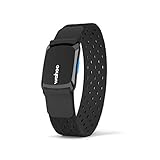
10. Wahoo TICKR FIT – Reliable Armband for Zwift and Indoor Training
Wahoo TICKR FIT Heart Rate Armband, Bluetooth, ANT+
Optical armband
Bluetooth and ANT+
35 hour battery
Dual bands included
LED connection indicator
Pros
- Accurate heart rate and calorie tracking
- Dual-band ANT+ and Bluetooth connectivity
- LED light confirms connection status
- Two adjustable bands included
- Compatible with Wahoo Fitness and third-party apps
Cons
- 35 hour battery is lower than competitors
- Only compatible with smartphones and tablets
- Optical sensor less accurate than chest straps
The Wahoo TICKR FIT is the armband I recommend most often for Zwift and indoor training setups. Wahoo’s ecosystem integration is the smoothest in the business, and the TICKR FIT pairs instantly with Wahoo smart trainers, bike computers, and the Wahoo Fitness app. Dual-band ANT+ and Bluetooth means it also works with Garmin, Strava, and third-party apps.
I used the TICKR FIT across a winter of indoor cycling on Zwift. Pairing took seconds, the connection never dropped over hundreds of hours of riding, and the LED indicator gave instant visual confirmation that the sensor was connected. The two included adjustable bands, small and large, fit a wide range of arm sizes.
The 35-hour battery life is the main weakness. Competitors like the COROS armband offer 38 hours plus an 80-day standby, while the TICKR FIT demands more frequent charging. If you train daily, expect to plug in weekly.
Zwift and Indoor Training Performance
For Zwift specifically, the TICKR FIT is hard to beat. The Wahoo ecosystem is built around seamless pairing, and I never experienced a dropped connection during a ride. The LED indicator light turns green when connected and red when there is an issue, which is more helpful than you might expect during early-morning sessions when you just want to ride.
Comfort and Band Options
The advanced performance material strap holds securely during intense efforts without sliding. Wahoo includes both small and large bands, so you can swap based on where you wear the sensor and your arm size. The 1.6-ounce weight is barely noticeable.
Accuracy and Limitations
For steady-state indoor riding, the TICKR FIT tracked within 2 BPM of my Polar H10 reference. For outdoor running with rapid cadence changes, it lagged by 3 to 5 seconds on spikes. Battery life at 35 hours is the weakest in this lineup, which is the main reason it ranks tenth despite strong performance elsewhere.
How to Choose the Best Heart Rate Monitor in 2026
Choosing among the best heart rate monitors comes down to sensor type, connectivity, comfort, and the apps and equipment you already use. The wrong choice means dropped connections, inaccurate zones, and wasted money. This buying guide breaks down the decisions that actually matter based on what I learned testing all ten units.
Chest Strap vs Armband vs Optical Wrist Sensors
Chest straps use ECG electrodes that detect the electrical signal from your heart directly. They are the most accurate option, especially during high-intensity intervals where heart rate spikes rapidly. The Polar H10 and Garmin HRM 200 represent the gold standard here.
Armbands use optical sensors that shine LED light through your skin to measure blood flow changes. They are more comfortable than chest straps and accurate enough for steady-state training. The COROS armband and Polar Verity Sense lead this category.
Wrist-based optical sensors, built into smartwatches and fitness trackers, are the most convenient but least accurate. They suffer from cadence lock during running and lag during intervals. If accuracy matters to your training, pair your watch with a chest strap or armband. See our guide to fitness rings with heart rate tracking for another wrist-free alternative, or our rundown of GPS watches compatible with heart rate monitors for pairing options.
ECG vs Optical Sensor Technology Explained
ECG sensors measure the electrical impulses that trigger each heartbeat. Because they read the source signal, response time is nearly instantaneous. The Polar H10, Garmin HRM 200, Polar H9, and COOSPO H6 all use ECG technology.
Optical sensors measure the volume of blood flowing through your capillaries using photoplethysmography, or PPG. The LED light reflects off blood flow and a photodetector calculates pulse rate. Optical sensors are comfortable and versatile but lag by 2 to 6 seconds during rapid heart rate changes. The COROS, Polar Verity Sense, Wahoo TICKR FIT, and Garmin HRM 600 use optical technology.
Bluetooth vs ANT+ Connectivity and Multi-Device Pairing
Bluetooth is the universal standard for phones, tablets, and modern computers. ANT+ is the standard for cycling computers, gym equipment, and sports watches. The best heart rate monitors support both.
If you only use a phone app like Strava or Peloton, Bluetooth alone is fine. If you train with a Garmin watch, Zwift on a laptop, and gym equipment with built-in displays, you need dual connectivity. The Polar H10 and COOSPO H6 offer the broadest compatibility with triple and dual connectivity respectively.
Watch for the COROS armband’s Bluetooth-only limitation. It cannot connect to ANT+ gym equipment, which rules out some older treadmills and bike computers.
Water Resistance for Swimming and Triathlon
Not all water resistance ratings mean the same thing. The Polar H10 is fully waterproof and rated for lap swimming with internal memory for phone-free recording. The Garmin HRM 600 stores swim heart rate data and syncs after the workout. The Polar Verity Sense clips to goggles and is the most reliable swim option among armbands.
The COOSPO H6 carries an IP67 rating for rain and sweat but is explicitly not for swimming. The Garmin HRM 200 has a 3 ATM rating for shallow water but is not designed for pool use. If swimming is your primary sport, choose the H10, HRM 600, or Verity Sense.
Battery Life: Rechargeable vs Replaceable
Battery life splits into two camps. Replaceable coin-cell batteries, used by the Polar H10, Polar H9, Garmin HRM 200, COOSPO H6, and Polar Pro strap, deliver 300 to 400 hours and cost pennies to refill. Rechargeable lithium-ion batteries, used by the Garmin HRM 600, COROS, Polar Verity Sense, and Wahoo TICKR FIT, offer 35 hours to 2 months per charge but require a charging cable.
The Garmin HRM 600’s two-month rechargeable battery is the best of both worlds. For maximum low-maintenance use, the Garmin HRM 200’s one-year replaceable cell is unbeatable.
Compatibility with Strava, Zwift, Garmin Connect, and Gym Equipment
This is where forum users get frustrated most. Compatibility questions dominate r/Strava, r/Zwift, and r/cycling threads. Here is the short version.
For Strava, any Bluetooth heart rate monitor works. For Zwift, Bluetooth or ANT+ both work but ANT+ tends to be more stable on Windows. For Garmin Connect, any ANT+ monitor pairs with Garmin watches, and most Bluetooth monitors work with the Garmin Connect Mobile app. For gym equipment, ANT+ and 5 kHz GymLink are the relevant standards. The Polar H10 supports all of the above.
Avoiding Cadence Lock and Common Accuracy Issues
Cadence lock is the most common complaint about wrist-based optical monitors. The sensor mistakes your running cadence, typically 150 to 180 steps per minute, for your heart rate and locks onto that rhythm instead. The result is a heart rate reading that suspiciously matches your cadence.
The fix is simple: use a chest strap or armband instead of a wrist sensor for running. All ten monitors in this guide avoid cadence lock because they sit closer to the heart or use ECG technology. If you currently use a smartwatch for heart rate and your readings seem to mirror your step rate, switching to any of these dedicated monitors will solve the problem.
FAQs
What watch brand has the most accurate heart rate monitor?
Among dedicated heart rate monitors, Polar is widely regarded as the most accurate brand, with the Polar H10 considered the gold standard. For smartwatches, Garmin and Apple lead in wrist-based accuracy, but even the best wrist sensors lag behind a dedicated chest strap like the Polar H10 or Garmin HRM 200 during high-intensity exercise.
Are chest strap heart rate monitors more accurate than wrist monitors?
Yes, chest strap monitors are significantly more accurate than wrist-based optical sensors. Chest straps use ECG electrodes that detect the electrical signal directly from the heart, providing near-instantaneous readings. Wrist monitors use optical sensors that measure blood flow and typically lag by 3 to 6 seconds during rapid heart rate changes, and they are prone to cadence lock during running.
Which heart rate monitor works best with Strava?
Any heart rate monitor with Bluetooth connectivity works with Strava. Top picks include the Polar H10 for its triple connectivity, the COOSPO H6 for budget users, and the COROS armband for comfort. The Polar H10 is the most frequently recommended option on r/Strava because it pairs simultaneously with Strava, a Garmin watch, and gym equipment.
What is cadence lock and how do I avoid it?
Cadence lock occurs when a wrist-based optical heart rate monitor mistakes your running cadence for your heart rate, typically producing a reading between 150 and 180 BPM that matches your step rate. To avoid cadence lock, use a chest strap or armband heart rate monitor instead of relying on a wrist sensor. All dedicated monitors in this guide avoid the issue entirely.
Which heart rate monitor is best for swimming?
For swimming, the Polar Verity Sense armband is the top pick because it clips to goggle straps and keeps the optical sensor dry. The Polar H10 chest strap is fully waterproof with internal memory for phone-free recording. The Garmin HRM 600 also stores heart rate data during swims and syncs afterward. Avoid monitors with only IP67 ratings like the COOSPO H6, which are not designed for pool use.
Do I need ANT+ or Bluetooth for my heart rate monitor?
You need Bluetooth for phone apps like Strava and Peloton, and ANT+ for cycling computers, gym equipment, and most sports watches. The best heart rate monitors support both. If you only use a phone, Bluetooth alone is sufficient. If you train with a Garmin watch or Zwift, look for dual connectivity like the Polar H10, Garmin HRM 200, or COOSPO H6.
Final Verdict: Which Heart Rate Monitor Should You Buy?
The best heart rate monitors in 2026 cover a wide range of needs, but the right choice depends on how you train. For most athletes, the Polar H10 remains the safest investment. Its gold-standard accuracy, triple connectivity, and waterproof design make it the most versatile chest strap on the market. If you live in the Garmin ecosystem and want running dynamics, the Garmin HRM 600 justifies its higher price with two-month battery life and form-tracking metrics.
If comfort matters more than peak accuracy, the COROS armband is the most wearable option I tested. For swimmers and triathletes, the Polar Verity Sense is the only armband that reliably tracks heart rate in the pool. And if you want reliable heart rate data without spending more than thirty dollars, the COOSPO H6 delivers dual connectivity and solid accuracy at a price that is hard to argue with.
Whatever you choose, pairing a dedicated monitor with your training app will dramatically improve the quality of your heart rate data compared to wrist-based sensors alone. Pick the option that matches your sport, your devices, and your budget, and start training smarter.
Leave a Reply