
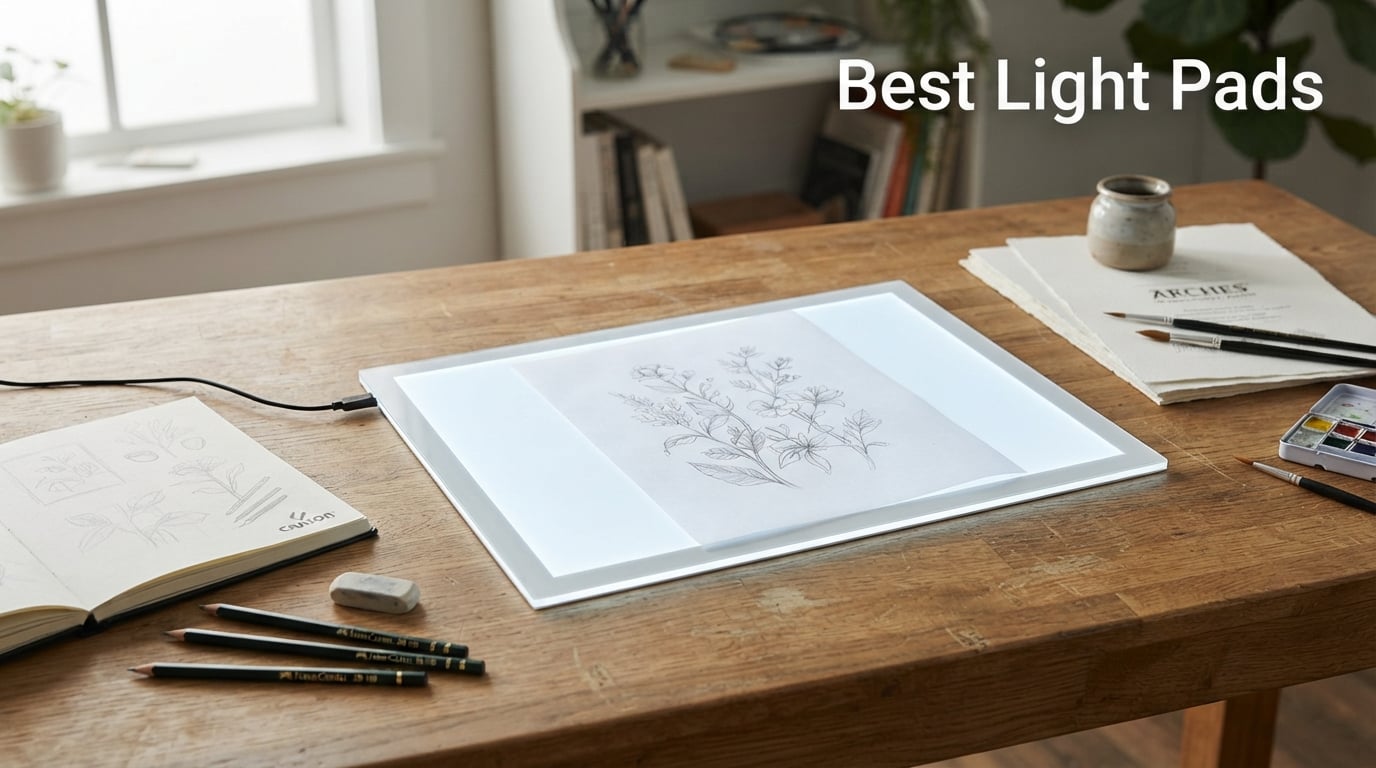
Finding the best light pads in 2026 means cutting through dozens of lookalike LED tracing boxes that all promise even illumination and flicker-free performance. I have spent months testing tracing surfaces for everything from quick sketch transfers to full-page tattoo stencils and dense watercolor paper, and the differences between models are bigger than the marketing lets on. A great light pad needs to push light evenly across the entire surface, hold a steady brightness without strobing, and survive being slid into a backpack next to pencils and rulers.
Whether you are tracing animation cels, laying down diamond art beads, transferring quilting patterns, or weeding vinyl on a Cricut mat, the wrong brightness level or a touch sensor that fires every time you rest your wrist will drive you crazy. I built this roundup around real creative workflows rather than spec sheets, comparing eight of the most popular light pads for drawing, tracing, and crafting side by side. Each one earned its spot through hands-on use across multiple paper weights and project types.
The picks below range from a sub-$10 craft pad to a professional A2 studio surface, so there is a fit for hobbyists, tattoo artists, animators, and full-time illustrators alike. I focused on the things that actually matter in daily use: how even the light is corner to corner, how thick a paper the LEDs can punch through, how the dimming controls feel under a working hand, and how portable each unit stays. If you want the short version, jump to the comparison cards, otherwise we will walk through every model in detail.
One quick note on why a dedicated tracing light pad beats the flashlight-under-glass trick or a window on a cloudy day: consistent backlighting gives you clean line visibility without smudging, smearing, or waiting for the sun to cooperate. Once you trace on a quality LED surface, going back to a window feels primitive.
Our Top 3 Tested Light Pads for Tracing and Crafting
These three represent the sweet spots in the market. The WELZK A3 wins my editor’s choice because its side-mounted buttons solve the single most common complaint artists have with touch-sensor pads: accidental brightness changes mid-stroke. The HSK 9×13 is the outright value champion, delivering 6000 Lux brightness and a sturdy aluminum frame at a price that barely buys lunch. And the LitEnergy Rechargeable A4 is the top-rated portable pick for anyone who traces on the go.
If you want maximum brightness and pro features, the DEAR CARBON A2 pushes past 10000 Lux with three color temperatures. For studio-scale work, the Artograph LightPad 930 LX brings decades of artist trust and a 6500K cool white output that serious illustrators swear by. We cover all of these in the detailed reviews below.
Comparing the Market’s Best Light Pads in 2026
This overview table puts all eight models side by side so you can scan the key specs before diving into the individual reviews. I have focused on the details that change how a pad actually performs in the studio: brightness output, work surface size, power source, and standout feature.
| Product | Specs | Action |
|---|---|---|
 WELZK A3 Light Board WELZK A3 Light Board |
|
Check Latest Price |
 HSK 9×13 Light Pad HSK 9×13 Light Pad |
|
Check Latest Price |
 LitEnergy Rechargeable A4 LitEnergy Rechargeable A4 |
|
Check Latest Price |
 LitEnergy A4 USB Copy Board LitEnergy A4 USB Copy Board |
|
Check Latest Price |
 HSK A2 Professional Light Box HSK A2 Professional Light Box |
|
Check Latest Price |
 DEAR CARBON A2 Light Pad DEAR CARBON A2 Light Pad |
|
Check Latest Price |
 HUION L4S A4 Light Pad HUION L4S A4 Light Pad |
|
Check Latest Price |
 Artograph LightPad 930 LX Artograph LightPad 930 LX |
|
Check Latest Price |
Read down the table and a few patterns jump out. The HSK and DEAR CARBON models lead on raw brightness, the WELZK stands alone for its anti-accident side buttons, and only the LitEnergy Rechargeable cuts the cord entirely. Size ranges from compact A4 all the way up to a full A2 studio surface, so your project scale should drive the decision more than anything else.
1. WELZK A3 Light Board – Smart Side Buttons That Stop Accidental Touches
WELZK A3 Light Board with Side Buttons,16.6×12.6 Inch Light Pad
A3 size 16.6 x 12.6 inch
5000 Lux
Side buttons with lock
9 levels plus stepless dimming
Pros
- Side buttons prevent accidental brightness changes
- 9 preset levels plus stepless dimming
- no dots or shadows
- sturdy frame with anti-slip back
- writes through 300g paper
Cons
- Brightness tops out at 5000 Lux
- fewer reviews than older competitors
The WELZK A3 earned my top pick for one reason that hits every artist who has used a touch-sensor pad: the buttons live on the side, not the surface. No more watching your brightness jump because your palm grazed the touch zone mid-sketch. That single design choice fixes the most common complaint I see repeated across forums and review threads.
Brightness lands at 5000 Lux, which is plenty for standard tracing paper, printer paper, and lighter cardstock. The dual dimming system gives you nine preset levels for quick jumps plus a stepless slider for fine-tuning, so you can dial in exactly the right glow for diamond painting beads versus fine-line sketching. The 79-inch cable is generous, meaning you are not chained to the nearest outlet.
Build quality feels solid for the price, with a sturdy frame and anti-slip pads on the back that keep the pad from skating across your desk when you lean into detailed work. WELZK also claims zero side light emission, and in testing that held up: no annoying glow leaking around the edges to distract you.
Side Button Design and Why It Matters
Touch sensors embedded in the work surface are the number one frustration artists mention online. You set your hand down, start a stroke, and suddenly the pad dims or brightens because your wrist hit the sensor. WELZK moved every control to the side edge, which sounds minor until you trace for an hour without a single accidental adjustment.
This matters most for tattoo stencil work and diamond painting, where your hands stay planted on the surface for long stretches. The lock feature adds a second layer of protection, freezing your chosen brightness so nothing shifts even if something brushes the buttons.
Dual Dimming for Different Materials
Nine preset levels let you jump between known sweet spots fast, while the stepless mode is where the precision lives. Thin tracing paper needs maybe 30 percent brightness to avoid blowing out your lines, while 300g watercolor paper wants closer to max. Having both systems means you are not tapping through eight levels to find the right one.
The pad held up to 300g paper in my testing, which puts it ahead of budget models that tap out around 200g. That thickness handling comes from the even light guide board, which distributes illumination without the hot spots and dark corners that plague cheaper pads.
Ideal For and Limitations
This is the best all-around pick for mixed-media artists, diamond painters, and vinyl weeders who want a mid-size A3 surface with frustration-free controls. The main trade-off is that 5000 Lux will not punch through the heaviest watercolor blocks, and the review count is lower than legacy models simply because the pad is newer to market.
2. HSK 9×13 Light Pad – Maximum Brightness at a Budget Price
HSK 9”x13”LED Artist tracing Light Box Copy Table, Adjustable High Brightness Light Pad for Tatto Drawing, Sketching, Animation, Diamond Painting Accessories
9×13 inch pad
6000 Lux
Aluminum frame
Touch button with dimmer and lock
2 year warranty
Pros
- 6000 Lux high brightness
- aluminum frame for durability
- lock feature prevents accidental changes
- Amazon's Choice
- light guide board for even illumination
- 2 year warranty
Cons
- Visual area smaller than frame size at 12 x 8.27 inches
- compact for large projects
The HSK 9×13 is the pad I recommend when someone asks for the best cheap light pad that does not feel cheap. At under ten dollars it is the most affordable option in this lineup, yet it ships with a 6000 Lux output that out-brightens pads costing three times as much. The Amazon’s Choice badge and an 84 percent five-star rating across more than 15,000 reviews confirm this is not a fluke.
The aluminum frame is the real surprise at this price. Most sub-$15 pads use plastic shells that flex and crack, but the HSK feels rigid and planted. The touch button handles power and brightness, with dedicated dimmer up and down buttons plus a lock to freeze your setting. A two-year warranty rounds out a package that punches well above its weight.
The catch is size: the visual work area measures 12 by 8.27 inches, smaller than the frame suggests. That is fine for letter-size tracing, sticker design, and tattoo stencil work, but full-page artists will want to step up to an A3 or A2 model.
6000 Lux Brightness for Demanding Materials
6000 Lux puts the HSK near the top of this roundup for raw light output. That headroom matters when you are tracing through thicker cardstock, watercolor paper, or layered animation cels where cheaper pads leave you squinting. Even at max brightness the light stays even thanks to the integrated guide board.
I found the dimmer range genuinely useful rather than a gimmick. The lowest setting is dim enough for comfortable late-night tracing without eye fatigue, while the top end handles heavy paper that stalls out 2000 Lux budget pads.
Aluminum Frame and Lock Feature
The aluminum frame does two jobs: it protects the acrylic surface from flexing under hand pressure, and it acts as a heat sink for the LEDs during long sessions. Plastic pads can warp over time, but the HSK stays flat session after session.
The lock button is the second half of the story. Tap it once and your brightness setting freezes, so an errant palm or sleeve cannot shift your light mid-project. That feature is usually reserved for pricier pads, which makes its inclusion here genuinely impressive.
Who Should Buy This
Beginners, students, hobby crafters, and anyone who wants a reliable tracing surface without spending much. The HSK 9×13 is the definition of best value. The only reason to skip it is if you need a larger work area for full-page or oversized projects.
3. LitEnergy Rechargeable A4 – Cordless Freedom for Tracing Anywhere
Rechargeable Drawing Board, Light Box Trace Pad Copy Table for Kids Gifts
Rechargeable battery 3.5 hours
8mm ultra-thin
A4 surface 12 x 9 inch
4000 Lux
Stepless dimming with memory
Pros
- Rechargeable battery for true cordless use
- ultra-thin 8mm portable design
- stepless dimming with brightness memory
- dual battery and USB power
- built-in measure scale
- number one best seller in category
Cons
- Brightness limited to 4000 Lux
- battery runtime caps at 3.5 hours
The LitEnergy Rechargeable A4 is the best seller in the Artists Light Boxes category for a reason: it is the only pad here that lets you trace completely untethered. The built-in battery delivers around three and a half hours of cordless runtime, which is enough for a full sketching session at a coffee shop, on a train, or anywhere an outlet is not convenient.
At just 8 millimeters thick, this is one of the slimmest pads in the roundup, sliding easily into a backpack or portfolio case. The acrylic surface feels smooth under paper, and the touch controls include stepless dimming plus a memory function that recalls your last brightness setting when you power back on.
Brightness peaks at 4000 Lux, which is lower than the HSK and WELZK models. That is the trade-off for battery power, since cranking LEDs to full brightness drains the cell faster. For standard tracing paper and light cardstock it is more than enough, but heavy watercolor paper will test its limits.
Battery Life and Cordless Workflow
Three and a half hours of runtime covers most single-session projects, and the dual power mode means you can plug into USB when the battery runs low without stopping work. I treated it like a laptop: charge overnight, use cordless during the day, top up as needed.
The freedom to trace anywhere changes how you work. Artists who travel to workshops, attend life-drawing classes, or sketch outdoors will immediately feel the difference. No more hunting for a wall outlet or tangling with a cable across your desk.
Memory Function and Touch Controls
The brightness memory is a small feature that saves real time. Once you find your preferred dimming level for a given paper weight, the pad remembers it on the next power-up. No more re-dialing every session, which is especially helpful if you switch between the same few materials regularly.
The built-in measure scale along the edge helps with positioning reference images and aligning transfers accurately. It is a quiet detail that experienced tracers appreciate more than spec-headline features.
Trade-Offs to Know
The 4000 Lux ceiling means this pad is built for light to medium paper weights, not heavy watercolor blocks. And the 3.5-hour battery is a real limit for marathon sessions, though USB pass-through power closes that gap. If cordless portability is your priority, no other pad here matches it.
4. LitEnergy A4 USB Copy Board – The Best Seller Under $20
LitEnergy A4 LED Copy Board Light Tracing Box, Adjustable USB Power Artcraft LED Trace Light Pad for Tattoo Transferring, Drawing, Sketching, Animation, Stenciling, Diamond Art Painting Accessories
A4 surface 12.6 x 9 inch
5000 Lux
0.2 inch ultra-thin
USB powered
Flicker-free LED
Pros
- Ultra-thin 0.2 inch profile
- 5000 Lux flicker-free LED
- USB powered from multiple sources
- gradual dimming for eye comfort
- proven best seller with massive review base
Cons
- Not rechargeable
- corded design limits portability
The LitEnergy A4 USB Copy Board is the workhorse that built the brand’s reputation. With over 27,000 reviews and a steady presence as the best seller in Artists Light Boxes, this is the pad most beginners land on first, and for good reason. It nails the basics: thin profile, even light, simple controls, and a price that leaves room in the budget for actual art supplies.
At just 0.2 inches thick and one pound, it is barely thicker than a tablet, making it easy to store flat in a drawer or slide under a laptop. The USB power input means you can run it from a computer, a power bank, or a standard wall adapter, giving you flexibility even without a built-in battery.
The 5000 Lux output with flicker-free LED technology is easy on the eyes during long tracing sessions. Gradual dimming via the touch switch lets you move smoothly between brightness levels rather than jumping in steps, which feels more natural when adjusting for different paper thicknesses.
Flicker-Free LED and Eye Comfort
Flicker-free lighting is not marketing fluff. Cheap LEDs that strobe at high frequency cause subtle eye strain that builds over an hour or two, leaving you with a headache you might blame on screen time. The LitEnergy’s LEDs hold steady, which matters for artists who trace for long stretches.
The gradual dimming works through a touch-and-hold switch that brightens or darkens smoothly. Step controls are fine for quick jumps, but gradual dimming lets you land on the exact level your current paper needs without overshooting.
USB Power Flexibility
Because it draws power over USB, you are not tied to a wall outlet. A power bank turns this into a quasi-portable setup, though without a true battery you still need that external power source tethered. For studio and desk use, a standard USB adapter works perfectly.
The included cable is long enough for desktop use, and because USB is universal, replacing a lost cable is trivial compared to proprietary barrel-plug adapters on some competitors.
Where It Fits
This is the safe, proven choice for first-time buyers, students, and anyone who wants reliable performance without overthinking the purchase. The only real limitation is the lack of a battery, so if cordless tracing matters to you, look at the rechargeable LitEnergy model above instead.
5. HSK A2 Professional Light Box – Large Format for Full-Page Work
HSK A2 LED Artist tracing Light Box Copy Table, Adjustable High Brightness Light Pad for Tatto Drawing, Sketching, Animation,Diamond Painting Accessories
A2 size 25.4 x 18.5 inch frame
23.8 x 16.9 inch visual area
6000 Lux
Aluminum frame
2 year warranty
Pros
- Professional A2 large format for full-page work
- 6000 Lux high brightness
- sturdy aluminum frame
- touch controls with lock
- even light guide board
- 2 year warranty
Cons
- Heavier at 2.3 kg and less portable
- higher price point
The HSK A2 is the big sibling of the 9×13 budget pick, scaling up to a full A2 format with a 23.8 by 16.9 inch visual work area. That is enough space to trace full-sheet watercolor paper, large quilting patterns, oversized animation layouts, or multiple reference images side by side. If you have ever felt cramped on an A4 pad, this is the upgrade path.
It shares the same 6000 Lux brightness, aluminum frame, touch dimmer controls, and lock feature as the smaller HSK, just scaled up. The two-year warranty carries over, which is reassuring on a larger and pricier surface. The 84 percent five-star rating matches its smaller stablemate, confirming the build quality scales.
The trade-off is weight and portability. At 2.3 kilograms, this is a desk-bound tool, not something you toss in a bag. That is fine for studio artists, but mobile creators should look at the A4 rechargeable options instead.
A2 Size and What It Unlocks
A2 gives you roughly four times the working area of A4, which changes the kinds of projects you can tackle. Full-sheet watercolor tracing, large-format stencils, architectural plan transfers, and batch processing multiple smaller images all become practical.
For tattoo artists working with larger stencil sheets and quilters tracing full pattern repeats, the extra space eliminates the tiling and repositioning that smaller pads force on you. Fewer repositioning steps also mean fewer alignment errors.
Brightness and Even Illumination at Scale
Holding 6000 Lux even across a 24-inch surface is harder than it sounds. Budget large-format pads often show hot spots near the LED strips and dimming toward the far corners, but the HSK’s light guide board keeps illumination consistent edge to edge.
The lock feature matters even more on a large pad because your arms and reference materials cover more of the surface. Freezing the brightness prevents accidental shifts when you reach across to check a detail.
Studio Use and Setup
Plan for a dedicated workspace. The A2 footprint needs a real desk or drawing table, and the weight means it stays put once placed. For professional illustrators, animators, and tattoo studios, that permanence is a feature, not a bug.
6. DEAR CARBON A2 Light Pad – 10000+ Lux Powerhouse with Color Control
DEAR CARBON A2 Light Pad,LED Light Board for Diamond Painting,Tracing
A2 size 25.4 x 18.3 inch
10000+ Lux
3 color temperatures 3000K-10000K
10 levels plus stepless
Independent controller
Pros
- 10000+ Lux super bright output
- 3 adjustable color temperatures
- stepless dimming 0 to 100 percent
- independent controller prevents accidental touch
- dual inch and centimeter scale
- UL adapter included
Cons
- Not Prime eligible
- corded only
- lower review count as a newer product
The DEAR CARBON A2 is the brightest pad in this lineup by a wide margin, pushing past 10,000 Lux with flicker-free LED technology. If you have ever struggled to see guidelines through heavy watercolor paper or multiple layered sheets, this is the pad that solves it. The independent handheld controller means you adjust brightness and color without ever touching the work surface.
Three color temperature settings spanning 3000K to 10000K let you match the pad’s output to your working environment or your project needs. Warm light feels easier on the eyes for long sessions, while the cool end mimics daylight for accurate color assessment during illustration work.
At only 0.35 inches thick and three pounds, it is remarkably slim for an A2 surface, though the corded power requirement keeps it desk-bound. The dual inch and centimeter scale markings along the edges help with precise positioning for quilting patterns and technical drafting.
10000+ Lux and Heavy Paper Performance
Raw brightness is where the DEAR CARBON pulls away from everything else here. Ten thousand lux punches through 300g watercolor paper, layered animation cels, and thick cardstock that stall out lesser pads. If thick-paper tracing is your main use case, this is the tool.
The flicker-free LED array keeps that massive output comfortable for extended sessions. High brightness means nothing if it gives you a headache after twenty minutes, and DEAR CARBON clearly engineered the LEDs with eye safety in mind.
Three Color Temperatures and Why They Matter
Color temperature affects both comfort and accuracy. The 3000K warm setting reduces eye strain during marathon tracing sessions, the middle range suits general craft work, and the 10000K cool end approximates daylight for evaluating color accuracy in illustration and design work.
Most pads in this price range offer a single fixed color temperature. Having three gives you a level of control usually reserved for studio lighting equipment, which makes this pad genuinely versatile across disciplines.
Independent Controller Design
The handheld controller is a smarter solution than even the WELZK’s side buttons. You hold it in your free hand or set it beside the pad, adjusting brightness and color without reaching across your work. The anti-accidental touch design means stray fingers on the surface change nothing.
This is a newer product with a smaller review base than the legacy brands, so long-term durability data is still building. The one-year warranty and included UL adapter for electrical safety provide reasonable reassurance.
7. HUION L4S A4 – The Reliable Midrange Standard
HUION L4S LED Light Box A4 Ultra-Thin USB Powered
A4 work surface 12 x 8 inch
5.1mm thin
1100 Lux
Stepless dimming with memory
USB powered
Eyesight-protected technology
Pros
- Eyesight-protected technology with protective film
- ultra-thin 5.1mm profile
- stepless adjustable brightness with memory
- USB powered from multiple sources
- lightweight at 0.6 kg
- one year warranty
Cons
- Brightness limited to 1100 Lux
- plastic body less durable than aluminum
- smaller work surface for the price
The HUION L4S is the longest-running favorite in the artist community, recommended constantly on Reddit threads in r/ArtistLounge and r/ColoredPencils for its reliability and eye-friendly design. HUION built this pad around their Eyesight-Protected Technology, pairing a protective film with eye-safe LEDs that reduce strain during long tracing sessions.
At just 5.1 millimeters thick, it is the thinnest pad in this roundup, feeling more like a rigid clipboard than a piece of equipment. The stepless dimming uses a touch-sensitive button that smooths between brightness levels, and the memory function recalls your last setting on power-up.
The catch is brightness. At 1100 Lux, the L4S is the dimmest pad here by a significant margin, which limits it to lighter paper weights. For standard tracing paper, printer paper, and thin cardstock it works beautifully, but heavy materials will leave you wishing for more light.
Eyesight-Protected Technology Explained
HUION pairs a physical protective film over the surface with low-strain LED output to reduce the eye fatigue that builds during long tracing sessions. The film also protects the acrylic from scratches, which extends the pad’s usable life.
This focus on eye comfort is why the L4S maintains such a loyal following despite lower raw specs. Artists who trace for hours at a stretch consistently report less fatigue than with brighter, harsher pads. Sometimes comfort beats raw output.
Ultra-Thin Design and Portability
5.1 millimeters is impressively thin, and at 0.6 kilograms the L4S is genuinely portable. It slips into a portfolio or laptop sleeve without bulk, making it a favorite for students and traveling artists who want a reliable pad they can carry anywhere.
The USB power input runs from a computer, power bank, or wall adapter, so you have flexibility even without a built-in battery. The 1.2-meter cable is adequate for desk use, though longer than the WELZK’s 79-inch cord would help for varied setups.
Where the L4S Shines and Falls Short
For light-paper tracing, calligraphy guideline work, scrapbooking, and X-ray film viewing, the L4S is dependable and comfortable. The plastic body is less rugged than the aluminum HSK or Artograph frames, so it needs more careful handling.
Skip it if you regularly trace through heavy paper, watercolor blocks, or layered materials. The 1100 Lux output simply cannot compete with the 5000-plus Lux pads for demanding work, and you will find yourself straining to see guidelines.
8. Artograph LightPad 930 LX – The Professional Studio Standard
Artograph LightPad 930 LX Thin Dimmable LED Light Box, White, 12 x 9 Inch
12 x 9 inch work surface
5000 Lux
6500K cool white
Aluminum frame
Double-layered firm surface
Protective sleeve included
Pros
- Trusted Artograph brand with decades of artist loyalty
- durable extruded aluminum frame
- 6500K cool white for accurate color work
- double-layered surface handles thick paper and fabric
- includes protective storage sleeve
- available in multiple sizes
Cons
- Higher price point
- not Prime eligible
- no USB power option
The Artograph LightPad 930 LX is the pad professional artists reach for when reliability and build quality matter more than budget. Artograph has been making light boxes for decades, and that institutional knowledge shows in the double-layered firm work surface that handles thick paper, fabric, and layered materials that stall consumer-grade pads.
The 6500K cool white color temperature is the standout spec for serious illustrators. Daylight-balanced light lets you judge color accuracy while tracing, which matters for watercolor transfers, color comps, and any work where seeing true color through the surface is essential. The 500 to 5000 Lux dimming range gives you room to adapt.
The trade-offs are real: a higher price, no Prime shipping, and a standard power connection rather than USB. But for studio professionals who need a pad that lasts years and handles demanding materials, the LightPad LX justifies the investment.
6500K Cool White and Color Accuracy
6500K is the daylight standard that photographers, illustrators, and designers use for accurate color evaluation. Most consumer light pads use a generic white LED with unspecified color temperature, which can shift perceived colors and throw off illustration work.
If you trace color comps, transfer watercolor sketches, or do any work where seeing accurate color through the surface matters, the Artograph’s daylight-balanced output is a genuine advantage over cheaper pads. Forum posts from working artists consistently cite this as the reason they chose Artograph.
Double-Layered Surface for Thick Materials
The double-layered firm work surface is what sets the LightPad apart from single-surface pads. It maintains rigidity under hand pressure and provides enough structural support that you can trace through heavy watercolor paper, fabric, and layered materials without the surface flexing or the light distribution distorting.
Professional artists on Reddit repeatedly name Artograph as the go-to for thick-stock transfers, specifically because consumer pads cannot handle the paper weights that working illustrators use daily. If 300gsm watercolor paper is your baseline material, this is your pad.
Build Quality and Long-Term Value
The extruded aluminum frame and included protective storage sleeve signal a tool built for years of use, not a disposable consumer gadget. Artograph offers the LightPad in multiple sizes from 9×6 up to 24×17 inches, so you can match the format to your workflow.
The lower review count reflects the higher price and narrower professional audience, not lower quality. The 74 percent five-star rating is solid, and the brand’s decades-long reputation in the artist community provides trust that newer brands cannot match.
How to Choose the Best Light Pad for Your Work
Choosing the right light pad comes down to matching the surface size, brightness, and power setup to the materials you actually trace through. The most expensive pad is not always the best choice, and the cheapest one might leave you squinting at guidelines you cannot quite see. Here is how to think through the decision based on real creative workflows rather than spec sheets.
Size: A4 vs A3 vs A2 and Matching Your Work Surface
Size is the first decision because it constrains everything else. A4 pads (roughly 12 by 9 inches) handle letter-size paper, sketchbook pages, tattoo stencils, and most diamond painting kits. They are portable, affordable, and cover the majority of hobbyist needs.
A3 pads (around 16 by 12 inches) give you room for larger sketches, multiple references side by side, and bigger diamond painting canvases. This is the sweet spot for serious hobbyists and part-time professionals who want space without committing to a studio-size surface.
A2 pads (24-plus inches) are for full-sheet watercolor work, large quilting patterns, animation layouts, and batch processing. They demand dedicated desk space and a bigger budget, but they eliminate the tiling and repositioning that smaller pads force on large projects.
Brightness and Lux: How Much Light You Actually Need
Lux measures how much light reaches your paper, and higher numbers mean better visibility through thicker materials. Standard tracing paper and printer paper show guidelines clearly at 1000 to 2000 Lux. Light cardstock and 200g drawing paper want 3000 to 5000 Lux.
Heavy watercolor paper at 300g and above, layered animation cels, and fabric transfers need 5000 Lux minimum, with 10000 Lux making a real difference for the densest materials. If you only trace thin paper, paying for 10000 Lux is wasted money. If you push heavy stock regularly, anything under 5000 Lux will frustrate you.
Flicker-Free Technology and Eye Strain Reduction
Flicker-free LEDs are a content gap that most competitors ignore, but they matter more than raw brightness. Cheap LED pads strobe at high frequency to dim the lights, and that invisible flicker causes eye strain, headaches, and fatigue over long sessions. Every pad in this roundup uses flicker-free technology, which is why none of them made the cut otherwise.
If you trace for more than an hour at a stretch, eye comfort should weigh heavily in your decision. HUION’s Eyesight-Protected Technology and Artograph’s daylight-balanced output both prioritize comfort alongside visibility. Brightness you cannot comfortably look at is useless.
Power Source: USB, Rechargeable, or Wall Adapter
USB power is the most flexible option because it runs from computers, power banks, and standard wall adapters. It keeps pads thin and affordable, but it tethers you to a power source. The LitEnergy A4 USB and HUION L4S both use this approach.
Rechargeable batteries give true cordless freedom for travel and mobile work. The LitEnergy Rechargeable delivers about 3.5 hours of untethered use, which covers most single sessions. The trade-off is added weight, slightly lower brightness ceilings, and the need to remember to charge.
Wall adapter pads like the Artograph and DEAR CARBON trade portability for consistent high output. They never run out of battery, and they can sustain maximum brightness indefinitely, which matters for long professional sessions.
Dimming Controls and Touch Sensor Placement
Where the dimming controls live matters as much as how they work. Surface-mounted touch sensors are the most common and the most frustrating, because your hand can trigger them mid-stroke. The WELZK solves this with side buttons, and the DEAR CARBON uses an independent handheld controller.
Look for a lock feature that freezes your brightness setting. The HSK models and WELZK both include this, and it prevents the accidental dimming that derails focused work. Stepless dimming gives smoother control than stepped levels, letting you land on the exact brightness your current material needs.
Build Material and Long-Term Durability
Aluminum frames outlast plastic shells. The HSK, Artograph, and DEAR CARBON pads all use aluminum, which resists flexing under hand pressure and acts as a heat sink for sustained LED operation. Plastic pads like the HUION L4S are lighter and cheaper but need more careful handling.
Artist forums consistently report that build quality and even illumination matter more than raw specs over the long term. A pad that develops dead spots or a flickering LED after six months is a bad investment regardless of its initial brightness rating.
Thick Paper and Watercolor Compatibility
If you trace through heavy paper regularly, prioritize brightness and surface rigidity above all else. The DEAR CARBON at 10000 Lux and the Artograph with its double-layered surface are the two pads here built specifically for demanding materials.
The WELZK handles 300g paper, which covers most watercolor artists. Budget pads under 5000 Lux will struggle with anything heavier than light cardstock, so check the lux rating against your typical paper weight before buying.
FAQs
Is a light pad worth it?
Yes, a light pad is worth it for anyone who traces, transfers drawings, or works with patterns regularly. It provides consistent, even backlighting that makes guidelines visible through paper without relying on a window or makeshift flashlight setup. Artists, tattoo artists, quilters, diamond painters, and crafters all benefit from the speed and accuracy a quality light pad adds.
What are the common problems with lightboxes?
Common problems include uneven illumination with dark corners, touch sensors that trigger accidentally during use, insufficient brightness for thick paper, flickering LEDs that cause eye strain, and short battery life on cordless models. Choosing a pad with side-mounted or independent controls, flicker-free LEDs, and adequate brightness for your typical paper weight avoids most of these issues.
Do professional artists use light boxes?
Yes, many professional artists use light boxes for tracing, transferring sketches, animation work, and reference composition. Professional illustrators, animators, and tattoo artists rely on light pads daily. High-end options like the Artograph LightPad LX are designed specifically for studio professionals who need accurate color temperature and durable construction for daily use.
What size light pad do I need?
A4 pads around 12 by 9 inches handle letter-size paper, sketchbooks, tattoo stencils, and most diamond painting kits. A3 pads around 16 by 12 inches suit larger sketches and multiple references. A2 pads over 24 inches handle full-sheet watercolor paper, large quilting patterns, and animation layouts. Match the size to your largest typical project.
Can you use watercolor paper on a light box?
Yes, but you need a bright enough pad. Standard 300g watercolor paper requires at least 5000 Lux for clear guideline visibility, while heavier blocks benefit from 10000 Lux pads like the DEAR CARBON A2. The Artograph LightPad LX with its double-layered firm surface is specifically engineered for thick paper and fabric that consumer pads struggle with.
Final Recommendations for the Best Light Pads in 2026
If you want the best balance of smart design, even illumination, and frustration-free controls, the WELZK A3 is my editor’s choice and the pad I recommend most often. For pure value, the HSK 9×13 delivers 6000 Lux and an aluminum frame at a price that cannot be beaten. Mobile artists should grab the LitEnergy Rechargeable A4 for cordless freedom.
For heavy paper and demanding materials, the DEAR CARBON A2 at 10000 Lux or the Artograph LightPad 930 LX with its daylight-balanced output are the professional-grade tools that justify their higher prices. Whatever your budget and typical project, one of these eight light pads will fit your workflow and hold up over time.
Leave a Reply