
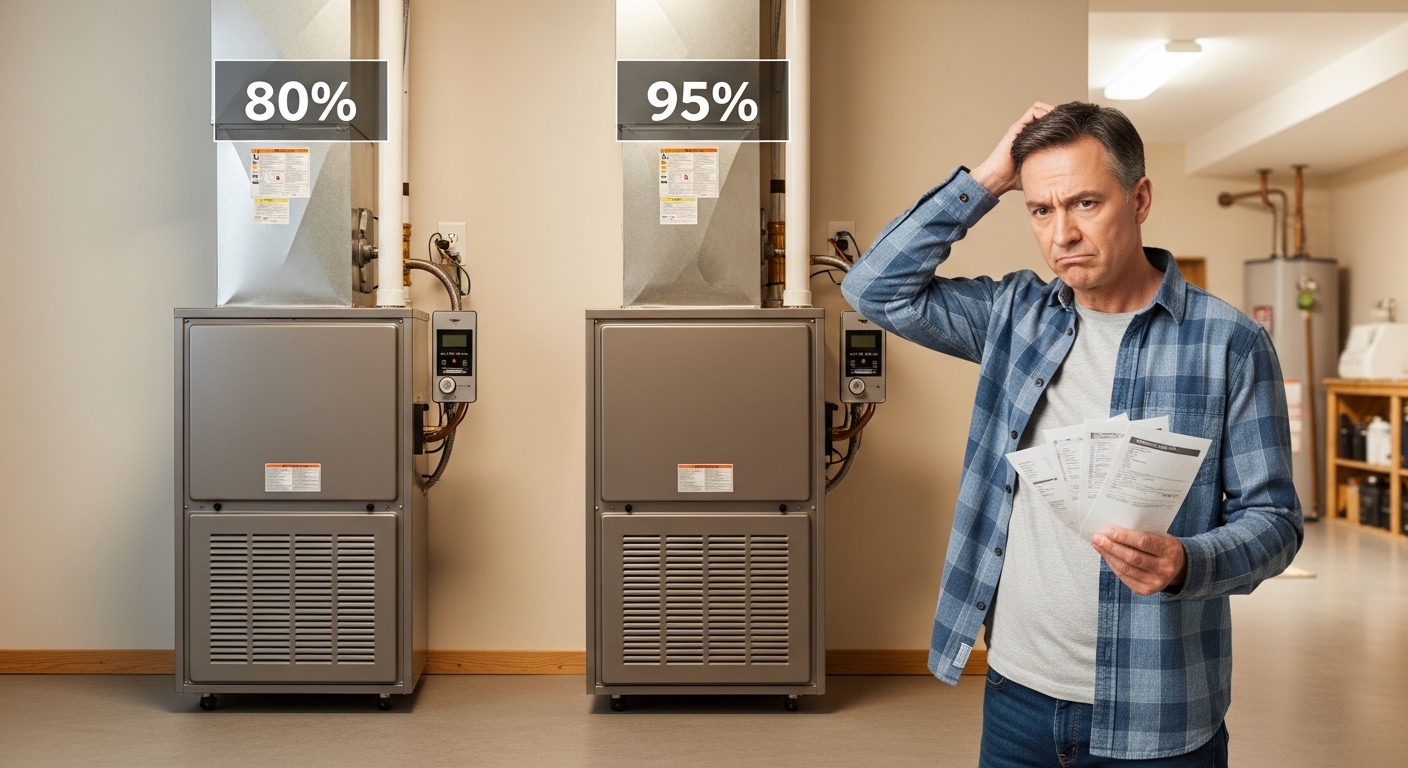
Deciding between an 80% and a 95% efficiency furnace feels like one of those homeowner decisions that should be simple but somehow is not. You research, you get contractor quotes, and suddenly you are drowning in AFUE ratings, venting requirements, and price differences that may or may not make sense for your situation.
I have spent years talking to homeowners, HVAC contractors, and reading real experiences from people who made this exact choice. The truth is, the answer is not the same for everyone. The right furnace depends on where you live, how your home is built, and how you heat. This guide breaks down everything you need to know to make the decision with confidence.
What Is AFUE and Why Does It Matter?
AFUE stands for Annual Fuel Utilization Efficiency. It tells you what percentage of the fuel your furnace burns actually becomes usable heat for your home. An 80% AFUE furnace converts 80% of the natural gas to heat, while the other 20% goes up the exhaust vent. A 95% furnace converts 95%, extracting more heat from the same fuel.
These numbers matter because they directly affect your monthly heating bills. Over a typical heating season, a 95% furnace uses less fuel to produce the same amount of heat as an 80% model. The difference sounds small, but it compounds year after year. According to the U.S. Department of Energy, heating accounts for about 30% of the average American home’s energy use, making this one of the bigger line items on your utility bill.
What many homeowners do not realize is that AFUE is measured under controlled laboratory conditions. Real-world efficiency depends heavily on how your furnace cycles, whether it has multiple heat stages, and how well your ductwork distributes that heat. This is why a two-stage 80% furnace sometimes outperforms a single-stage 95% furnace in actual home use.
80% vs 95% Furnace: Core Differences
The efficiency difference between these two furnace types comes from fundamentally different designs. An 80% furnace uses what is called open combustion. It pulls air from the room around it, burns the gas, and then vents the exhaust up through a traditional chimney or flue. This design has been around for decades and works well in spaces with normal ventilation.
A 95% furnace uses sealed combustion. It pulls air from outside through a dedicated intake pipe, burns the gas, and then uses a second heat exchanger to extract additional heat from the exhaust before venting it. This process creates condensation, which is why high-efficiency furnaces require a drain line. The exhaust vents through PVC pipe rather than a traditional chimney.
Here is a side-by-side look at how these differences add up:
| Feature | 80% Furnace | 95% Furnace |
|---|---|---|
| Combustion Type | Open combustion | Sealed combustion |
| Venting | Chimney or metal flue | PVC pipe (intake and exhaust) |
| Heat Exchangers | One primary | Primary plus secondary |
| Condensate Drain | Not required | Required |
| Installation Complexity | Lower | Higher |
| Upfront Cost | $1,500 – $3,000 | $2,500 – $5,500 |
The venting requirement alone can add significant cost when switching from 80% to 95%. If you are replacing an 80% furnace in a home with an existing chimney, you may need to reline that chimney or install new PVC venting, which can run $500 to $2,000 depending on your setup.
Understanding Furnace Sizing
Before getting too deep into efficiency ratings, you need to make sure you are looking at the right furnace size. A furnace that is too small will struggle to keep your home warm on the coldest days. One that is too large will cycle on and off constantly, wasting energy and wearing out faster.
BTU, or British Thermal Units, measures heating capacity. As a general rule, you need about 30 to 40 BTUs per square foot of living space in colder climates, and 25 to 35 BTUs per square foot in milder regions. A 80,000 BTU furnace typically heats a home between 2,000 and 2,500 square feet, depending on insulation, climate zone, and ceiling height.
Getting the right size matters more than the efficiency rating. An oversized 95% furnace will cost you more upfront and may not run long enough to reach its advertised efficiency. We regularly see homeowners who paid premium prices for high-efficiency furnaces only to have them cycle improperly because the unit was wrong for the home.
Stages of Heat: Why Single, Two, or Modulating Matters?
Here is the part that trips up a lot of people. The efficiency rating is not the only factor that determines how much you actually save on heating bills. The stages of heat your furnace offers matter just as much, sometimes more.
A single-stage furnace runs at full capacity whenever it turns on. It heats quickly but then shuts off completely, creating temperature swings. The house gets warm, then cool, then warm again. This on-off pattern uses more energy than necessary.
A two-stage furnace has two heat settings. Most of the time it runs on the lower setting, which uses less fuel and runs longer. When temperatures drop significantly, it switches to high fire to meet demand. This longer, steadier run time actually extracts more usable heat from the fuel, sometimes narrowing or even closing the gap between 80% and 95% efficiency in real-world use.
A modulating furnace adjusts its heat output in small increments, sometimes down to 1% increments. It maintains a consistent temperature by fine-tuning its output continuously. These furnaces are the most efficient in practice, though they come with a higher price tag.
As one Reddit user put it after researching this exact question: “An 80% furnace with two stages of heat will usually be better for your energy bills than a 95% furnace with just one stage.” This is not marketing fluff. It reflects how these systems actually operate in homes over a full heating season.
Variable Speed vs Fixed Speed Blowers
The blower motor in your furnace moves air through your ductwork and into your living spaces. Fixed speed blowers run at one speed and turn completely off when the heating cycle ends. Variable speed blowers run at low speeds continuously, adjusting based on heating demand.
Variable speed blowers offer several advantages. They distribute air more evenly, reduce hot and cold spots, improve air filtration since the air constantly moves through your filter, and use significantly less electricity than fixed speed models. The continuous low-speed operation also means quieter operation overall.
For homeowners in multistory homes or homes with longer duct runs, variable speed blowers make a noticeable difference in comfort. The initial cost is higher, but the energy savings and comfort improvements add up over time.
Installation Location: Where Your Furnace Lives?
Your furnace installation location plays a huge role in determining which efficiency level makes sense. This is one of the most overlooked factors in the 80% vs 95% decision.
In a vented attic, a standard 80% furnace works well because the open combustion draws air from the attic space. The furnace essentially uses the attic as its combustion air source, which works fine as long as the attic is ventilated. Exhaust vents through an existing chimney or roof penetration.
In a sealed crawl space or sealed closet, an 80% furnace presents a problem. The sealed environment does not provide enough air for proper combustion. You would need to install a 95% sealed combustion furnace that brings its own combustion air from outside through the PVC intake pipe.
If you are replacing an 80% furnace in a home with a sealed combustion requirement, switching to 95% is not optional. It is code-required for safety. This is a scenario where the upfront cost difference disappears because you simply cannot install an 80% unit.
In northern climate zones with long, harsh winters, the energy savings from a 95% furnace accumulate faster and make the higher upfront cost easier to justify. In southern regions where heating season is short, the payback period stretches out considerably.
Cost Analysis: Upfront vs Long-Term Savings
Let us talk numbers, because that is really what this decision comes down to for most homeowners. A standard efficiency 80% gas furnace typically costs between $1,500 and $3,000 installed, depending on size, brand, and labor rates in your area. A high-efficiency 95% furnace typically runs $2,500 to $5,500 installed.
The $1,000 to $2,500 upfront difference is real. However, the operating cost difference is smaller than many expect. On a 1,500 square foot home in a moderate climate, switching from 80% to 95% efficiency might save $100 to $200 per year on heating costs. That means the payback period could be 7 to 15 years, which is longer than many furnaces actually last.
In colder climates with higher heating costs, the savings are more significant. A home in Minnesota or North Dakota might see $300 to $500 in annual savings, bringing the payback period down to 4 or 5 years. That starts making more sense for a appliance you expect to last 15 to 20 years.
When you factor in installation modifications like chimney liners or new PVC venting, the true cost difference can be substantially higher. We have seen homeowners quoted an extra $2,000 to $3,000 for venting modifications when switching from 80% to 95%, which extends the payback period significantly.
The $5000 Rule for Furnace Replacement
One framework that helps with this decision is commonly called the $5,000 rule. The idea is straightforward: if your furnace repair would cost more than $5,000, or if the combined cost of repairs plus the efficiency upgrade exceeds $5,000, it typically makes more financial sense to replace the entire unit rather than patch an old system.
This rule becomes especially relevant if your current furnace is approaching 15 years old. At that age, you are entering the window where major components start failing, and investing in repairs often means throwing money at a system that may fail again soon. A new furnace with a 10 to 15 year warranty provides predictability and peace of mind that older systems simply cannot match.
The $5,000 threshold is not a hard line. It is a heuristic that reflects the economics of repair vs replace decisions. If a new high-efficiency furnace would cost $4,500 total but your current 12-year-old furnace needs a $2,500 repair, the math shifts toward replacement. If your current furnace is 8 years old and needs a $600 repair, fixing it makes more sense.
When to Choose an 80% Efficiency Furnace?
An 80% furnace makes the most sense in specific situations. If your furnace installs in a vented attic or garage with plenty of airflow, you have the ventilation required for open combustion without any modifications. The existing chimney venting likely already exists, so installation is straightforward and inexpensive.
If you live in a milder climate where heating costs are not a major budget concern, the energy savings from a 95% furnace will not justify the extra investment over the life of the unit. Places like Southern California, the Gulf Coast, or parts of the Southwest where you might run heat only 30 to 60 days per year simply do not have enough heating demand to make high efficiency worthwhile.
If your budget is tight and the upfront cost difference matters more than long-term savings, an 80% furnace gets the job done at a lower entry price. Sometimes the best decision is the one you can afford today.
If you are in an older home with an existing chimney in good condition, an 80% furnace lets you use that infrastructure without spending thousands on new venting. The simplicity of the design also means fewer potential failure points and generally lower maintenance costs over time.
When to Choose a 95% Efficiency Furnace??
A 95% furnace is the clear choice when your installation location requires sealed combustion. If your furnace goes in a sealed crawl space, a tight utility closet, or any area without adequate ventilation for open combustion, code requires a sealed combustion unit. In these cases, the 80% option is simply off the table.
In cold climates with long heating seasons, the annual energy savings add up substantially. If you are paying $200 per month or more for heating in a northern state, the difference between 80% and 95% efficiency could be $40 to $80 per month. Over a 6-month heating season, that is $240 to $480 in annual savings. Over 15 years, the numbers are substantial.
If your home uses a dual-fuel system with a heat pump, a 95% furnace pairs well as the backup heat source. The sealed combustion design works safely alongside the heat pump, and the high efficiency means lower costs when the furnace does need to run during extreme cold.
New construction or major renovations where you are already running new venting make 95% installation costs comparable to 80% installation. If the chimney does not exist yet, installing PVC venting for a high-efficiency furnace does not carry the premium that retrofitting does.
Is a 95 furnace worth the extra money?
A 95% furnace is worth the extra money when you live in a cold climate with high heating costs, when your installation location requires sealed combustion, or when the upfront cost difference is manageable within your budget. In milder climates, the payback period can stretch beyond 15 years, making an 80% furnace the more practical choice.
What is the $5000 rule for furnace?
The $5000 rule is a guideline that suggests replacing your furnace when repair costs would exceed $5,000, or when combined repair and upgrade costs surpass that threshold. It helps homeowners decide between fixing an aging system or investing in a new, more efficient unit that comes with warranties and predictability.
What size house will a 80,000 BTU furnace heat?
A 80,000 BTU furnace typically heats a home between 2,000 and 2,500 square feet, depending on your climate zone, home insulation quality, and ceiling height. In colder northern regions, plan for closer to 2,000 square feet. In milder climates, you might heat up to 2,500 square feet.
Is an 80 efficient furnace good enough?
An 80% efficient furnace is good enough for many homeowners, especially those in milder climates, vented attic installations with existing chimneys, or situations where budget constraints make the upfront cost difference significant. The key is matching the furnace to your specific home setup and heating needs rather than assuming higher efficiency is always better.
The Bottom Line
There is no universally correct answer to whether you should buy an 80% or 95% efficiency furnace. The right choice depends on your specific situation, and that is precisely why this question causes so much confusion.
If your home requires sealed combustion, the decision is made for you. You need a 95% furnace. If you have an existing chimney and a vented installation location, you have genuine choices to weigh.
Take a two-stage 80% furnace seriously as an alternative. It may cost less upfront, install simply using your existing venting, and provide real-world efficiency that rivals or exceeds a single-stage 95% furnace. The two-stage operation matters more than many homeowners realize until they experience the comfort difference firsthand.
Get multiple quotes from contractors who can assess your specific installation. Ask about venting modifications, ask about heat staging options, and ask for real numbers on operating costs in your specific climate zone. The best decision comes from understanding your home, your budget, and your long-term heating needs.
Leave a Reply