
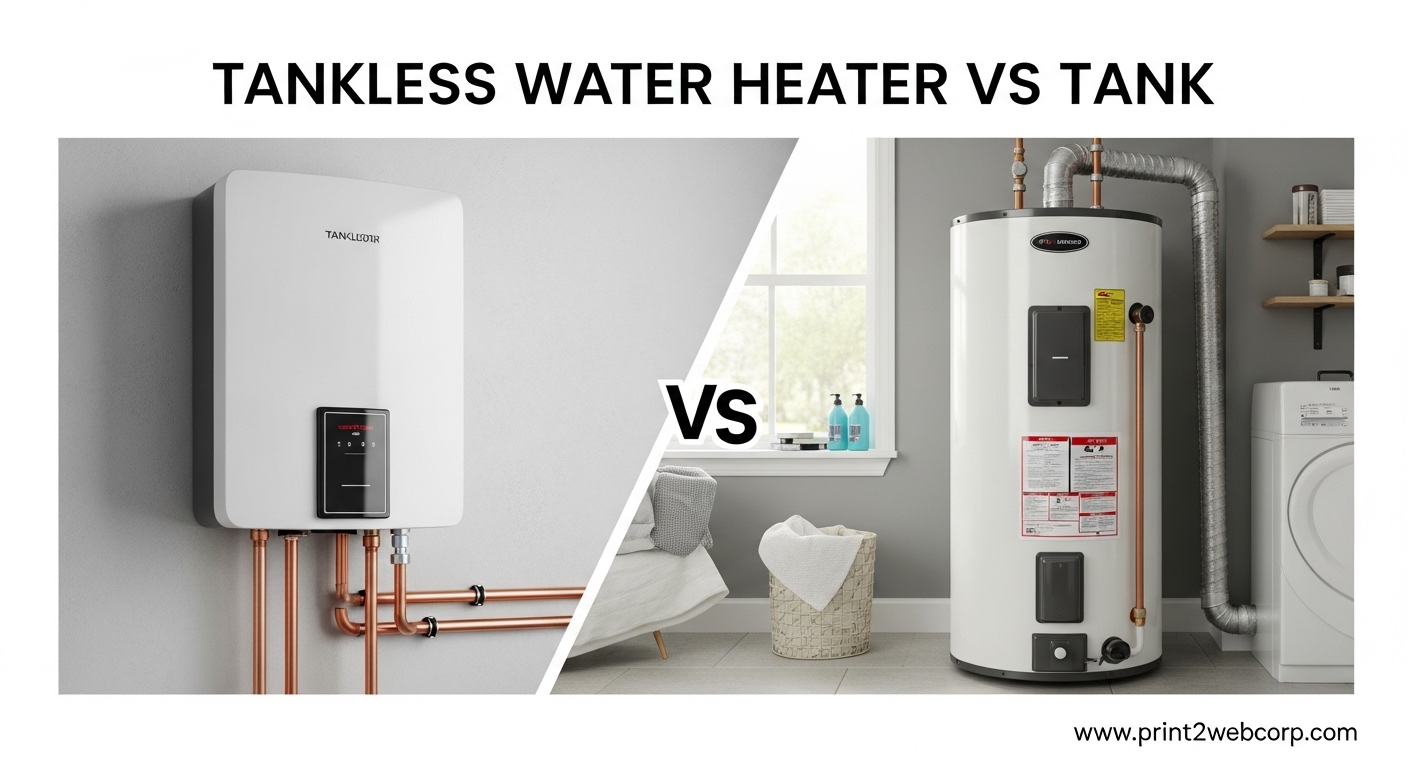
If you have been researching water heaters lately, you have probably stumbled across the debate: tankless water heater vs tank. We see this question come up constantly from homeowners trying to figure out which system actually makes sense for their home and budget. The short answer is that both options heat water effectively, but they work in completely different ways and come with distinct trade-offs that affect your monthly bills, installation complexity, and long-term satisfaction.
This guide cuts through the marketing noise and compares these two systems side-by-side using real-world data, actual cost figures, and honest assessments of where each option excels and falls short. By the end, you will know exactly which type of water heater fits your household’s hot water demands, your budget, and your home’s infrastructure.
Water heating accounts for roughly 17% of the average household’s energy consumption, according to the U.S. Department of Energy. That makes choosing the right system one of the most impactful decisions you can make for your home’s efficiency. Let us break it all down.
Quick Comparison: Tankless Vs Tank Water Heaters
The AI Overview and featured snippets for this topic use a consistent 6-category comparison format. Here is how tankless and tank water heaters stack up across the key factors that matter most:
Hot Water Supply
Tank water heaters store 30 to 50 gallons of hot water at all times, ready for use. When the tank empties, you must wait 20 to 60 minutes for it to refill and reheat. Tankless water heaters heat water on demand, meaning they theoretically provide endless hot water as long as you stay within their flow rate capacity. However, if multiple showers and appliances run simultaneously, a tankless unit can struggle to keep up, unlike the large storage tank that buffers demand.
Upfront Costs
Tank water heaters cost between $300 and $1,500 for the unit itself, with professional installation running another $500 to $1,500 depending on complexity. Total investment typically ranges from $800 to $3,000. Tankless units cost $1,000 to $3,000 for the heater, plus $500 to $1,500 or more for installation, particularly if gas line or electrical upgrades are needed. All-in costs for tankless can reach $7,000 to $8,000 in homes requiring significant modifications.
Energy Efficiency
Tank water heaters lose efficiency through standby heat loss, meaning the water in the tank cools down over time and requires reheating. Modern tanks achieve Energy Factor (EF) ratings of 0.55 to 0.75. Tankless units eliminate standby losses entirely, heating water only when needed. This translates to 8% to 34% greater efficiency depending on usage patterns, with EF ratings reaching 0.90 to 0.99 for high-efficiency models.
Lifespan
A traditional tank water heater lasts 10 to 12 years on average, sometimes extending to 15 years with excellent maintenance. Tankless units are built for longevity, typically lasting 20 years or more with proper care. That longer lifespan can partially offset the higher upfront investment over time.
Installation and Space
Tank water heaters are relatively straightforward to install, requiring standard 120-volt electrical outlets for electric models or gas connections for gas models. They take up significant floor space, usually 4 to 5 feet tall with a 2-foot footprint. Tankless heaters are compact and wall-mounted, freeing up floor space, but they demand proper venting (sometimes Category III or IV stainless steel for gas models), adequate gas line capacity, and potentially upgraded electrical service for electric models.
Maintenance
Tank water heaters require annual flushing to remove sediment buildup, especially in areas with hard water. Tankless units need periodic descaling to prevent mineral deposits on the heat exchanger, particularly in hard water regions. Tank heaters also require replacing the anode rod every 2 to 5 years to prevent tank corrosion. Tankless systems generally have fewer components prone to failure but can be more expensive to repair when issues arise.
How Tank Water Heaters Work
A traditional tank water heater operates exactly as the name suggests. The system maintains a reservoir of 30 to 50 gallons of water at a constant temperature, usually between 120 and 140 degrees Fahrenheit. Gas models use a burner at the bottom of the tank, while electric models use heating elements submerged in the water.
When you open a hot water tap, pressure pushes heated water out of the tank and through your pipes to the faucet or appliance. Simultaneously, cold water enters the tank bottom to replace the used water. A thermostat monitors the tank temperature and activates the heating source when the water cools below the set point.
This continuous cycling creates standby heat loss. Even with thick insulation, the tank inevitably loses some heat to the surrounding environment. The tank must then periodically reheat water to maintain its set temperature, even when no hot water is being used. This is why tank heaters use more energy in households with low hot water demand, the standby losses become a larger proportion of total energy use.
Storage tank water heaters have been the standard for decades because they are reliable, well-understood by every plumber, and relatively inexpensive to install and repair. The technology is mature, replacement parts are widely available, and most HVAC technicians have extensive experience with installation and troubleshooting.
How Tankless Water Heaters Work
Tankless water heaters, also called demand-type or instantaneous water heaters, take a fundamentally different approach. Instead of storing hot water, they heat it on the fly as it passes through the unit. When you open a hot water tap, a sensor detects the flow and triggers the heating mechanism, whether a gas burner or electric heating element.
For gas tankless units, water flows through a heat exchanger where it is warmed by the burner flame. Modern condensing models extract additional heat from exhaust gases, achieving very high efficiency ratings. Electric tankless units use resistance heating elements that activate instantly when water flows through internal chambers.
The key specification for tankless units is flow rate, measured in gallons per minute (GPM). A typical gas tankless heater provides 7 to 10 GPM, while electric models generally deliver 2 to 8 GPM depending on temperature rise requirements. The temperature rise depends on two factors: the incoming groundwater temperature and the desired output temperature. In cold climates, achieving a comfortable hot water temperature requires more energy, reducing the effective flow rate.
Users on forums like Reddit and DIY Stack Exchange often mention that electric tankless units struggle more with simultaneous multiple uses compared to gas models. The higher energy density of gas combustion allows gas tankless heaters to deliver more hot water per minute than electric equivalents at a comparable price point.
Initial Cost Comparison
Understanding the true cost of ownership requires looking beyond the sticker price. Let us break down what each system actually costs from purchase through installation.
Tank Water Heater Costs
A standard 40-gallon gas tank water heater typically costs $300 to $900 for the unit itself. Electric models fall in a similar range, $300 to $800. Premium models with longer warranties or enhanced features can run $1,000 to $1,500.
Installation adds $500 to $1,500 for most replacements. Factors affecting installation cost include the complexity of connecting to existing gas or electrical lines, whether code upgrades are needed, and labor rates in your area. Simple like-for-like replacements on lower floors of homes with easy access tend toward the lower end. Complex jobs requiring new gas lines, electrical panel upgrades, or difficult placements can hit $2,000 or more.
Total upfront investment for a tank water heater: $800 to $3,000 for most homeowners.
Tankless Water Heater Costs
Tankless units themselves cost $1,000 to $3,000 for quality gas models, with high-capacity units designed for whole-house hot water reaching $1,500 to $3,000. Electric tankless point-of-use units cost $200 to $500, while whole-house electric models range $500 to $1,500.
Installation complexity drives costs significantly higher than tank replacements. Gas tankless units often require:
- New stainless steel venting (Type IV): $300 to $800
- Gas line upgrades if existing line cannot supply sufficient BTUs: $300 to $1,000
- Condensate drainage installation: $150 to $400
- Possible electrical upgrades for electronic ignition: $100 to $300
- Labor for the more complex installation: $500 to $1,500
Forum users on Reddit frequently report total installed costs of $5,000 to $8,000 for tankless conversions, particularly in older homes requiring significant infrastructure updates. A homeowner on the r/HomeImprovement subreddit described paying $7,200 for a gas tankless installation that included a new gas line and upgraded venting.
Total upfront investment for a tankless water heater: $1,500 to $8,000 depending on home infrastructure needs.
When Tankless Costs Make Sense From Day One
In certain situations, the higher installation cost of tankless is easier to justify. If you are building a new home, adding a second bathroom, or conducting a major renovation where plumbing modifications are already happening, the incremental cost of going tankless is much lower. The infrastructure work is already being done.
Additionally, if your current tank heater is located in a finished living space where floor space is at a premium, the wall-mounted tankless option might enable reclaiming that square footage for other uses.
Operating Costs and Efficiency
Energy efficiency is where tankless systems have a clear theoretical advantage, but real-world savings depend heavily on usage patterns, climate, and local utility rates.
Understanding Standby Heat Loss
A tank water heater loses heat through its tank walls continuously. Even with excellent insulation, the warm water sitting in the tank gradually cools. The tank’s thermostat then fires up the heating source to bring the temperature back to setpoint. This cycle repeats throughout the day, consuming energy even when no hot water is being used.
Studies indicate standby heat loss can account for 15% to 25% of a tank water heater’s total energy consumption in typical households. In homes with low hot water usage, that proportion climbs even higher because the heating cycles are driven more by standby losses than by actual hot water demand.
What the Efficiency Ratings Mean
Both tank and tankless water heaters carry Energy Factor (EF) ratings that indicate overall efficiency. EF measures the ratio of useful hot water energy output to total energy input over a standardized daily cycle.
Standard tank gas heaters typically achieve EF ratings of 0.50 to 0.65. Electric tank heaters range from 0.90 to 0.95 because electric resistance heating converts nearly all input energy to heat, although this still results in higher operating costs due to electricity prices.
Tankless gas heaters achieve EF ratings of 0.80 to 0.95 for non-condensing models and 0.90 to 0.99 for high-efficiency condensing units. The improvement comes from eliminating standby losses, not from fundamentally more efficient heat transfer.
Real-World Energy Savings
According to U.S. Department of Energy estimates, a tankless water heater can be 8% to 34% more efficient than a tank system depending on usage. For a household using 41 gallons or less daily, tankless units realize 24% to 34% energy savings. At higher usage levels (86 gallons per day), savings drop to 8% to 14% because the relative impact of standby losses decreases.
Based on these figures, a typical household spending $600 per year on water heating could save $50 to $200 annually by switching to tankless. Over a 20-year lifespan, that totals $1,000 to $4,000 in energy savings, which partially or fully offsets the higher installation cost depending on your specific situation.
The Hard Water Complication
Forum users frequently raise the issue of hard water, and it deserves serious attention. In areas with hard water (high mineral content), both tank and tankless systems face challenges, but tankless units are particularly vulnerable.
Mineral deposits (primarily calcium and magnesium) accumulate inside tank heaters but tend to settle at the bottom where they can be flushed out during annual maintenance. In tankless units, scale builds up directly on the heat exchanger surfaces, reducing efficiency and potentially causing damage. This scale acts as an insulator, forcing the heater to work harder to transfer heat to the water.
Homeowners in hard water regions report needing to descale tankless units every 1 to 3 years, adding $100 to $300 per service call if done professionally. Some install water softeners specifically to protect their tankless investment, which adds its own ongoing cost and maintenance.
Installation Complexity
The installation process differs dramatically between these two systems, and this is one area where tank water heaters have a significant practical advantage.
Tank Water Heater Installation
Replacing a tank water heater is relatively straightforward for any licensed plumber. The existing connections typically match or require minimal adaptation. A gas tank heater needs a 120V outlet or hardwired connection, a gas supply line, and proper drafting venting to the exterior. Electric models need only a dedicated 240V circuit and water connections.
The job usually takes 4 to 6 hours for a straightforward replacement. Most municipalities require permits, but the inspection process is well-established and plumbers know the requirements cold. If the existing installation is up to code and accessible, replacement is a routine job that any experienced technician can handle.
Tankless Water Heater Installation
Installing a tankless system is considerably more involved. The process often requires:
Venting: Tankless gas heaters produce cooler exhaust than tank models and often require special stainless steel venting that can handle corrosive condensation. This venting costs significantly more than standard B-vent and may require longer runs to properly terminate outside.
Gas line capacity: A tankless heater needs substantially more BTU input than a tank heater. Your existing gas line may need upgrading to supply sufficient volume. A plumber must calculate the total demand from all gas appliances and ensure the line can deliver the required flow.
Electrical: Many tankless units have electronic ignition, control boards, and display screens that require a dedicated electrical connection. Some high-output electric models need 120 to 200 amps of service, potentially requiring a panel upgrade.
Condensate handling: High-efficiency condensing tankless units produce liquid condensate that must be drained properly, typically to a utility sink or floor drain. This requires installing drainage pipes and potentially a condensate pump.
Clearances: Tankless units require specific clearances from combustible materials and must be accessible for servicing. Proper placement is critical and may affect where the unit can be located.
This complexity explains why some plumbers hesitate to recommend tankless systems. The installation is more technically demanding, takes longer (often a full day or two), and leaves more room for things to go wrong. When a tankless installation fails or is improperly configured, the homeowner faces a much more complicated situation than a simple tank replacement.
Why Plumbers Sometimes Say No
The forum insight about plumbers not recommending tankless deserves unpacking. Beyond the installation complexity, there are practical reasons plumbers sometimes steer homeowners away from tankless:
First, the long payback period in moderate climates can mean the homeowner never recoups the installation premium through energy savings. A plumber who has seen hundreds of installations may be understandably skeptical of claims that tankless always makes financial sense.
Second, repair costs for tankless systems can be substantially higher. Control boards, sensors, and heat exchangers are expensive to replace. A tank heater repair typically costs $200 to $400, while a tankless repair can easily run $500 to $1,000 or more.
Third, in areas with poor water quality, the ongoing maintenance burden falls on the homeowner to maintain. If maintenance is neglected, the tankless unit fails prematurely and the plumber gets called to deal with the aftermath.
None of this means tankless is wrong for every home. Many plumbers enthusiastically recommend tankless for the right application. But the skepticism is rooted in real-world experience with installations that did not perform as expected.
Lifespan and Maintenance
Durability and longevity are significant factors in the true cost of ownership, and this is an area where tankless systems have a clear structural advantage.
Tank Water Heater Lifespan
Most tank water heaters are rated for 10 to 12 years of service. With exceptional maintenance and ideal water conditions, some units stretch to 15 years, but this is the exception rather than the rule. The limiting factor is typically internal corrosion. Even with sacrificial anode rods protecting the tank interior, the steel shell eventually corrodes through.
Signs your tank heater is approaching end of life include rust on the tank exterior, rumbling or popping noises from sediment buildup, water taking longer to heat, and water that looks rusty or has an odd smell. When a tank fails, it typically does so catastrophically, flooding the surrounding area. Replacing the anode rod annually can extend tank life, but most homeowners do not perform this maintenance.
Tankless Water Heater Lifespan
Tankless units are designed for 20+ years of service, roughly double the lifespan of tank heaters. The difference comes from their design: no large water reservoir sitting continuously full of hot water means no constant contact between water and metal tank walls. The heat exchanger in a tankless unit experiences thermal stress from cycling, but modern designs handle thousands of cycles without significant degradation.
Heat pump water heaters, sometimes discussed as a third option, use a different technology entirely and are beyond the scope of this comparison, but they deserve consideration for their exceptional efficiency if you are researching alternatives.
Maintenance Requirements
Tank water heaters need annual flushing to remove sediment, particularly in areas with hard water. The process involves connecting a hose to the drain valve and flushing until water runs clear. The anode rod should be inspected every 2 to 3 years and replaced when significantly corroded, typically a $50 to $150 service call if done professionally.
Tankless units require periodic descaling to remove mineral buildup, especially in hard water areas. The process involves circulating a descaling solution through the unit and is more involved than simple tank flushing. Many manufacturers recommend annual descaling, and the service typically costs $100 to $300 if performed by a professional. Some homeowners do this themselves with basic equipment and inexpensive descaling solution.
Both systems benefit from checking pressure relief valves periodically and inspecting connections for leaks. Neither requires complex ongoing maintenance, but tank heaters are somewhat more forgiving of neglected maintenance, while tankless units degrade more quickly if scale accumulates unchecked.
Pros and Cons Side-by-Side
Here is a straightforward breakdown of what each system gets right and where each falls short.
Tank Water Heater Pros
- Lower upfront cost ($300 to $1,500 unit, $800 to $3,000 installed)
- Simple, well-understood technology
- Any plumber can install or repair
- Handles high simultaneous hot water demand through stored capacity
- Works during power outages (gas models with standing pilot)
- Lower repair costs when issues arise
- More forgiving of hard water conditions
Tank Water Heater Cons
- Standby heat loss reduces efficiency
- Limited hot water supply (30 to 50 gallons at a time)
- Requires significant floor space
- Shorter lifespan (10 to 12 years typically)
- Larger carbon footprint over time
- Continuous energy use even when no hot water is needed
Tankless Water Heater Pros
- Eliminates standby heat loss for higher efficiency
- Longer lifespan (20+ years)
- Compact wall-mounted design saves floor space
- Theoretically endless hot water (within flow rate limits)
- Lower operating costs in the right application
- Smaller environmental footprint
- Potentially higher home resale value
Tankless Water Heater Cons
- Higher upfront cost ($1,000 to $3,000 unit, $1,500 to $8,000 installed)
- More complex installation requiring infrastructure upgrades
- Flow rate limitations with multiple simultaneous uses
- Electric models will not operate during power outages
- Sensitive to hard water scaling
- Higher repair costs when problems occur
- Longer payback period for energy savings
- More demanding maintenance in hard water areas
Which Should You Choose?
The decision between tankless and tank comes down to your specific circumstances. Here is a framework to help you decide.
Choose a Tank Water Heater If:
- Your upfront budget is limited ($3,000 or less for full installation)
- You have a large household with multiple people showering simultaneously
- You want a simple, low-maintenance solution
- You already have adequate gas service and venting infrastructure
- Your water has high mineral content and you do not want to manage a water softener
- You want reliable operation during power outages (choose gas with standing pilot)
- You prefer lower repair costs if something goes wrong
- You plan to sell your home in the next 10 years
Choose a Tankless Water Heater If:
- Floor space is at a premium in your home
- Your household has moderate hot water demand (two or fewer simultaneous uses)
- You are building new or doing a major renovation where installation complexity is already being managed
- You want to maximize energy efficiency and reduce monthly utility bills
- You are willing to perform or pay for regular maintenance (annual descaling in hard water areas)
- You plan to stay in your home for 15+ years where the longer lifespan pays off
- You want the latest technology and are comfortable with more complex systems
- You live in an area with high utility rates where the efficiency advantage translates to meaningful savings
Frequently Asked Questions
Which is better tank or tankless water heater?
The answer depends on your specific situation. Tank water heaters cost less upfront ($800-$3,000 installed) and work well for families who use multiple hot water sources simultaneously. Tankless water heaters cost more to install ($1,500-$8,000) but last longer (20+ years) and can save 30-50% on energy bills. Choose tank if you want lower upfront costs and have high simultaneous hot water needs. Choose tankless if you have limited space, want lower operating costs, and can handle the installation complexity.
Why do plumbers not recommend tankless water heaters?
Some plumbers hesitate to recommend tankless due to several factors: higher installation costs requiring gas line or electrical upgrades (sometimes $7,000-$8,000 total installed), complex venting requirements, and sensitivity to hard water causing scale buildup on the heat exchanger. Additionally, if a tankless unit fails completely, you have no hot water at all, whereas a tank heater typically shows warning signs before complete failure. However, many professional plumbers do recommend tankless for the right homes, especially with good water quality and moderate hot water demand.
What are the downsides of tankless water heaters?
The main downsides include: higher upfront costs ($1,000-$3,000 unit plus $500-$1,500+ installation), flow rate limitations that can struggle with multiple simultaneous uses in large households, dependence on continuous power (electric models will not work during outages), potential temperature fluctuations if flow rate exceeds capacity, and sensitivity to mineral buildup in hard water areas requiring regular descaling. The payback period for cost savings can stretch 10-15 years in moderate climates before energy savings offset the installation premium.
Can I replace my 40 gallon water heater with a tankless water heater?
Yes, you can replace a 40-gallon tank with a tankless unit, but sizing matters. A tankless heater is rated by flow rate (gallons per minute) rather than tank size. For a typical 40-gallon household, you would need a tankless unit rated at 7-10 GPM for gas or 18-24 kW for electric. Proper sizing requires considering your climate (colder groundwater requires more energy to heat), number of bathrooms, and simultaneous usage patterns. Professional assessment is recommended to ensure the tankless unit can meet your household’s hot water demands.
Final Verdict
Both tank and tankless water heaters have earned their place in American homes for good reasons. The tankless water heater vs tank decision ultimately hinges on your budget, household size, and how long you plan to stay in your home.
If upfront cost is your primary concern and you have a busy household with high simultaneous hot water demand, a quality tank water heater remains a sensible choice. Modern tanks are highly efficient, reliable, and any plumber can service them. For most homeowners, a tank heater will deliver satisfactory performance at a price that does not require extensive financial planning.
If you have the budget to invest in tankless, value floor space, and plan to stay in your home long enough for the efficiency gains to pay off the installation premium, tankless is the way to go. Just be realistic about the total installed cost, commit to regular maintenance, and ensure your household usage patterns fit within a tankless unit’s flow rate capabilities.
Water heating is not a decision to rush. Take the time to calculate your actual hot water usage, get multiple installation quotes, and talk to a plumber who has experience with both types in homes similar to yours. The right choice is the one that fits your specific situation and gives you reliable hot water without buyer’s remorse.
Leave a Reply