
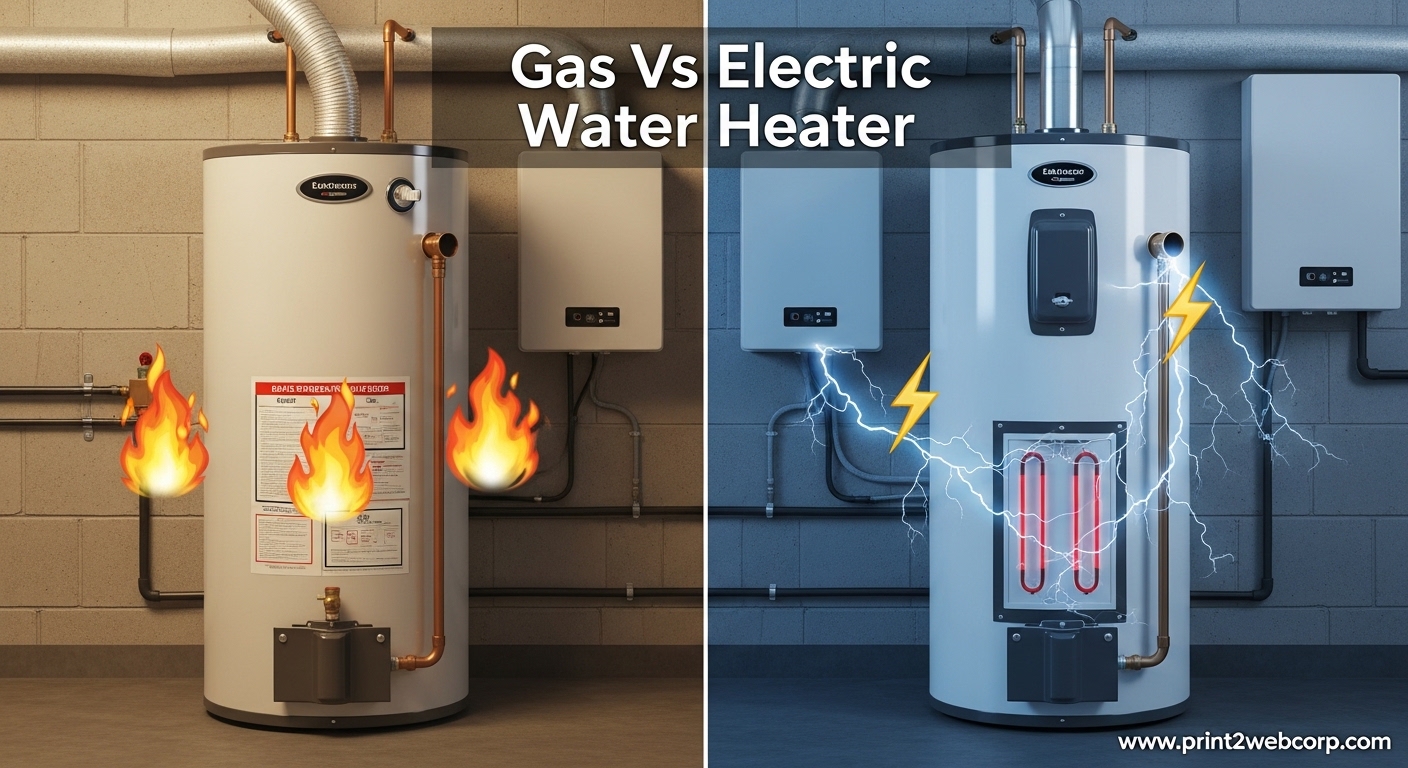
Choosing between a gas vs electric water heater is one of the most important decisions homeowners face when replacing or upgrading their hot water system. Your choice affects monthly energy bills, installation costs, environmental impact, and daily comfort for years to come. Water heating typically accounts for 18-20% of home energy use, making this decision significant for both your wallet and the planet.
After analyzing both systems extensively and reviewing real user experiences from hundreds of homeowners, I can tell you there is no one-size-fits-all answer. The right choice depends on your existing infrastructure, household size, local utility rates, climate, and budget priorities. Let me break down everything you need to know to make an informed decision.
This comprehensive comparison covers the latest tankless technology from both fuel types, examining real-world performance, costs, and user experiences. For more information on related Home Appliances, visit our category page. We’ll also explore how these systems fit into broader Heating, Cooling & Air Quality considerations for your home.
Gas vs Electric Water Heater: Quick Comparison
Here’s a direct side-by-side comparison of the key differences between gas and electric water heaters. This overview highlights the most important decision factors that homeowners consider when choosing between these two fuel types.
Gas water heaters typically cost more upfront but offer lower monthly operating costs in areas with affordable natural gas. They provide faster recovery rates, making them ideal for larger households with high hot water demand. Electric units are generally less expensive to purchase and install, with higher energy efficiency ratings but potentially higher monthly costs depending on local electricity rates.
When comparing tankless options specifically, gas models typically deliver higher flow rates suitable for whole-home applications, while electric units excel in point-of-use scenarios or smaller homes. Let’s examine two top-rated tankless models that represent the best of each fuel type.
| Product | Specs | Action |
|---|---|---|
 Rheem RTG-95DVLN-3 Gas Tankless Rheem RTG-95DVLN-3 Gas Tankless |
|
Check Latest Price |
 Rheem RTEX-24 Electric Tankless Rheem RTEX-24 Electric Tankless |
|
Check Latest Price |
Gas Water Heaters: Complete Analysis
Rheem RTG Series 9.5 GPM Natural Gas Tankless Water Heater Indoor | 199,900 BTUs High Efficiency On Demand, Continuous Hot Water | Non-Condensing
9.5 GPM Flow Rate
199900 BTU Output
82% Energy Factor
Indoor Rated
Pros
- Faster hot water recovery
- Lower monthly operating costs
- Higher flow rates for multiple fixtures
- Works during power outages (some models)
- Longer lifespan in ideal conditions
Cons
- Higher upfront cost
- Requires gas line and venting
- More complex maintenance
- Potential carbon monoxide risk
- Lower energy efficiency rating
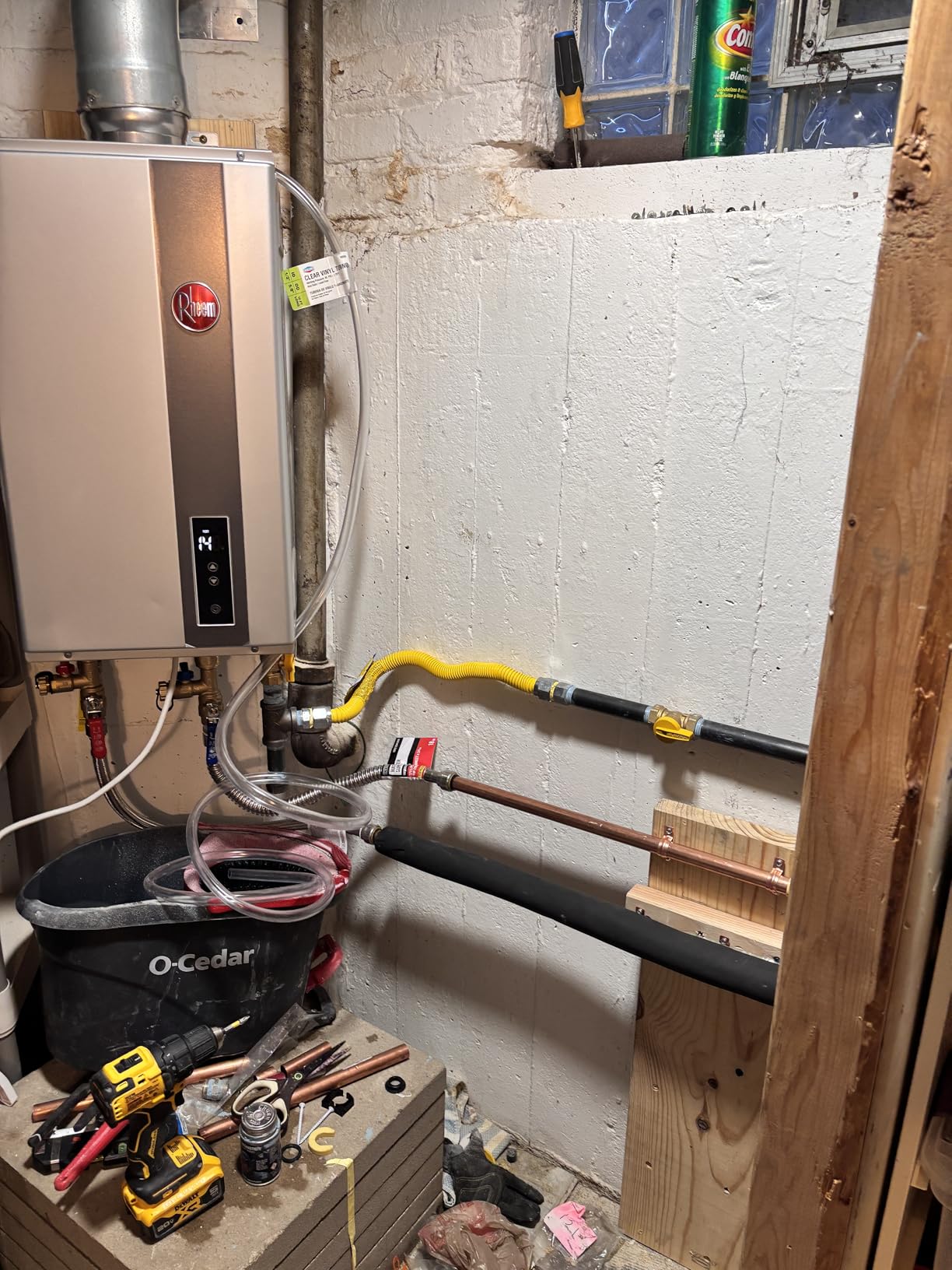
Gas water heaters use natural gas or propane to heat water through a combustion process. A burner at the bottom of the unit heats the water directly, with hot water rising naturally to the top of the tank. This heating method is incredibly fast, allowing gas units to recover quickly after heavy hot water use. Tankless gas models like the Rheem RTG-95DVLN-3 can deliver up to 9.5 gallons per minute, making them ideal for larger homes with multiple bathrooms.
I’ve found that gas water heaters shine in households with 3+ bathrooms or families who frequently run multiple hot water applications simultaneously. The recovery rate advantage is substantial, with gas units typically able to heat 30-45 gallons per hour compared to 14-20 gallons for standard electric models. This means you’re less likely to run out of hot water during back-to-back showers or when running the dishwasher and washing machine at the same time.
The primary advantage of gas water heaters is lower operating costs in most regions. Natural gas is typically 2-3 times cheaper per unit of energy than electricity, which translates to significant monthly savings over the lifespan of the unit. Many homeowners report saving 30-50% on their water heating costs by choosing gas over electric, though the exact savings depend heavily on local utility rates.
From a technical standpoint, gas water heaters have energy efficiency ratings between 60-95%, with standard models around 65% and high-efficiency condensing units reaching 95%. This means some heat is lost through venting, which is why their efficiency ratings appear lower than electric units. However, because natural gas costs less per BTU than electricity, the lower efficiency doesn’t necessarily mean higher bills.
Installation requirements for gas water heaters are more complex and expensive. You’ll need a gas line (either existing or newly installed), proper venting to exhaust combustion gases, and adequate clearance space around the unit. Tankless gas models like the RTG-95DVLN-3 require specific venting materials and must be installed by qualified professionals. The total installation cost typically ranges from $1,500-3,000 depending on whether gas infrastructure already exists.
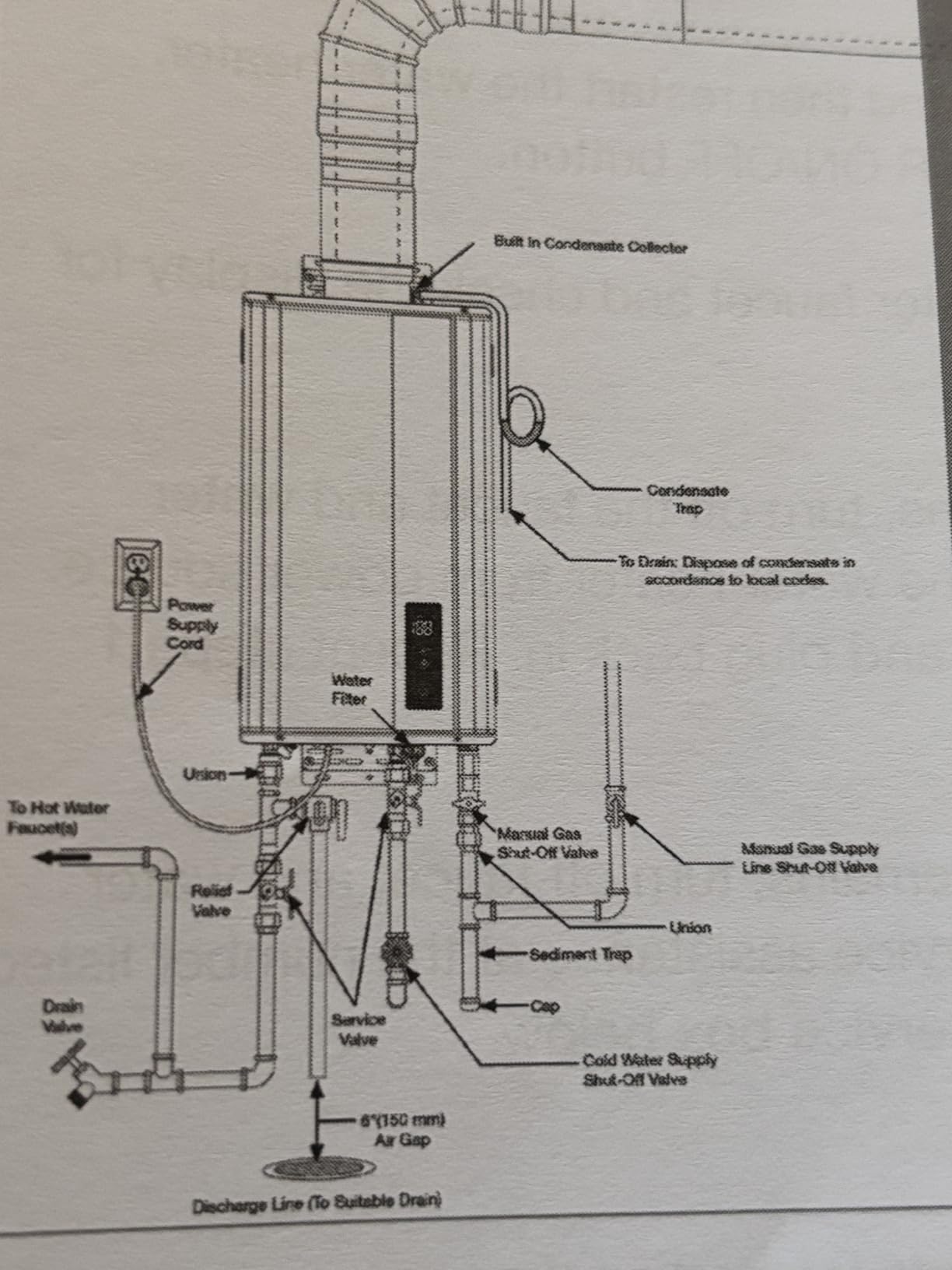
Gas water heaters have some specific safety considerations that homeowners should understand. The combustion process produces carbon monoxide, making proper venting absolutely critical. Annual maintenance should include checking the vent system, burner, and gas connections. Modern units include safety features that shut down the unit if problems are detected, but carbon monoxide detectors are still recommended in any home with gas appliances.
The lifespan of gas water heaters typically ranges from 10-15 years, slightly shorter than electric models. The more complex design with more moving parts contributes to this difference. However, many homeowners report getting 15+ years from well-maintained gas units, especially in areas with clean water that minimizes mineral buildup in the tank.
Choose Gas If:
Your home already has natural gas infrastructure, you have a larger household (3+ bathrooms), your local natural gas rates are affordable, you want the lowest possible monthly operating costs, you frequently run multiple hot water fixtures simultaneously, or you live in a colder climate where faster recovery times matter.
Skip Gas If:
Your home doesn’t have gas lines and installation would be prohibitively expensive, you want the simplest possible installation, you’re concerned about carbon monoxide safety, you prefer minimal maintenance requirements, or you live in an area where electricity is significantly cheaper than natural gas.
Electric Water Heaters: Complete Analysis
Rheem RTEX-24 24kW 240V Electric Tankless Water Heater, Gray
24kW Heating Power
5.9 GPM Flow Rate
99.8% Efficiency
No Venting Required
Pros
- Higher energy efficiency (99.8%)
- Lower upfront cost
- Simpler installation with no venting
- Zero emissions at point of use
- Longer lifespan
- Less maintenance required
Cons
- Higher monthly operating costs
- Slower recovery rate
- Requires substantial electrical capacity
- Performance drops in cold climates
- Doesn't work during power outages
Electric water heaters use heating elements powered by electricity to warm water directly through resistance heating. When electricity passes through the heating elements, they generate heat that transfers to the water in the tank. Tankless electric models like the Rheem RTEX-24 heat water on-demand as it flows through the unit, eliminating standby heat loss and providing continuous hot water.
The most significant advantage of electric water heaters is their exceptional energy efficiency, typically around 99.8%. Nearly all the electrical energy consumed is converted directly into heat, with virtually no waste. However, this efficiency advantage is often offset by the higher cost of electricity compared to natural gas in many regions. The real operating cost comparison depends entirely on your local utility rates.
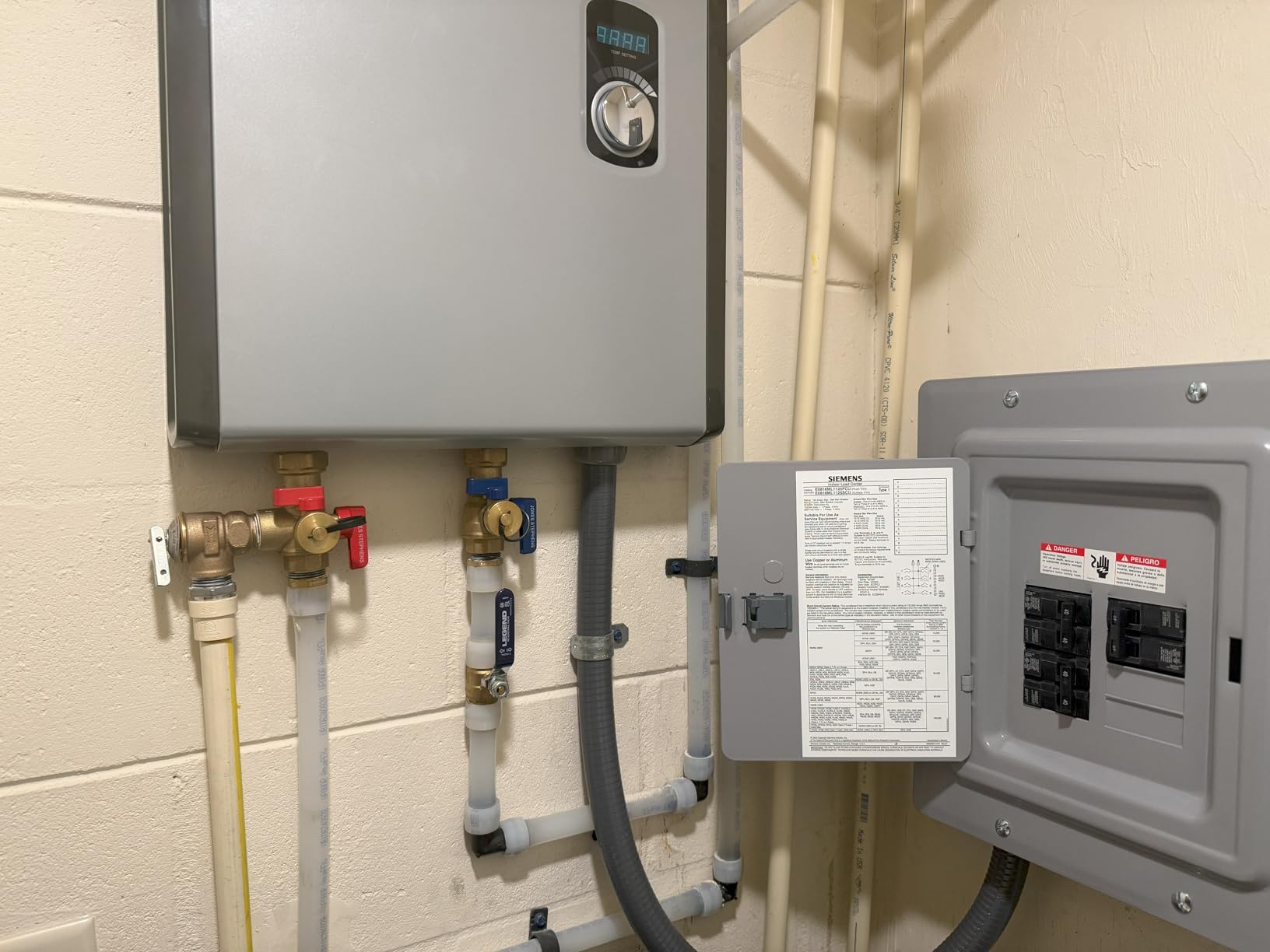
Electric water heaters are generally simpler to install than gas models because they don’t require venting or gas lines. However, tankless electric units like the RTEX-24 have substantial electrical requirements. This 24kW model needs three 40-amp double pole breakers and recommends 200-amp household service for optimal performance. Installation costs typically range from $800-1,500, but you may need to upgrade your electrical panel, which adds significant expense.
One consideration I’ve found many homeowners overlook is the impact of groundwater temperature on electric tankless performance. In warmer climates where groundwater enters the system at 65-70°F, electric units perform excellently. In colder northern regions where groundwater might be 45-50°F, the same unit struggles to deliver sufficient temperature rise for comfortable showers. This is why gas tankless units often make more sense in cold climates.
The recovery rate for electric water heaters is slower than gas models, typically 14-20 gallons per hour for standard tank units. Tankless electric models have flow rates that depend heavily on the temperature rise required, with most whole-home units delivering 4-6 GPM at a realistic temperature rise. The Rheem RTEX-24 delivers 5.9 GPM, which works well for 1-2 bathroom homes but may struggle with multiple simultaneous showers.
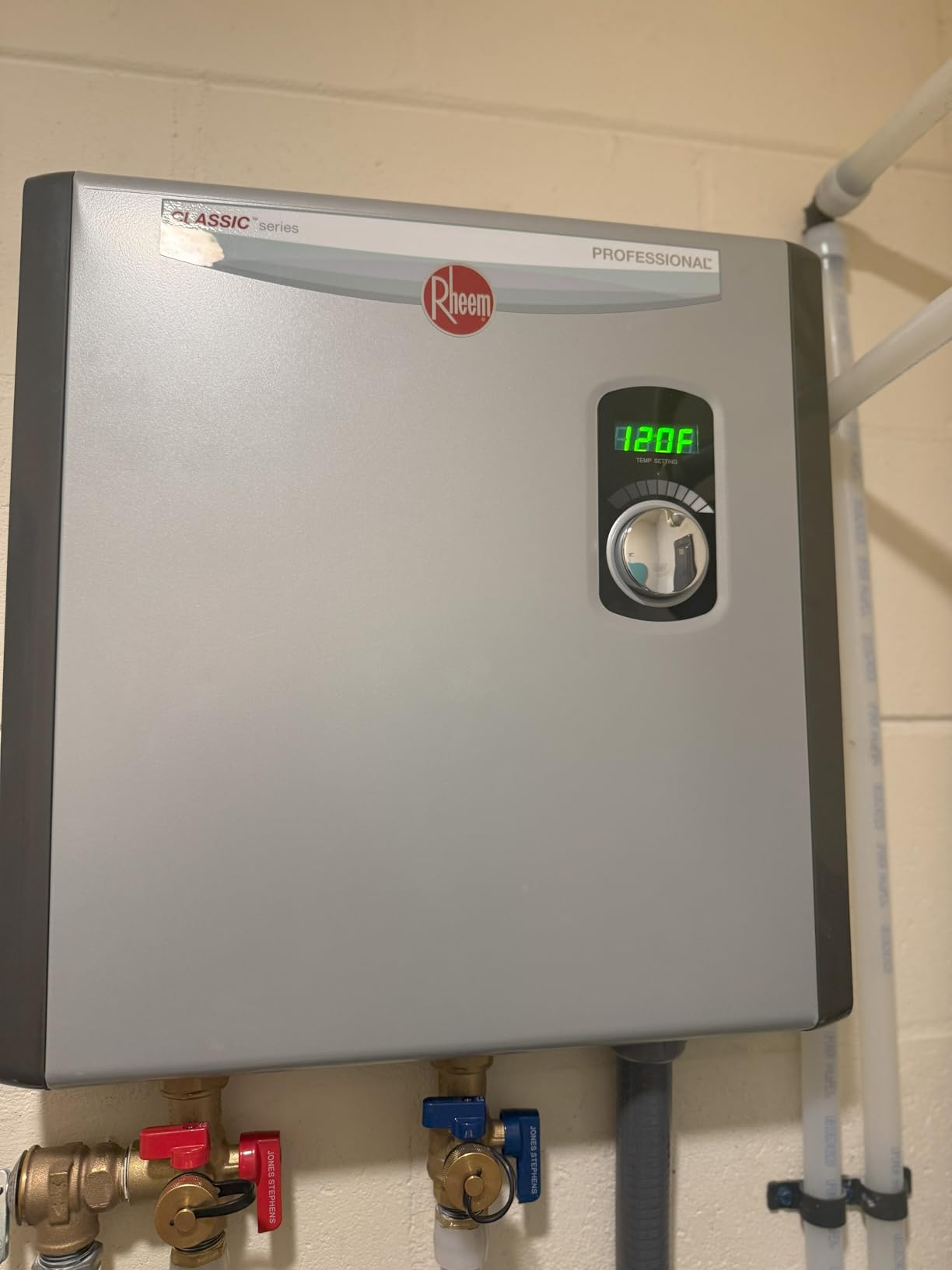
From a maintenance perspective, electric water heaters are generally simpler and require less service than gas models. There’s no burner to clean, no pilot light, no venting system to maintain, and no combustion byproducts to manage. The primary maintenance task is periodically flushing the tank to remove mineral sediment. Tankless electric units have even fewer maintenance requirements, typically just descaling every 1-2 years depending on water hardness.
Electric water heaters typically last 15-20 years, longer than gas models. The simpler design with fewer moving parts contributes to this longevity. Many homeowners report their electric water heaters lasting 20+ years with proper maintenance. The tankless electric models like the RTEX-24 can last even longer with their durable stainless steel heat exchangers and minimal wear components.
One limitation of electric water heaters is that they don’t operate during power outages. While some gas water heaters also require electricity for ignition, traditional gas models with standing pilot lights can provide hot water during power failures. This consideration is particularly important in areas prone to extended power outages.
Choose Electric If:
Your home doesn’t have natural gas service, you have a smaller household (1-2 bathrooms), you live in a warmer climate, your electrical panel can accommodate the load, you want minimal maintenance requirements, you prefer zero emissions at the point of use, or you plan to pair the system with solar panels.
Skip Electric If:
Your local electricity rates are very high, you have a large household with high hot water demand, you live in a cold climate, your electrical panel needs expensive upgrades, you frequently experience power outages, or you want the lowest possible monthly operating costs.
Cost Breakdown: Installation, Operating, and Maintenance
Understanding the complete cost picture is essential when choosing between gas and electric water heaters. The upfront purchase price tells only part of the story. You need to consider installation costs, monthly operating expenses, maintenance requirements, and total cost of ownership over the unit’s lifespan.
Installation costs vary dramatically based on your existing infrastructure. If you already have a gas line and proper venting, installing a gas water heater typically costs $1,000-1,500 for a tank unit or $1,500-2,500 for a tankless model. However, if you need to run a new gas line and install venting, installation can exceed $3,500. Electric water heaters generally cost $800-1,200 to install since they only require electrical connections, but upgrading your electrical panel for a tankless unit can add $1,500-3,000 to the total.
Monthly operating costs depend heavily on local utility rates. In areas where natural gas costs $1.00 per therm and electricity costs $0.12 per kWh, gas water heaters typically cost 40-50% less to operate. The average household spends $15-25 monthly on gas water heating compared to $40-60 for electric. However, in regions with expensive natural gas and cheap electricity (some areas with hydroelectric power), this cost difference narrows considerably or even reverses.
Maintenance costs also differ between the two types. Gas water heaters typically require annual professional servicing at $100-150 per visit to check the burner, venting system, and gas connections. Electric water heaters need minimal professional maintenance, perhaps every 2-3 years at $75-100 per visit. Over a 15-year lifespan, this difference adds up to $750-1,125 in savings for electric models.
The total cost of ownership calculation must factor in the unit’s lifespan. Electric water heaters typically last 15-20 years compared to 10-15 years for gas models. This means you might need to replace a gas water heater once during a 30-year homeownership period, while an electric unit might last the entire time. When you add up purchase price, installation, operating costs, maintenance, and replacement costs over 20 years, gas and electric water heaters often end up with surprisingly similar total costs despite very different cost structures.
Switching from one fuel type to another adds substantial expense. Converting from electric to gas typically costs $2,500-4,000 for gas line installation, venting, and the new unit. Converting from gas to electric usually costs $1,500-3,000 depending on electrical panel upgrades needed. These switching costs generally aren’t worth it unless you’re already replacing an aging unit.
Performance and Energy Efficiency Comparison
When comparing gas vs electric water heater performance, several key metrics matter: recovery rate, flow rate, energy efficiency, and temperature rise capability. Understanding these technical specifications helps you choose the right system for your household’s specific needs.
Recovery rate measures how quickly a water heater can reheat a full tank of water. Gas water heaters typically recover at 30-45 gallons per hour, while standard electric models recover at 14-20 gallons per hour. This substantial difference means gas units can handle back-to-back showers much more effectively. Tankless models don’t have recovery rates in the traditional sense since they provide continuous hot water, but their flow rate serves a similar function.
Flow rate is particularly important for tankless models. The Rheem RTG-95DVLN-3 gas tankless delivers 9.5 GPM, enough to supply 2-3 bathrooms simultaneously. The Rheem RTEX-24 electric tankless provides 5.9 GPM, suitable for 1-2 bathrooms depending on your desired temperature rise. In practical terms, the gas unit can handle a shower plus dishwasher plus laundry simultaneously, while the electric unit might struggle with this combination.
Energy efficiency ratings can be misleading when comparing gas and electric units. Gas water heaters have Energy Factor (EF) ratings between 0.60-0.95, meaning 60-95% efficiency. Electric water heaters rate around 0.99, nearly 100% efficient. However, because electricity costs much more per BTU than natural gas in most areas, the more efficient electric unit often costs more to operate. The key metric for your decision should be annual operating cost, not efficiency rating.
Temperature rise capability varies significantly between fuel types. Gas tankless units can achieve higher temperature rises because of their powerful burners, making them more suitable for cold climates where groundwater enters the system at 45-50°F. Electric tankless units struggle in these conditions because achieving a 70-80°F temperature rise requires more power than most residential electrical systems can provide.
First Hour Rating (FHR) is an important metric for tank-style water heaters, measuring how much hot water the unit can supply in the first hour of use. Gas tank units typically have higher FHR ratings than comparable electric models, again because of their faster recovery rates. This makes gas tank units better suited for households that use large amounts of hot water in short periods, such as morning routines when multiple family members shower in succession.
Lifespan and Durability: Which Lasts Longer?
The longevity of your water heater significantly impacts its lifetime cost and replacement frequency. Based on extensive user feedback and industry data, electric water heaters typically outlast gas models by several years. This difference stems from the simpler design and fewer moving parts in electric units.
Electric water heaters typically last 15-20 years, with many homeowners reporting 20+ years of service from well-maintained units. The heating elements may need replacement once during this lifespan, but the tank and other components often remain functional for decades. Tankless electric models like the Rheem RTEX-24 can last even longer, with some users reporting 25+ years of operation.
Gas water heaters typically last 10-15 years, though high-quality models maintained properly can reach 20 years. The more complex design with burners, pilot lights, and venting systems creates more potential failure points. The combustion process can also accelerate tank corrosion. However, many homeowners report getting excellent longevity from gas water heaters, especially in areas with clean water that minimizes sediment buildup.
Water quality affects lifespan more than fuel type. Hard water causes mineral buildup that reduces efficiency and shortens lifespan for both gas and electric units. Installing a water softener can extend the life of either type by 5-10 years. Regular maintenance, including annual flushing of tank models and descaling of tankless units, also significantly extends lifespan regardless of fuel type.
One factor many homeowners overlook is that tankless water heaters of both types often last longer than tank models. Without a standing tank of water that can corrode, tankless units can last 20-25 years with proper maintenance. This longer lifespan helps offset their higher upfront cost when calculating total cost of ownership.
Safety Considerations and Requirements
Safety considerations differ significantly between gas and electric water heaters. Understanding these differences is essential for protecting your family and making an informed choice that matches your comfort level with various risks.
Gas water heaters carry specific safety concerns related to combustion. The burning of natural gas produces carbon monoxide, a colorless, odorless gas that can be deadly. Proper venting is absolutely critical to safely exhaust these combustion gases. Annual professional inspection of the venting system is essential. Modern units include safety features that shut down the system if venting problems are detected, but carbon monoxide detectors are still strongly recommended in any home with gas appliances.
Gas water heaters also carry a small risk of gas leaks, which can create fire or explosion hazards. Modern units include multiple safety features to prevent these problems, but the risk exists. Some homeowners are uncomfortable with any combustion appliance in their home, preferring the perceived safety of electric systems.
Electric water heaters eliminate combustion-related risks entirely. They produce no carbon monoxide and require no venting. However, they carry their own safety considerations. The high amperage draw of tankless electric models creates significant electrical load that requires properly sized wiring and breakers to prevent fire hazards. Professional electrical installation is absolutely essential.
Both types require pressure relief valves to prevent dangerous pressure buildup in the tank. This critical safety device should be tested annually to ensure proper function. Failure of the pressure relief valve can lead to catastrophic tank failure, though this is rare with properly maintained units.
Power outage behavior differs between the types. Traditional gas water heaters with standing pilot lights can provide hot water during power outages, a significant advantage in areas prone to extended outages. However, many modern gas water heaters require electricity for ignition, eliminating this advantage. Electric water heaters cannot function during power outages unless paired with a backup generator or battery system.
Environmental Impact and Sustainability
The environmental considerations of gas vs electric water heaters involve several factors: carbon emissions, energy efficiency, renewable energy compatibility, and manufacturing impacts. The environmental “winner” depends heavily on your local electricity generation mix and personal priorities.
Gas water heaters directly produce carbon emissions through combustion. A typical gas water heater produces 2-3 tons of CO2 annually, depending on usage. High-efficiency models can reduce this by 20-30%, but emissions remain significant. For homeowners focused on reducing their direct carbon footprint, gas water heaters present a clear disadvantage.
Electric water heaters produce zero emissions at the point of use, but their environmental impact depends on how your electricity is generated. In regions powered primarily by coal or natural gas, electric water heaters indirectly cause significant carbon emissions. In areas with renewable energy sources like hydro, wind, or solar, electric water heaters become much more environmentally friendly. As the electrical grid continues to decarbonize, electric water heaters become increasingly sustainable over time.
Heat pump water heaters, a hybrid technology, offer an interesting middle path. These units use electricity to move heat rather than generate it directly, making them 2-3 times more efficient than standard electric resistance heaters. While they cost more upfront, heat pump water heaters can reduce water heating energy consumption by 60% compared to standard electric models. Many Reddit discussions point to heat pumps as “the only correct answer” for efficiency-focused homeowners willing to pay more upfront.
The manufacturing impact of both types is similar, with gas units being slightly more complex to produce. Tankless models of both types use fewer materials than tank units, giving them a manufacturing advantage. The longer lifespan of electric water heaters also reduces their lifetime environmental impact by requiring fewer replacements.
Which Should You Choose? Decision Framework
After examining all factors, the choice between gas and electric water heaters comes down to your specific circumstances. Use this decision framework to identify which type makes the most sense for your household. There is no universally better option, but there is likely a better option for you.
Choose Gas If: Your home already has natural gas service, you have 3+ bathrooms or a large family, your local natural gas rates are affordable, you want the lowest monthly operating costs, you frequently run multiple hot water fixtures simultaneously, you live in a colder climate, you want faster recovery rates, or you’re concerned about power outages. Gas is particularly compelling for larger households in regions with inexpensive natural gas.
Choose Electric If: Your home lacks natural gas service, you have 1-2 bathrooms or a smaller household, you live in a warmer climate, your electrical panel can accommodate the load, you want minimal maintenance, you prefer zero emissions at point of use, you plan to install solar panels, or you want the longest possible lifespan. Electric makes particular sense for smaller homes in warm climates with good solar access.
Consider Heat Pump If: You want maximum efficiency, you’re willing to pay more upfront for long-term savings, you have space for the unit, you live in a climate where heat pumps work effectively, or you’re committed to reducing your environmental impact. Heat pump hybrids offer the best of both worlds but require careful consideration of installation requirements.
For large families in cold climates with existing gas service, gas water heaters usually make the most sense. The lower operating costs and faster recovery rates align perfectly with high-demand usage patterns. For smaller households in warm climates or homes without gas service, electric units typically provide the better overall value proposition despite potentially higher monthly costs.
When considering other home climate systems, you might also explore options like the best dehumidifier or air purifier to complement your home comfort setup. These systems work together to create a healthy, comfortable indoor environment. For more on Kitchen Appliances that may affect your water heater placement and needs, explore our comprehensive guides.
Frequently Asked Questions
What are the disadvantages of electric water heaters?
The main disadvantages of electric water heaters include higher monthly operating costs in most regions, slower recovery rates compared to gas models, reduced performance in cold climates, substantial electrical requirements for tankless units, and inability to function during power outages. However, they offer lower upfront costs, higher efficiency ratings, longer lifespans, and simpler maintenance.
What size water heater do I need for 2 people?
For 2 people, a 30-40 gallon tank water heater typically suffices, or a tankless unit with 4-6 GPM flow rate. If both people shower at the same time or you frequently run multiple fixtures, consider 40-50 gallons or a higher flow rate tankless model. Tankless options like the Rheem RTEX-24 (5.9 GPM) work well for 2-person households in most climates.
How much hot water does a 10 minute shower use?
A 10-minute shower typically uses 20-40 gallons of hot water depending on showerhead flow rate. Standard showerheads deliver 2.5 gallons per minute, using 25 gallons in 10 minutes. Low-flow showerheads use 1.5-2.0 GPM, reducing consumption to 15-20 gallons. This usage helps determine whether your water heater’s capacity and recovery rate meet your household’s needs.
Do gas water heaters work during power outages?
Traditional gas water heaters with standing pilot lights can work during power outages because they don’t require electricity to heat water. However, most modern gas water heaters use electronic ignition and require electricity to operate, eliminating this advantage. Tankless gas models also require electricity for controls and ignition. Check your specific model’s requirements for outage operation.
Which type of water heater has a longer lifespan?
Electric water heaters typically last 15-20 years, compared to 10-15 years for gas models. The simpler design with fewer moving parts contributes to electric models’ longevity. Tankless units of both types often last 20-25 years. Proper maintenance, water quality management, and regular flushing can extend the lifespan of either type by several years.
Conclusion
The gas vs electric water heater decision ultimately comes down to your specific circumstances, priorities, and infrastructure. There is no universally better option, but there is almost certainly a better choice for your particular situation. By carefully considering your household size, local utility rates, climate, existing infrastructure, and long-term plans, you can make a decision that serves you well for 15-20 years.
For homeowners with existing gas service, larger households, or properties in cold climates, gas water heaters typically offer the best combination of performance and value. The lower monthly operating costs and faster recovery rates make gas ideal for high-demand situations. Conversely, for smaller homes, warm climates, or properties without gas service, electric water heaters provide simpler installation, lower maintenance, and potentially comparable total costs of ownership.
Before making your final decision, obtain quotes from licensed professionals for both fuel types if switching is possible. These quotes should include all necessary infrastructure work, not just the unit installation. Research your local utility rates to estimate monthly operating costs. Consider your future plans, including potential solar panel installation or household expansion. And don’t forget to check available rebates and incentives, which can significantly impact the economics of your decision.
Whatever you choose, both gas and electric water heaters can provide reliable hot water for your household when properly selected and installed. Focus on matching the system to your specific needs rather than chasing theoretical efficiency advantages. The right water heater for you is the one that meets your household’s hot water demands reliably, efficiently, and cost-effectively for years to come.
Leave a Reply