
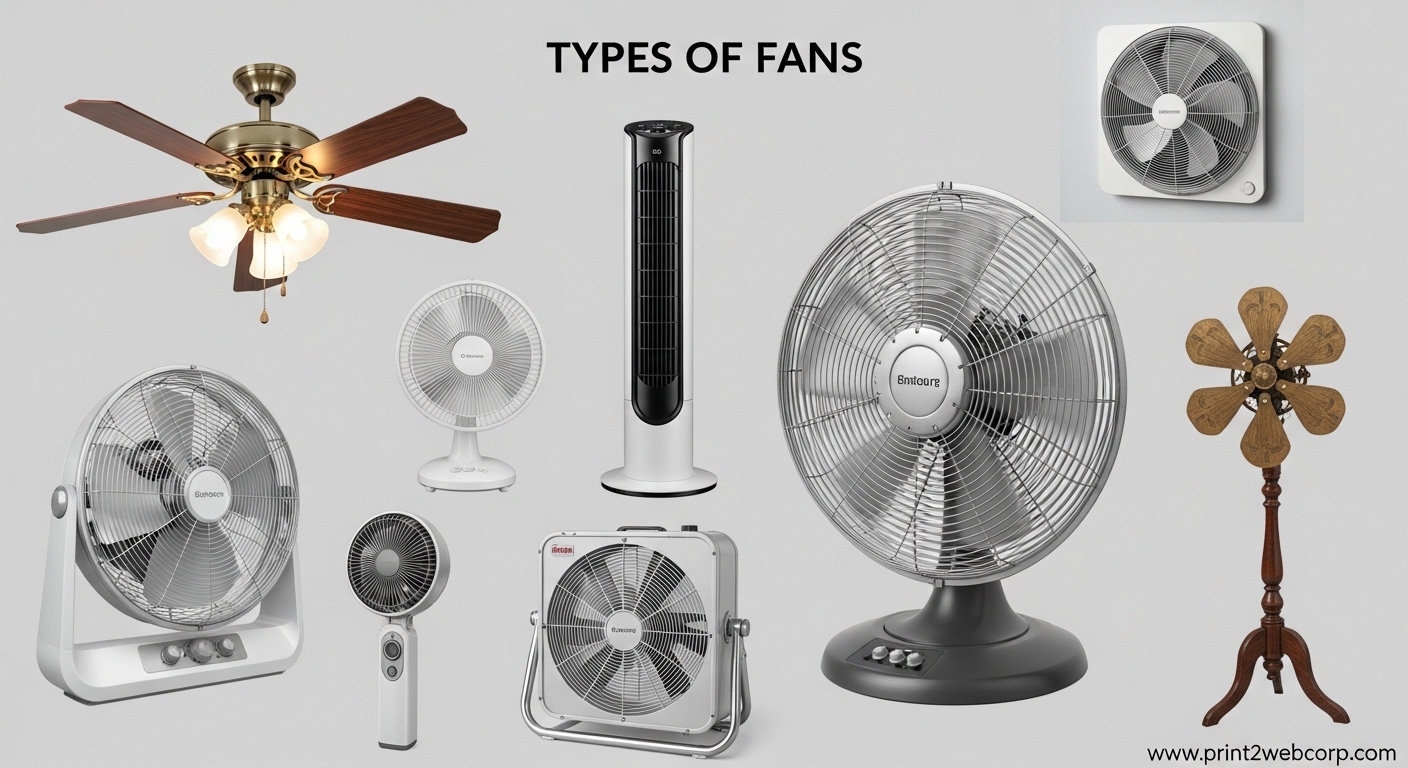
When summer heat hits or stuffy rooms need better airflow, choosing the right cooling solution makes all the difference. Understanding the different types of fans available helps you make smarter decisions for your home, office, or commercial space.
Fans have come a long way from simple hand-held devices. Today’s market offers specialized options designed for specific rooms, purposes, and preferences. Whether you need whisper-quiet cooling for bedrooms or powerful ventilation for workshops, there’s a fan type built for the job.
This guide breaks down every major fan category, from residential ceiling fixtures to industrial blowers, so you can match the right type of fans to your specific needs.
Types of Fans in 2026
Modern fans fall into several distinct categories based on design, placement, and airflow mechanism. Each type serves specific purposes and excels in different environments. Let’s explore the most common options you’ll encounter when shopping for cooling solutions.
Ceiling Fans
Ceiling fans remain the most popular choice for whole-room circulation. Mounted overhead, these fans spin blades to push air downward, creating a cooling breeze throughout the space. They’re ideal for bedrooms, living rooms, and covered outdoor areas.
Modern ceiling fans come with various motor types. Traditional AC motors are affordable but noisier, while BLDC (Brushless DC) motors offer superior energy efficiency and whisper-quiet operation. The best ceiling fans use BLDC technology, consuming up to 65% less electricity than conventional models.
Ceiling fans work year-round when equipped with a reverse switch. In summer, blades rotate counter-clockwise to create cooling wind chill. In winter, clockwise rotation at low speed pushes warm air down from ceiling level, improving heating efficiency.
These fans excel at large spaces but require proper installation. Standard rooms need 42-52 inch blade spans, while great rooms may require 60+ inches. Always maintain at least 18 inches of clearance from walls and 7 feet from the floor.
Tower Fans
Tower fans deliver sleek, vertical design perfect for modern homes. These narrow units fit into tight corners where traditional pedestal fans would be obtrusive. Air is drawn through vents in the base and pushed upward through a vertical column.
What sets tower fans apart is their oscillation range. Most models sweep 60-90 degrees, distributing airflow across wide areas. Higher-end units offer 180-degree rotation or even 360-degree coverage on select models.
Tower fans shine in bedrooms and offices thanks to slim profiles and space-efficient design. Many models include sleep mode functions that gradually reduce speed through the night. However, their vertical airflow pattern means they’re less effective at cooling floor-seated areas compared to pedestal alternatives.
Look for tower fans with multiple speed settings, timer functions, and remote control operation. Some premium models integrate air purifiers or ionizers for added air quality benefits.
Pedestal Fans
Pedestal fans combine the power of traditional box fans with adjustable height and versatile placement. These stand-mounted units feature an adjustable head that tilts up or down, plus height customization from 40-60 inches to direct airflow exactly where needed.
The adjustable height makes pedestal fans exceptionally versatile. Position them low for floor-level cooling while exercising, or extend fully to direct airflow toward beds or seating areas. The tilting head allows precise aiming impossible with fixed-position alternatives.
Pedestal fans deliver powerful airflow that covers larger areas than tower models. Their horizontal blade design pushes air more effectively at face and torso level. This makes them ideal for living rooms, home gyms, and any space where directional cooling matters.
Most pedestal fans oscillate horizontally while allowing manual vertical adjustment. Look for models with wide oscillation ranges and stable bases that won’t tip over during operation.
Desk and Table Fans
Desk fans provide personal cooling in compact packages. These small units sit directly on desks, tables, or countertops, delivering targeted airflow exactly where you need it. They’re perfect for home offices, study areas, and bedside tables.
Table fans come in several styles. Traditional models feature exposed blades similar to miniature pedestal fans. Modern designs incorporate bladeless technology or clip-on mounting for workspace flexibility. Battery-powered options offer cordless operation for ultimate portability.
The main advantage of desk fans is precise cooling control. Instead of cooling an entire room, you direct airflow exactly where you sit. This targeted approach saves energy compared to larger fans running at higher speeds.
For desk work, look for models with whisper-quiet operation under 45 decibels. Noise levels matter significantly when the fan runs just feet from your ears during focused work sessions.
Exhaust Fans
Exhaust fans serve a different purpose than cooling fans—they remove stale, humid, or contaminated air from enclosed spaces. You’ll find these essential in bathrooms, kitchens, and laundry rooms where moisture and odors accumulate.
Bathroom exhaust fans prevent mold and mildew by removing humid air after showers. Kitchen exhaust fans eliminate cooking odors, smoke, and grease particles. Proper ventilation protects your home’s structure while improving indoor air quality.
Exhaust fans are rated by CFM (cubic feet per minute) of air movement. Small bathrooms require 50-80 CFM, while larger bathrooms or those with multiple fixtures may need 100+ CFM. Kitchen exhaust needs vary based on cooking style and stove type.
Modern exhaust fans often include humidity sensors that activate automatically when moisture levels rise. Some models integrate lighting functions, combining ventilation with illumination in a single fixture.
Bladeless Fans
Bladeless fans represent a significant design innovation in cooling technology. Instead of exposed spinning blades, these units use air multiplier technology to draw air through a base and amplify it through a circular loop. The result is a smooth, uninterrupted airflow stream.
The primary advantage is safety—no exposed blades make these ideal for homes with children or pets. They’re also easier to clean without blades to accumulate dust. The smooth airflow feels more natural than the choppy breeze produced by traditional bladed fans.
Bladeless fans tend to be premium-priced compared to conventional models. However, they offer whisper-quiet operation and modern aesthetics that complement contemporary decor. Many bladeless models include heating functions for year-round climate control.
While effective for personal cooling, bladeless fans generally produce less airflow than large bladed alternatives. They’re best suited for bedrooms, offices, and small living spaces rather than large open areas.
Floor and Box Fans
Box fans offer straightforward, no-frills cooling at affordable prices. These square units feature simple blade designs housed in protective grills. They can sit on the floor, be placed on window sills, or mounted to walls for versatile positioning.
The strength of box fans lies in raw air-moving power. Few fan types move as much air for the price. They’re excellent for ventilating rooms by pushing stale air out windows or drawing fresh air in. Place one fan blowing out and another blowing in to create effective cross-ventilation.
Box fans are notoriously noisy compared to other types. The simple motor design and exposed blades create significant operational sound. They’re best suited for garages, workshops, and situations where noise isn’t a concern.
Modern box fans include three speed settings and adjustable tilt heads. Some models offer timer functions and remote control operation, but they remain fundamentally simple cooling devices.
Window Fans
Window fans install directly in window openings, pulling fresh outdoor air inside or pushing indoor air outside. These reversible fans are excellent for seasonal ventilation and can significantly reduce reliance on air conditioning during moderate weather.
The reversible function is what makes window fans uniquely valuable. Set them to exhaust mode during hot days to push hot air out. Switch to intake mode during cool evenings to pull fresh air inside. Some models feature twin fans that can work simultaneously—one pulling air in, one pushing it out—for maximum air exchange.
Window fans work best in climates with significant day-to-night temperature swings. They’re less effective in humid regions where nighttime air remains warm and muggy. Proper sizing to your window dimensions is essential for effective operation.
Installation requires some effort but is straightforward for most DIYers. Look for models with adjustable side panels that fit various window widths and weather-resistant construction for year-round use.
Wall Mount Fans
Wall mount fans provide permanent cooling solutions without consuming floor space. These fixed-position fans mount directly to walls, making them ideal for garages, workshops, commercial spaces, and rooms where floor space is at a premium.
The advantage of wall mounting is consistent airflow positioning without needing to reset the fan each time. Once installed, they deliver reliable circulation to the same area. Many models offer tilting and oscillating heads for directional control despite fixed mounting.
Wall mount fans come in various sizes from compact 12-inch models to heavy-duty 30-inch industrial units. Smaller versions work well in bedrooms and offices, while larger models suit commercial spaces and warehouses.
Installation requires mounting brackets and electrical connections. Hardwired models offer cleaner appearance but require professional installation. Plug-in models provide easier setup but require nearby electrical outlets.
Air Circulator Fans
Air circulators differ from traditional fans in their airflow pattern and purpose. Instead of creating a direct breeze, they circulate air throughout the entire room to eliminate hot and cold spots. Think of them as air mixers rather than directional cooling devices.
The most famous example is the Vornado design, which uses a unique blade and housing configuration to create a vortex of circulating air. This vortex pattern keeps air moving continuously throughout the space rather than just cooling whatever is directly in front of the fan.
Air circulators excel at maintaining consistent room temperature. Place them near corners or walls, and they’ll keep air moving throughout the entire space. This makes them ideal for rooms with multiple occupants or situations where direct breeze would be undesirable.
Many users find air circulators more comfortable than traditional fans because they don’t create the drying effect of direct airflow. They’re particularly effective when paired with air conditioning, helping distribute conditioned air more evenly throughout rooms.
Industrial and Commercial Fans
Industrial fans are heavy-duty air movers designed for warehouses, factories, commercial kitchens, and large commercial spaces. These units prioritize raw air-moving power over quiet operation or compact design.
Commercial fans come in several configurations. High-velocity floor fans deliver powerful airflow for spot cooling. Large drum fans move massive air volumes for warehouse ventilation. Explosion-proof models serve hazardous environments where standard electrical equipment would be dangerous.
Industrial fans feature robust construction with steel housings, heavy-duty motors, and commercial-grade electrical components. They’re built to run continuously for long periods in demanding environments. Many models offer multiple speed settings and tilt adjustment for directing airflow.
While primarily commercial, some homeowners use industrial fans for garages, workshops, and large outdoor areas. The noise levels and industrial aesthetics make them unsuitable for most residential applications, but they’re unmatched for raw cooling power.
Misting Fans
Misting fans combine traditional fan airflow with water mist to create powerful evaporative cooling. These specialized units are popular for outdoor patios, sporting events, and industrial facilities where traditional cooling isn’t sufficient.
The principle is simple: water forced through nozzles creates a fine mist that the fan’s airflow pushes outward. As the tiny water droplets evaporate, they absorb significant heat energy from surrounding air, producing cooling effects that can lower perceived temperatures by 15-30 degrees.
Misting fans excel in hot, dry climates where evaporative cooling works efficiently. They’re less effective in humid environments where the air already contains significant moisture. They’re commonly seen at outdoor restaurants, amusement parks, and sporting events.
Residential misting fans are available for patio use, often connecting to standard garden hoses. Industrial models use high-pressure pumps and specialized nozzles to create finer mists. All require water supply connections and regular maintenance to prevent clogging.
Technical Fan Classifications
Beyond consumer categories, engineers classify fans by their airflow mechanism and design. Understanding these technical classifications helps explain why different fan types perform differently and how they’re suited for specific applications.
Axial Flow Fans
Axial fans move air parallel to the fan shaft—the same direction the blades rotate. This is the most common residential fan type, including ceiling fans, box fans, and most portable fans. The airflow moves straight through from one side to the other.
Axial fans excel at moving large air volumes with relatively low pressure. They’re ideal for general ventilation and cooling applications where air needs to move through spaces rather than being pushed through resistance. The simple design makes them affordable and reliable for most residential needs.
Most household fans use axial flow because it provides effective personal cooling at reasonable cost. However, they’re less effective when air needs to be pushed through ducts, filters, or other resistance sources.
Centrifugal Fans
Centrifugal fans use a different approach—air enters the center of the spinning impeller and is expelled outward at 90 degrees to the intake. This creates higher pressure than axial designs, making centrifugal fans ideal for pushing air through ducts, filters, and ventilation systems.
You’ll find centrifugal fans in HVAC systems, bathroom exhaust fans, range hoods, and any application where air must overcome resistance. The higher pressure capability makes them essential for forced-air heating and cooling systems.
Centrifugal fans generally move less air than axial fans of similar size but create significantly higher pressure. This tradeoff makes them unsuitable for general cooling but perfect for ventilation and air movement through ductwork.
Mixed Flow Fans
Mixed flow fans combine characteristics of both axial and centrifugal designs. Air moves through at an angle between pure axial and pure centrifugal flow. This hybrid approach provides moderate pressure capabilities while maintaining good air volume.
These specialized fans serve applications requiring both pressure and volume. They’re commonly found in ventilation systems where some resistance exists but high pressure isn’t required. Mixed flow designs offer a compromise between the two main fan types.
While less common in residential applications, mixed flow fans appear in some specialized ventilation equipment and certain industrial applications. They represent an engineering middle ground between the two primary fan classifications.
Cross Flow Fans
Cross flow fans use a unique impeller design that creates a wide, flat airflow pattern. Instead of air entering at one point, it enters along the entire length of the cylindrical impeller and exits through a rectangular opening.
This design creates a broad, even airflow across a wide area. Cross flow fans are commonly used in air conditioners, automotive HVAC systems, and some specialty ventilation applications. The wide, even airflow pattern makes them ideal for applications requiring consistent air distribution across a broad area.
In residential applications, you’ll most commonly encounter cross flow fans in portable air conditioners and some specialized heating equipment. Their unique design serves specific engineering requirements that other fan types can’t address effectively.
How to Choose the Right Fan for Your Space?
Selecting the perfect fan requires matching type to room, purpose, and personal preferences. Consider these key factors when deciding which types of fans will work best in your specific situation.
Room Size and Layout
Small spaces under 100 square feet work well with desk fans, small tower fans, or table models. Medium rooms between 100-300 square feet benefit from medium tower fans, pedestal fans, or standard ceiling fans. Large rooms over 300 square feet require large ceiling fans, high-velocity floor fans, or multiple smaller units positioned strategically.
Room shape matters too. Long narrow rooms benefit from fans placed at one end creating airflow down the length. Open concept spaces may need multiple fans to provide adequate coverage. Consider furniture placement and how airflow will reach occupied areas.
Noise Considerations
Bedrooms and home offices require the quietest options. BLDC ceiling fans, bladeless tower fans, and high-quality air circulators typically operate under 45 decibels on low settings. Living rooms and family rooms can tolerate moderate noise levels around 50-55 decibels.
Garages, workshops, and commercial spaces can use louder options if necessary. Box fans and industrial fans often exceed 60 decibels but provide maximum airflow for situations where noise isn’t a concern.
Energy Efficiency
BLDC motor fans offer the best energy efficiency, consuming significantly less electricity than traditional AC motors. Look for Energy Star certifications on ceiling fans and check wattage ratings on portable fans. Lower wattage means lower operating costs.
Variable speed options provide energy savings by allowing operation at the lowest effective speed. Timer functions prevent unnecessary operation by shutting fans off automatically. Smart fans can adjust operation based on temperature and humidity conditions.
CFM Ratings
CFM (cubic feet per minute) measures air volume movement. Higher CFM means more air movement but not necessarily better cooling for your needs. Small bedrooms need 1,500-2,500 CFM, medium rooms require 2,500-3,500 CFM, and large spaces benefit from 3,500+ CFM.
Personal cooling requires less CFM than whole-room circulation. Desk fans providing 500-1,000 CFM deliver adequate personal cooling, while whole-room circulation needs proportionally more air movement.
Primary Use Case
Sleep cooling requires quiet operation with gentle airflow. BLDC ceiling fans on low speed or whisper-quiet tower fans work best. Exercise and activity cooling benefit from powerful directional airflow—pedestal fans or high-velocity floor fans provide the strong breeze needed during physical activity.
General room circulation works well with ceiling fans or air circulators that keep air moving throughout the space. Spot cooling for specific areas calls for desk fans or small tower fans positioned to deliver targeted airflow exactly where needed.
Climate Considerations
Dry climates benefit from evaporative cooling options like misting fans that take advantage of low humidity for enhanced cooling effect. Humid climates need traditional fans that provide airflow without adding moisture to already-damp air.
Areas with cool nights can use window fans to bring in fresh evening air and flush out heat accumulated during the day. This natural cooling approach significantly reduces air conditioning reliance in suitable climates.
Maintenance Requirements
Bladeless fans and smooth designs are easiest to clean with no intricate blade assemblies to accumulate dust. Traditional fans with exposed blades require regular cleaning to maintain performance and prevent dust distribution. Industrial fans need professional maintenance due to their size and complexity.
Consider how much effort you’re willing to invest in maintenance. Easy-clean designs cost more but save time over the long run. Traditional fans require more frequent attention but generally cost less upfront.
FAQ’s
What are the three types of fans?
The three main types of fans are axial fans, centrifugal fans, and mixed flow fans. Axial fans move air parallel to the blade axis and are common in residential cooling. Centrifugal fans move air perpendicular to the intake and are used in HVAC systems and exhaust applications. Mixed flow fans combine characteristics of both, offering a balance between air volume and pressure for specialized ventilation needs.
What type of fan is best for cooling?
Tower fans and pedestal fans provide the best cooling for most residential spaces due to their powerful airflow and oscillation features. Ceiling fans offer excellent whole-room circulation when sized correctly for the space. For personal cooling, desk fans deliver targeted airflow exactly where needed. The best choice depends on room size, noise tolerance, and whether you need whole-room circulation or focused personal cooling.
Can a fan help with sleep apnea?
While fans cannot treat sleep apnea directly, they may help some people sleep more comfortably. The white noise created by fans can mask disruptive sounds that might interrupt sleep. Improved airflow and ventilation can create a more comfortable sleeping environment. However, fans should never replace prescribed sleep apnea treatments like CPAP therapy. Anyone with sleep apnea should consult their doctor about appropriate treatment options.
What is an old fashioned fan called?
Old fashioned hand-held fans are simply called hand fans or palm-leaf fans. Before electric cooling, people used manually operated fans made from palm leaves, paper, or fabric. In the early electric era, oscillating table fans became popular and are now considered vintage or retro styles. Some companies reproduce these classic designs for those seeking nostalgic aesthetics with modern motor technology.
Conclusion
Understanding the different types of fans helps you choose the right cooling solution for any space. From whisper-quiet bladeless towers for bedrooms to powerful industrial units for workshops, there’s a fan type designed specifically for your needs.
Consider room size, noise tolerance, and primary purpose when selecting among the various types of fans. Energy-efficient BLDC motors, smart features, and proper sizing ensure you get effective cooling without wasting electricity.
The right fan transforms uncomfortable spaces into pleasant environments while reducing reliance on expensive air conditioning. Choose wisely based on your specific requirements, and enjoy improved comfort and air quality throughout 2026.
Leave a Reply