
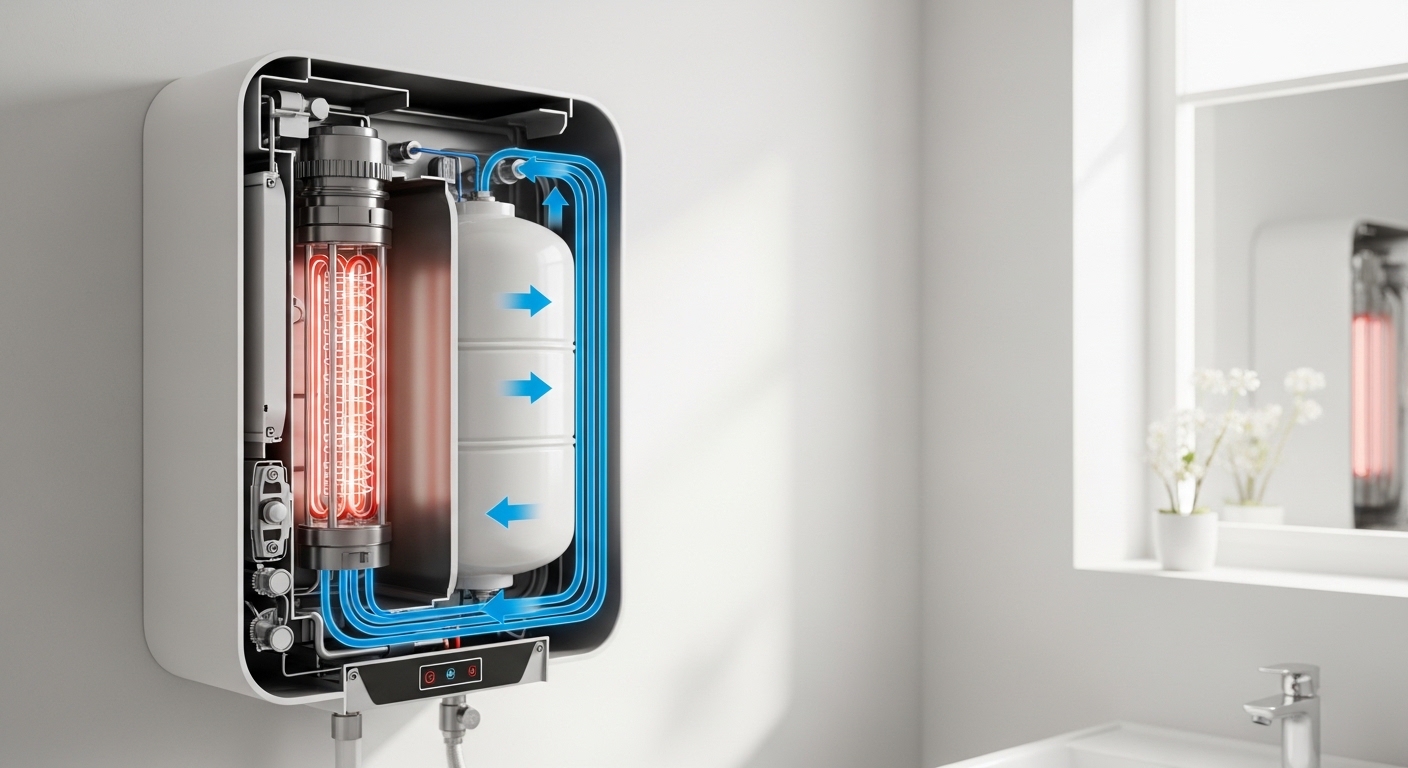
Every morning you turn on the shower expecting hot water, but have you ever wondered what makes it happen? Understanding how does a water heater work can help you maintain your system better and make informed decisions when it’s time for an upgrade. Your water heater is one of the hardest-working appliances in your home, operating silently day and night to ensure comfort for showers, dishwashing, and laundry.
In this guide, we’ll break down exactly how water heaters work, explain the different types available in 2026, and walk you through the key components that keep hot water flowing. Whether you have a traditional tank system or a modern tankless unit, knowing the basics can save you money on repairs and help you troubleshoot minor issues before they become major problems.
How Does a Water Heater Work?
At its core, a water heater does exactly what its name suggests: it heats water. Cold water enters your home at ground temperature (usually around 50-60°F) and needs to be raised to 120-140°F for everyday use. The water heater accomplishes this through either a gas burner or electric heating elements, then stores the hot water until you need it or heats it instantly on demand.
Basic Working Principle
The fundamental process is simple: cold water enters the heater, gets warmed by a heat source, and exits as hot water when you turn on a faucet. In tank models, hot water rises to the top of the tank due to thermal convection (hot water is less dense than cold water), where it’s drawn off when needed. Cold incoming water settles at the bottom to be heated, creating a continuous cycle.
The thermostat monitors water temperature and activates the heating mechanism when the water drops below the set point (usually 120°F). This maintains a ready supply of hot water at all times, ensuring you don’t have to wait for heating when you need it most.
Does All Water Go Through the Water Heater
No, and this is a common misconception. Your home’s plumbing system splits at the water heater. Cold water that needs heating enters through the dip tube, while all other cold water bypasses the heater entirely and goes directly to cold water fixtures, toilets, and outdoor faucets. This design is more efficient because it only heats the water you actually need hot, rather than warming your entire water supply.
How Does a Tank Water Heater Work?
The traditional storage tank water heater is the most common type found in American homes. It consists of an insulated tank (typically 30-80 gallons) that holds heated water until needed. These units can run on either electricity or natural gas/propane, with gas models generally recovering faster but electric models being more energy-efficient in operation.
Step-by-Step Process
Cold water enters the tank through the dip tube, a long pipe that extends to the bottom of the tank. This ensures incoming cold water doesn’t mix with the hot water already stored at the top.
The thermostat senses the water temperature and activates the heating mechanism when the temperature drops below the set point (usually 120°F).
In gas models, a burner assembly at the bottom of the tank ignites, heating the water directly. In electric models, one or two heating elements submerged in the water warm it through electrical resistance.
As water heats, it becomes less dense and rises to the top of the tank through thermal convection. Hot water collects at the upper portion of the tank, ready for use.
When you open a hot water tap, hot water exits from the top of the tank through the hot water outlet pipe. Simultaneously, fresh cold water enters through the dip tube at the bottom to replace it.
The heating mechanism continues running until all water in the tank reaches the target temperature, then shuts off until the thermostat signals it’s needed again.
Key Components and Their Functions
Understanding the parts inside your water heater helps you diagnose problems and communicate effectively with repair technicians. The dip tube delivers cold water to the tank bottom where heating occurs, while the thermostat monitors temperature and controls the heating element or burner. Gas models use a gas valve and burner assembly, while electric units have upper and lower heating elements.
The temperature-pressure relief valve (T&P valve) is a critical safety device that opens if pressure or temperature exceeds safe limits, preventing tank explosion. Inside the tank, a sacrificial anode rod attracts corrosive elements in the water, protecting the tank lining from rust. The tank itself has a glass-lined interior and is wrapped in insulation to minimize standby heat loss.
Recovery Time Explained
Recovery time refers to how long it takes your water heater to reheat a full tank of water after it’s been depleted. Gas water heaters typically recover in 30-40 minutes because gas burners deliver heat more quickly (around 40,000 BTU/hr). Electric models take longer, usually 60-80 minutes, because heating elements provide less heat input (around 4,500 watts each). This recovery time affects your hot water availability during high-demand periods.
How Does a Tankless Water Heater Work?
Tankless water heaters, also called on-demand or instantaneous water heaters, take a completely different approach. Instead of storing hot water, they heat it only when you need it. When a hot water tap is opened, cold water flows through the unit and passes over a powerful heat exchanger, instantly raising its temperature to the desired level.
On-Demand Heating Process
The process begins when you turn on a hot water faucet, which triggers flow sensors in the unit. These sensors activate the heating mechanism—either a gas burner or electric heating elements. Cold water circulates through the heat exchanger, where it’s rapidly heated to the set temperature (typically 120-140°F) before exiting to your fixtures.
The system continuously modulates the heat output based on flow rate and incoming water temperature. Higher flow rates or colder incoming water require more heat input. Once you close the faucet, the unit shuts off completely, consuming no energy until the next hot water demand.
Heat Exchanger Technology
The heart of a tankless system is its heat exchanger, typically made of copper or stainless steel for optimal heat transfer. In gas models, a secondary heat exchanger captures additional heat from exhaust gases, improving efficiency to over 90%. The exchanger consists of coiled tubes that maximize surface area contact with the heating source, allowing rapid heat transfer as water flows through.
Advanced models use modulating gas valves or variable-speed blowers to precisely match heat output with demand. This technology eliminates temperature fluctuations and prevents the “cold water sandwich” effect that plagued early tankless designs.
Flow Rate and Limitations
Every tankless water heater has a maximum flow rate, measured in gallons per minute (GPM). Typical residential units handle 3-5 GPM, which might cover a shower and a sink simultaneously but could struggle with multiple showers plus a dishwasher. The actual flow rate depends heavily on the temperature rise needed—colder incoming water reduces the unit’s capacity.
While tankless units provide endless hot water, they’re not truly unlimited. If demand exceeds the unit’s flow capacity, you’ll experience reduced hot water temperature at multiple fixtures. This is why many homes with high hot water needs install either larger units or multiple smaller tankless heaters in a parallel configuration.
How Does a Heat Pump Water Heater Work?
Heat pump water heaters, also called hybrid water heaters, represent the most efficient technology available for residential water heating in 2026. Instead of generating heat directly through combustion or electrical resistance, they move heat from one place to another—essentially working like a refrigerator in reverse.
Heat Pump Technology Explained
Think of your refrigerator: it pulls heat from inside the box and releases it into your kitchen through coils on the back. A heat pump water heater does the opposite—it pulls heat from the surrounding air and transfers it into the water tank. The system contains a refrigerant that evaporates at low temperatures, absorbing heat from the air even when it feels cool to you.
A compressor pressurizes this heated refrigerant, raising its temperature further, and then condenses it inside a coil wrapped around the water tank. As the refrigerant condenses, it releases heat into the water. This process is incredibly efficient because it’s moving existing heat rather than creating new heat, requiring only about one-third the energy of standard electric water heaters.
Hybrid Mode Operation
Most heat pump water heaters operate in hybrid mode, automatically switching between heat pump mode and standard electric resistance heating based on demand and conditions. During normal operation, the heat pump handles the work efficiently. However, during periods of high hot water demand or when surrounding air is very cold (below 40°F), the system may supplement with electric heating elements to maintain adequate hot water supply.
Smart controls learn your usage patterns and optimize operation accordingly. For example, they might run the heat pump during off-peak electricity hours to store hot water for morning showers, or switch to electric mode during peak usage when the heat pump alone can’t keep up.
Efficiency Benefits
Heat pump water heaters achieve Uniform Energy Factor (UEF) ratings of 3.0-4.0, compared to 0.9-1.0 for standard electric tanks and 0.6-0.7 for gas tanks. This translates to 60-70% energy savings compared to conventional electric water heaters. Over the 10-15 year lifespan of a unit, this can save thousands in energy costs, easily offsetting the higher upfront price.
The trade-off is that heat pump water heaters cool and dehumidify the space around them, which can be beneficial in summer but problematic in winter. They also require installation in areas with adequate air volume (at least 1,000 cubic feet) and produce some operating noise similar to a window air conditioner.
Other Water Heater Types
While tank, tankless, and heat pump models dominate the market, other technologies serve specific needs and conditions. Understanding these alternatives helps you make informed decisions if your situation differs from typical residential applications.
How Does a Solar Water Heater Work?
Solar water heaters use the sun’s energy to heat water directly or indirectly through a heat transfer fluid. In direct systems, water circulates through solar collectors (typically roof-mounted panels) where it’s heated by sunlight before returning to a storage tank. Indirect systems use a glycol solution that transfers heat to the water through a heat exchanger, making them suitable for freezing climates.
These systems require backup heating (usually electric) for cloudy days and periods of high demand. However, in sunny climates, solar water heaters can provide 70-80% of hot water needs annually with zero operating cost. The collectors typically last 20+ years, and while upfront costs are higher than conventional systems, federal tax credits and long-term energy savings make them financially attractive over the system’s lifetime.
How Does a Condensing Water Heater Work?
Condensing water heaters capture additional heat from exhaust gases that would otherwise be wasted in standard gas water heaters. In a conventional gas heater, hot combustion gases go directly up the flue, carrying away significant heat. Condensing designs use a secondary heat exchanger to extract this remaining heat, cooling the exhaust gases enough that water vapor in them condenses into liquid (hence the name).
This additional heat extraction pushes thermal efficiency above 90%, compared to 60-70% for standard gas models. The trade-off is higher upfront cost and the need for a drain to remove the condensed water (which is slightly acidic due to carbon dioxide absorption). Condensing technology is most valuable in high-use applications where the efficiency gains quickly offset the additional cost.
Gas vs Electric Water Heaters
The choice between gas and electric depends on your home’s infrastructure, local energy costs, and hot water needs. Both types use similar tank technology but differ in how they heat the water and their operational characteristics.
Gas Water Heater Operation
Gas water heaters use a burner assembly beneath the tank, similar to a gas stove. A gas valve controls fuel flow to the burner, and either a standing pilot light or electronic ignition lights the gas when the thermostat calls for heat. Combustion gases rise through a vent in the tank center, transferring heat to the water before exiting through the flue pipe.
Modern gas water heaters use sealed combustion chambers that draw air from outside and power vents that exhaust horizontally through walls, offering more installation flexibility. Gas models recover faster (higher first-hour rating) but have slightly lower energy efficiency due to heat loss through venting.
Electric Water Heater Operation
Electric water heaters use one or two heating elements submerged directly in the water, similar to oversized versions of the heating element in an electric kettle. The thermostat sends electricity to the elements when heating is needed, and they warm the water through resistance heating. No combustion or venting is required, making installation simpler and allowing placement in more locations.
Electric models are more energy-efficient at the point of use (nearly 100% of electricity becomes heat) but electricity often costs more per BTU than gas. They recover more slowly, which can be problematic during high-demand periods. However, they require less maintenance (no pilot light or burner assembly) and work well with solar panel systems.
Which Is Better for Your Home?
If your home already has natural gas service, a gas water heater typically costs less to operate and provides faster recovery. Electric models make sense for homes without gas service, in areas where electricity is relatively cheap, or when pairing with solar panels. For new construction or major renovations, consider a heat pump water heater for maximum efficiency, or tankless for endless hot water.
Why Do Water Heaters Run Out of Hot Water?
Running out of hot water mid-shower is frustrating, but understanding why it happens helps you prevent it. The cause depends on your water heater type and usage patterns.
Tank Capacity Limitations
Storage tank water heaters run out when you consume more hot water than the tank holds. A 40-gallon tank actually delivers only about 30-35 gallons of hot water before incoming cold water dilutes the remaining supply too much. During high-demand periods—like back-to-back showers, running the dishwasher after a shower, or filling a large bathtub—you can easily exceed this capacity.
The first-hour rating (FHR) indicates how much hot water a tank can provide in one hour of peak usage, combining stored hot water plus recovery capacity. When choosing a tank size, consider your household’s peak hour demand rather than just the number of people.
Recovery Time Factors
Once a tank is depleted, you must wait for recovery—the time needed to heat the incoming cold water. Recovery time depends on the heating element or burner size (BTU or wattage), the temperature rise required (incoming water temperature vs. target temperature), and the tank volume. Gas models typically recover 2-3 times faster than electric.
Tankless water heaters don’t run out in the traditional sense, but they can be overwhelmed by simultaneous high-flow demands. If you’re showering while the dishwasher runs and someone else uses hot water, the unit may not be able to heat all that water to the desired temperature, resulting in lukewarm output.
Essential Water Heater Maintenance
Regular maintenance extends your water heater’s lifespan and maintains efficiency. Most tasks are simple enough for DIY, while others require professional service.
Annual Maintenance Tasks
Flush your tank annually to remove sediment that accumulates at the bottom. Sediment buildup reduces efficiency, creates noise, and can cause premature tank failure. Attach a hose to the drain valve and run 3-5 gallons of water into a bucket or floor drain until it runs clear. Check the anode rod every 2-3 years and replace it when more than 50% corroded—this simple $30 part can add years to your tank’s life.
Test the temperature-pressure relief valve yearly by lifting the test lever and ensuring water flows out the discharge pipe. If it doesn’t, replace the valve immediately—this is a critical safety device. For gas models, inspect the venting for blockages and ensure the burner area is clean. Inspect flexible water supply lines for cracks or corrosion and replace if needed.
Signs Your Water Heater Needs Attention
Rust-colored water indicates tank corrosion or failing anode rod. Popping or rumbling noises during heating signal excessive sediment buildup. Leaks around the base mean tank failure is imminent. If your hot water runs out faster than usual, the heating element or burner may be failing. Foul odors (rotten egg smell) suggest bacteria growth in the tank, which can be addressed by flushing with hydrogen peroxide solution.
A water heater typically lasts 10-15 years with proper maintenance. If yours is approaching this age and showing problems, replacement is usually more cost-effective than repair, especially with newer, more efficient models available in 2026.
Does all the water in your house go through the hot water heater?
No. Only cold water that needs to be heated enters the water heater through the dip tube. The rest of your home’s cold water supply bypasses the water heater entirely and goes directly to cold water faucets and appliances.
How long does it take for a water heater to heat the water?
A standard 40-gallon electric water heater takes approximately 60-80 minutes to heat a full tank from cold to hot (120-140°F). Gas water heaters are faster, typically heating a full tank in 30-40 minutes. Recovery time varies based on the heater’s BTU or wattage rating and the incoming water temperature.
How do water heaters run out of hot water?
Tank water heaters run out when you use more hot water than the tank holds. Once the stored hot water is depleted, you must wait for the tank to refill and reheat. This happens during high-demand periods like multiple showers or running the dishwasher and washing machine simultaneously.
How much hot water does a 10 minute shower use?
A 10-minute shower with a standard 2.5 gallons per minute showerhead uses 25 gallons of water. If you’re using a low-flow 1.5 GPM showerhead, you’ll use 15 gallons. This means a standard 40-gallon water heater can typically provide about 15-25 minutes of continuous hot showering before running out.
What is the anode rod in a water heater?
The anode rod is a sacrificial metal rod (usually made of aluminum, magnesium, or zinc) that hangs inside your water heater tank. It attracts corrosive elements in the water, causing the rod to corrode instead of the tank lining. This extends the tank’s lifespan significantly—usually 10-15 years before the anode needs replacement.
Conclusion
Understanding how does a water heater work empowers you to maintain your system better and make informed decisions when upgrades are needed. Whether you have a traditional tank model, a space-saving tankless unit, or an ultra-efficient heat pump system, the basic principle remains the same: move heat into water efficiently and reliably.
Water heater technology continues evolving in 2026, with heat pump hybrids gaining popularity and smart features becoming standard. Regardless of the type you choose, regular maintenance remains key to maximizing efficiency and extending lifespan. Flush your tank annually, check the anode rod periodically, and address warning signs promptly to avoid costly replacements.
When it’s time to upgrade, consider your household’s hot water usage patterns, available space, and local energy costs. The right water heater for your home provides reliable hot water for 10-15 years while keeping energy costs manageable. Now that you understand how these systems work, you’re equipped to choose wisely and keep yours running smoothly for years to come.
Leave a Reply